Results by title
6 books match the query 'Telling Stories'
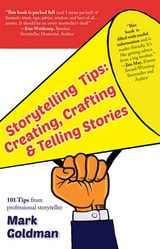
Storytelling Tips
Creating, Crafting & Telling StoriesMark Goldman
Parkhurst Brothers, Inc., 2015
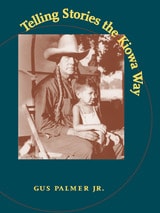
Telling Stories the Kiowa Way
Gus Palmer
University of Arizona Press, 2003
This book explores the traditional art of storytelling still practiced by Kiowas today as Gus Palmer shares conversations held with storytellers. Combining narrative, personal experience, and ethnography in an original and artful way, Palmer—an anthropologist raised in a traditional Kiowa family—shows not only that storytelling remains an integral part of Kiowa culture but also that narratives embedded in everyday conversation are the means by which Kiowa cultural beliefs and values are maintained.
Palmer's study features contemporary oral storytelling and other discourses, assembled over two and a half years of fieldwork, that demonstrate how Kiowa storytellers practice their art. Focusing on stories and their meaning within a narrative and ethnographic context, he draws on a range of material, including dream stories, stories about the coming of Táimê (the spirit of the Sun Dance) to the Kiowas, and stories of tricksters and tribal heroes. He shows how storytellers employ the narrative devices of actively participating in oral narratives, leaving stories wide open, or telling stories within stories. And he demonstrates how stories can reflect a wide range of sensibilities, from magical realism to gossip.
Firmly rooted in current linguistic anthropological thought, Telling Stories the Kiowa Way is a work of analysis and interpretation that helps us understand story within its larger cultural contexts. It combines the author's unique literary talent with his people's equally unique perspective on anthropological questions in a text that can be enjoyed on multiple levels by scholars and general readers alike.
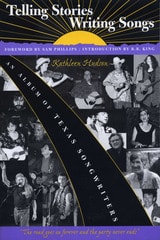
Telling Stories, Writing Songs
An Album of Texas SongwritersBy Kathleen Hudson
University of Texas Press, 2001
Willie Nelson, Joe Ely, Marcia Ball, Tish Hinojosa, Stevie Ray Vaughan, Lyle Lovett...the list of popular songwriters from Texas just goes on and on. In this collection of thirty-four interviews with these and other songwriters, Kathleen Hudson pursues the stories behind the songs, letting the singers' own words describe where their songs come from and how the diverse, eclectic cultures, landscapes, and musical traditions of Texas inspire the creative process.
Conducted in dance halls, dressing rooms, parking lots, clubs-wherever the musicians could take time to tell their stories-the interviews are refreshingly spontaneous and vivid. Hudson draws out the songwriters on such topics as the sources of their songs, the influence of other musicians on their work, the progress of their careers, and the nature of Texas music. Many common threads emerge from these stories, while the uniqueness of each songwriter becomes equally apparent. To round out the collection, Hudson interviews Larry McMurtry and Darrell Royal for their perspectives as longtime friends and fans of Texas musicians. She also includes a brief biography and discography of each songwriter.
Telling Stories
Perspectives on Longitudinal Writing ResearchJenn Fishman
Utah State University Press, 2023
In Telling Stories, more than a dozen longitudinal writing researchers look beyond conventional project findings to story their work and, in doing so, offer otherwise unavailable glimpses into the logics and logistics of long-range studies of writing. The result is a volume that centers interrelations among people, places, and politics across two decades of praxis and an array of educational sites: two-year colleges, a senior military college, an adult literacy center, a small liberal arts college, and both public and private four-year universities.
Contributors share direct knowledge of longitudinal writing research, citing project data (e.g., interview transcripts, research notes, and journals), descriptions drawn from memory, and extended personal reflections. The resulting stories, tempered by the research and scholarship of others, convey a sense of longitudinal research as a lived activity as well as a prominent and consequential approach to inquiry. Yet Telling Stories is not a how-to guide, nor is it written for longitudinal researchers alone. Instead, this volume addresses issues about writing research that are germane to all who conduct or count on it. Such topics include building and sustaining good interpersonal research relations, ethically negotiating the institutional power dynamics that undergird writing research, effectively using knowledge from longitudinal studies to advocate for writers and writing educators, and improving both conceptual and concrete resources for long-range research in writing studies.
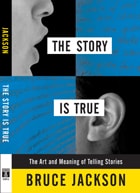
The Story Is True
The Art and Meaning of Telling StoriesBruce Jackson
Temple University Press, 2008
Making and experiencing stories, remembering and retelling them is something we all do. We tell stories over meals, at the water cooler, and to both friends and strangers. But how do stories work? What is it about telling and listening to stories that unites us? And, more importantly, how do we change them-and how do they change us?
In The Story Is True, author, filmmaker, and photographer Bruce Jackson explores the ways we use the stories that become a central part of our public and private lives. He examines, as no one before has, how stories narrate and bring meaning to our lives, by describing and explaining how stories are made and used. The perspectives shared in this engaging book come from the tellers, writers, filmmakers, listeners, and watchers who create and consume stories.
Jackson writes about his family and friends, acquaintances and experiences, focusing on more than a dozen personal stories. From oral histories, such as conversations the author had with poet Steven Spender, to public stories, such as what happened when Bob Dylan "went electric" at the 1965 Newport Folk Festival. Jackson also investigates how "words can kill" showing how diction can be an administrator of death, as in Nazi extermination camps. And finally, he considers the way lies come to resemble truth, showing how the stories we tell, whether true or not, resemble truth to the teller.
Ultimately, The Story Is True is about the place of stories-fiction or real-and the impact they have on the lives of each one of us.
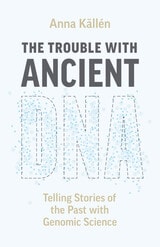
The Trouble with Ancient DNA
Telling Stories of the Past with Genomic ScienceAnna Källén
University of Chicago Press, 2025
In recent years, discoveries brought to light through analysis of ancient DNA—or aDNA—have made headlines around the world. While ancient DNA studies may appear to focus on laboratory science and objective results, the findings have also relied heavily on storytelling and can be influenced by political interests.
In The Trouble with Ancient DNA, Anna Källén explores how the parameters of genetic science influence the stories we tell about our ancient ancestors, questioning what narratives we can and should take at face value. Through accounts of migrations, warriors, and figures like Cheddar Man, we see enticing and potent narratives that reach far beyond what can be gathered from the scientific study of molecules alone. Rather, by privileging certain narratives and questions—like those about sex or eye and skin color—our stories of ancient DNA are spun around the structure of today’s methodologies, technologies, and popular and political interests. Källén considers how DNA is used to sensationalize stories, how its use poses questions of ethics and care, and who is responsible if stories of ancient DNA are adopted for dangerous political projects.