Results by title
3 books match the query 'Telotte, J. P.'
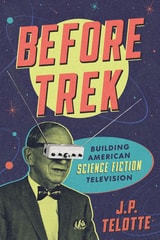
Before Trek
Building American Science Fiction TelevisionJ. P. Telotte
University of Texas Press, 2026
Recounts the early development of TV science fiction as it shaped how American audiences looked at television in an increasingly mediated world.
Long before Star Trek became synonymous with televised science fiction, a generation of space operas and anthology programs laid the groundwork for the genre’s cultural legitimacy. With Before Trek, J. P. Telotte reexamines the formative decades of science fiction television, the late 1940s through the mid-1960s, when both the medium and genre were defining themselves. At a moment when science fiction was often dismissed as juvenile escapism, early programs such as Captain Video, Space Patrol, Tales of Tomorrow, and Science Fiction Theatre worked to reshape audience and industry expectations, establishing the genre as a vehicle for serious storytelling.
Tracing the evolution of the genre through The Twilight Zone, The Outer Limits, and ultimately Star Trek, Telotte reveals how television and science fiction developed in tandem, each helping to articulate the technological anxieties of the postwar era. These programs offered viewers new ways of seeing: approaches to social critique, political tension, and cultural change that conventional broadcasting often could not accommodate. By situating early televised science fiction within broader debates about media, modernity, and what Guy Debord termed the “Society of the Spectacle,” Telotte reclaims a largely overlooked body of work and demonstrates its foundational role in shaping both contemporary television and the imaginative vocabulary of modern culture.
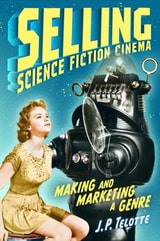
Selling Science Fiction Cinema
Making and Marketing a GenreJ. P. Telotte
University of Texas Press, 2023
How science fiction films in the 1950s were marketed and helped create the broader genre itself.
For Hollywood, the golden age of science fiction was also an age of anxiety. Amid rising competition, fluid audience habits, and increasing government regulation, studios of the 1950s struggled to make and sell the kinds of films that once were surefire winners. These conditions, the leading media scholar J. P. Telotte argues, catalyzed the incredible rise of science fiction.
Though science fiction films had existed since the earliest days of cinema, the SF genre as a whole continued to resist easy definition through the 1950s. In grappling with this developing genre, the industry began to consider new marketing approaches that viewed films as fluid texts and audiences as ever-changing. Drawing on trade reports, film reviews, pressbooks, trailers, and other archival materials, Selling Science Fiction Cinema reconstructs studio efforts to market a promising new genre and, in the process, shows how salesmanship influenced what that genre would become. Telotte uses such films as The Thing from Another World, Forbidden Planet, and The Blob, as well as the influx of Japanese monster movies, to explore the shifting ways in which the industry reframed the SF genre to market to no-longer static audience expectations. Science fiction transformed the way Hollywood does business, just as Hollywood transformed the meaning of science fiction.
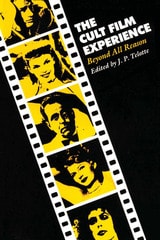
The Cult Film Experience
Beyond All ReasonEdited by J. P. Telotte
University of Texas Press, 1991
"Play it again, Sam" is the motto of cult film enthusiasts, who will watch their favorite movie over and over, "beyond all reason." What is the appeal of cult movies? Why do fans turn up in droves at midnight movies or sit through the same three-hanky classics from Hollywood's golden era? These are some of the questions J. P. Telotte and twelve other noted film scholars consider in this groundbreaking study of the cult film.
The book identifies two basic types of cult films—older Hollywood movies, such as Casablanca, that have developed a cult following and "midnight movies," most notably The Rocky Horror Picture Show. Telotte, Bruce Kawin, and Timothy Corrigan offer thought-provoking discussions about why these two types of movies become cult films, the sort of audience they attract, and the needs they fulfill for that audience. Subsequent essays employ a variety of cultural, feminist, ideological, and poststructural strategies for exploring these films.
In a section on the classical cult film, the movie Casablanca receives extensive treatment. An essay by T. J. Ross considers Beat the Devil as a send-up of cult films, while another essay by Wade Jennings analyzes the cult star phenomenon as personified in Judy Garland.
"Midnight movie madness" is explored in essays on The Rocky Horror Picture Show, movie satires of the 1950s, science fiction double features, and horror thrillers.
Illustrated with scenes from favorite movies and written for both fans and scholars, The Cult Film Experience will appeal to a wider audience than the "usual suspects."