Results by title
15 books match the query 'Trinidad'
Bacchanalian Sentiments
Musical Experiences and Political Counterpoints in TrinidadKevin K. Birth
Duke University Press, 2008
Birth draws on fieldwork he conducted in one of Trinidad’s ethnically diverse rural villages to explore the relationship between music and social and political consciousness on the island. He describes how Trinidadians use the affective power of music and the physiological experience of performance to express and work through issues related to identity, ethnicity, and politics. He looks at how the performers and audience members relate to different musical traditions. Turning explicitly to politics, Birth recounts how Trinidadians used music as a means of making sense of the attempted coup d’état in 1990 and the 1995 parliamentary election, which resulted in a tie between the two major political parties. Bacchanalian Sentiments is an innovative ethnographic analysis of the significance of music, and particular musical forms, in the everyday lives of rural Trinidadians.
Beyond Boundaries
The Intellectual tradition of Trinidad and Tobago in the Nineteenth CenturySelwyn R. Cudjoe
University of Massachusetts Press, 2003
When V. S. Naipaul received the Nobel Prize for Literature in 2001, the award marked the culmination of a literary tradition that was almost two hundred years in the making. The island nation of Trinidad and Tobago has produced such important writers and thinkers as C. L. R. James, J. J. Thomas, Eric Williams, Oliver Cromwell Cox, Sylvester Williams, George Padmore, Earl Lovelace, Arnold Rampersad, and Merle Hodge. Yet this literary legacy is not well known, particularly with respect to works dating from the nineteenth century.
Beyond Boundaries traces the development of the country's literary and intellectual history from the “Narrative of Louisa Calderon” (1803) to Stephen Cobham's Rupert Gray: A Tale of Black and White (1907). Selwyn R. Cudjoe examines a wide range of narratives by and about the people of Trinidad and Tobago, from treatises in the natural sciences, to journals and memoirs, histories, slave narratives, travelers' accounts, poems, stories, novels, theatrical works, and writings in the popular press. Along the way, he discusses such seminal works as Jean Baptiste Philippe's Free Mulatto (1824) and Maxwell Philip's Emmanuel Appadocca (1854), the first indigenous novel. He explores books that shed light on ideological processes, such as J. J. Thomas's The Theory and Practice of Creole Grammar (1869) and Froudacity (1899). He examines how notions of savagery and civilization were deployed in the writings of the dominant class to stymie the growing self-awareness of the colonized. And he traces the rise of racial pride and nationalist sentiments among Indo- and Afro-Trinidadians.
Cudjoe demonstrates how Enlightenment concepts, English literature, African philosophy, Hindu theology, Islamic passion plays, and the culture of carnival all contributed to this body of ideas to create a vibrant literature, which in turn helped to shape a national identity.

Caliban's Freedom
The Early Political Thought of C.L.R. JamesAnthony Bogues
Pluto Press, 1997
Callaloo Nation
Metaphors of Race and Religious Identity among South Asians in TrinidadAisha Khan
Duke University Press, 2004
Khan combines ethnographic research she conducted in Trinidad over the course of a decade with extensive archival research to explore how Hindu and Muslim Indo-Trinidadians interpret authority, generational tensions, and the transformations of Indian culture in the Caribbean through metaphors of mixing. She demonstrates how ambivalence about the desirability of a callaloo nation—a multicultural society—is manifest around practices and issues, including rituals, labor, intermarriage, and class mobility. Khan maintains that metaphors of mixing are pervasive and worth paying attention to: the assumptions and concerns they communicate are key to unraveling who Indo-Trinidadians imagine themselves to be and how identities such as race and religion shape and are shaped by the politics of multiculturalism.

Energy without Conscience
Oil, Climate Change, and ComplicityDavid McDermott Hughes
Duke University Press, 2017
Experiments with Power
Obeah and the Remaking of Religion in TrinidadJ. Brent Crosson
University of Chicago Press, 2020
From eighteenth-century slave rebellions to contemporary responses to police brutality, Caribbean methods of problem-solving “spiritual work” have been criminalized under the label of “obeah.” Connected to a justice-making force, obeah remains a crime in many parts of the anglophone Caribbean. In Experiments with Power, J. Brent Crosson addresses the complex question of what obeah is. Redescribing obeah as “science” and “experiments,” Caribbean spiritual workers unsettle the moral and racial foundations of Western categories of religion. Based on more than a decade of conversations with spiritual workers during and after the state of emergency, this book shows how the reframing of religious practice as an experiment with power transforms conceptions of religion and law in modern nation-states.
Governing Sound
The Cultural Politics of Trinidad's Carnival MusicsJocelyne Guilbault
University of Chicago Press, 2007
Calypso music is an integral part of Trinidad’s national identity. When, for instance, Franklin D. Roosevelt asked the great Trinidadian musician Roaring Lion where he was from, Lion famously replied “the land of calypso.” But in a nation as diverse as Trinidad, why is it that calypso has emerged as the emblematic music?
In Governing Sound, Jocelyne Guilbault examines the conditions that have enabled calypso to be valorized, contested, and targeted as a field of cultural politics in Trinidad. The prominence of calypso, Guilbault argues, is uniquely enmeshed in projects of governing and in competing imaginations of nation, race, and diaspora. During the colonial regime, the period of national independence, and recent decades of neoliberal transformation, calypso and its musical offshoots have enabled new cultural formations while simultaneously excluding specific social expressions, political articulations, and artistic traditions. Drawing on over a decade of ethnographic work, Guilbault maps the musical journeys of Trinidad’s most prominent musicians and arrangers and explains the distinct ways their musical sensibilities became audibly entangled with modes of governing, audience demands, and market incentives.
Generously illustrated and complete with an accompanying CD, Governing Sound constitutes the most comprehensive study to date of Trinidad’s carnival musics.
Mobilizing India
Women, Music, and Migration between India and TrinidadTejaswini Niranjana
Duke University Press, 2006
Niranjana draws on nineteenth-century travel narratives, anthropological and historical studies of Trinidad, Hindi film music, and the lyrics, performance, and reception of chutney-soca and calypso songs to argue that perceptions of Indian female sexuality in Trinidad have long been central to the formation and disruption of dominant narratives of nationhood, modernity, and normative sexuality in India. She illuminates debates in India about “the woman question” as they played out in the early-twentieth-century campaign against indentured servitude in the tropics. In so doing, she reveals India’s disavowal of the indentured woman—viewed as morally depraved by her forced labor in Trinidad—as central to its own anticolonial struggle. Turning to the present, Niranjana looks to Trinidad’s most dynamic site of cultural negotiation: popular music. She describes how contested ideas of Indian femininity are staged by contemporary Trinidadian musicians—male and female, of both Indian and African descent—in genres ranging from new hybrids like chutney-soca to the older but still vibrant music of Afro-Caribbean calypso.
Obeah, Orisa, and Religious Identity in Trinidad, Volume I, Obeah
Africans in the White Colonial Imagination, Volume 1Tracey E. Hucks
Duke University Press, 2022
Obeah, Orisa, and Religious Identity in Trinidad, Volume II, Orisa
Africana Nations and the Power of Black Sacred Imagination, Volume 2Dianne M. Stewart
Duke University Press, 2022
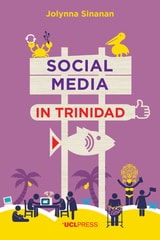
Social Media in Trinidad
Values and VisibilityJolynna Sinanan
University College London, 2017
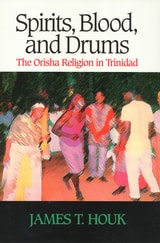
Spirits, Blood and Drums
The Orisha Religion in TrinidadJames T. Houk
Temple University Press, 1995
James Houk's field work in Trinidad and subsequent involvement in the Orisha religion allows him a uniquely intimate perspective on a complex and eclectic religion. Originating in Nigeria, Orisha combines elements of African religions (notably Yoruba), Catholicism, Hinduism, Protestantism Spiritual Baptist, and Kabbalah. A religion of spirits and spirit possession, ceremonies and feasts, churches and shrines, sacrifices and sacred objects, Orisha is constantly shifting and unstable, its practice widely varied. As a belief system, it is a powerful presence in the social structure, culture, and, more recently, the political realm of Trinidad.
Houk carefully examines the historical forces that have transformed Orisha from a relatively simple religion in colonial Trinidad to an abstruse mix of belief, ritual, and symbolism. The voices of worshippers and Orisha leaders spring to life the intensity and power of the religion. Houk's own recounting of participation in many of the mystical ceremonies, including taking on the important role of drummer in several feasts, his initiation into Orisha, and his exceptional field research provide fascinating details essential in understanding the development of this Caribbean religion.
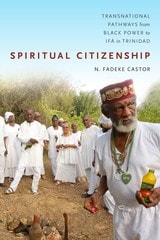
Spiritual Citizenship
Transnational Pathways from Black Power to Ifá in TrinidadN. Fadeke Castor
Duke University Press, 2017
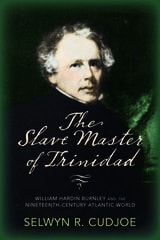
The Slave Master of Trinidad
William Hardin Burnley and the Nineteenth-Century Atlantic WorldSelwyn R. Cudjoe
University of Massachusetts Press, 2018
William Hardin Burnley (1780–1850) was the largest slave owner in Trinidad during the nineteenth century. Born in the United States to English parents, he settled on the island in 1802 and became one of its most influential citizens and a prominent agent of the British Empire. A central figure among elite and moneyed transnational slave owners, Burnley moved easily through the Atlantic world of the Caribbean, the United States, Great Britain, and Europe, and counted among his friends Alexis de Tocqueville, British politician Joseph Hume, and prime minister William Gladstone.
In this first full-length biography of Burnley, Selwyn R. Cudjoe chronicles the life of Trinidad's “founding father” and sketches the social and cultural milieu in which he lived. Reexamining the decades of transition from slavery to freedom through the lens of Burnley's life, The Slave Master of Trinidad demonstrates that the legacies of slavery persisted in the new post-emancipation society.
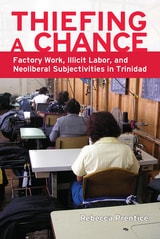
Thiefing a Chance
Factory Work, Illicit Labor, and Neoliberal Subjectivities in TrinidadRebecca Prentice
University Press of Colorado, 2015
When an IMF-backed program of liberalization opened Trinidad’s borders to foreign ready-made apparel, global competition damaged the local industry and unraveled worker entitlements and expectations but also presented new economic opportunities for engaging the “global” market. This fascinating ethnography explores contemporary life in the Signature Fashions garment factory, where the workers attempt to exploit gaps in these new labor configurations through illicit and informal uses of the factory, a practice they colloquially refer to as “thiefing a chance.”
Drawing on fifteen months of fieldwork, author Rebecca Prentice combines a vivid picture of factory life, first-person accounts, and anthropological analysis to explore how economic restructuring has been negotiated, lived, and recounted by women working in the garment industry during Trinidad’s transition to a neoliberal economy. Through careful social coordination, the workers “thief” by copying patterns, taking portions of fabric, teaching themselves how to operate machines, and wearing their work outside the factory. Even so, the workers describe their “thiefing” as a personal, individualistic enterprise rather than a form of collective resistance to workplace authority. By making and taking furtive opportunities, they embrace a vision of themselves as enterprising subjects while actively complying with the competitive demands of a neoliberal economic order.
Prentice presents the factory not as a stable institution but instead as a material and social space in which the projects, plans, and desires of workers and their employers become aligned and misaligned, at some moments in deep harmony and at others in rancorous conflict. Arguing for the productive power of the informal and illicit, Thiefing a Chance contributes to anthropological debates about the very nature of neoliberal capitalism and will be of great interest to undergraduate students, graduate students, and faculty in anthropology, labor studies, Caribbean studies, and development studies.