Results by title
6 books match the query 'Teotihuacán Site (San Juan Teotihuacán, Mexico)'
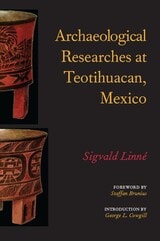
Archaeological Researches at Teotihuacan, Mexico
Sigvald Linne, with a foreword by Staffan Brunius and introduction by George L.
University of Alabama Press, 2003
In 1932, the Ethnographical Museum of Sweden sent an archaeological expedition to Mexico under the direction of Sigvald Linné to determine the full extent of this ancient Teotihuacan occupation and to collect exhibit-quality artifacts. Of an estimated 2,000-plus residential compounds at Teotihuacan, only 20 apartment-like structures were excavated at the time. Yet Linné’s work revealed residential patterns that have been confirmed later in other locations.
Some of the curated objects from the Valley of Mexico and the adjacent state of Puebla are among the most rare and unique artifacts yet found. Another important aspect of this research was that, with the aid of the Museum of Natural History in Washington, Linné’s team conducted ethnographic interviews with remnant native Mexican peoples whose culture had not been entirely destroyed by the Conquest, thereby collecting and preserving valuable information for later research.
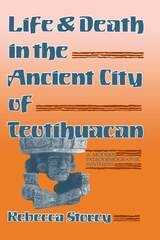
Life and Death in the Ancient City of Teotihuacan
A Modern Paleodemographic SynthesisRebecca Storey
University of Alabama Press, 1992
Cities arose independently in both the Old World and in the pre-Columbian New World. Lacking written records, many of these New World cities can be studied only through archaeology, including the earliest pre-Columbian city, Teotihuacan, Mexico, one of the largest cities of its time (150 B.C. to A.D. 750). Thus, an important question is how similar New World cities are to their Old World counterparts.
Before recent times, the dense populations of cities made them unhealthy places because of poor sanitation and inadequate food supplies. Storey's research shows clearly that although Teotihuacan was a very different environment and culture from 17th-century London, these two great cities are comparable in terms of health problems and similar death rates.
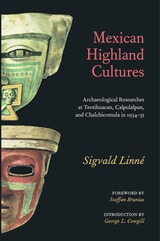
Mexican Highland Cultures
Archaeological Researches at Teotihuacan, Calpoulalpan and Chalchicomula in 1934-35Sigvald Linné
University of Alabama Press, 2003
Presents the broad picture and analysis of excavations at three cultural centers in central Mexico
This classic work published in 1942, ten years after archaeological excavations were begun in the Valley of Mexico by Linné's team, presents additional data that had not been fully detailed in the previously published Archaeological Researches at Teotihuacan. It provides comparative information on the high-status ruins situated on the fringes of the Valley of Mexico and excavation results from a compound within the city of Teotihuacan. This information is of critical use to archaeologists still excavating at Teotihuacan in projecting compound extent, types of artifacts expected to be discovered, and patterns of artifacts to be found in particular types of rooms. The characteristics of burials is also explored.
This book, along with its predecessor, is an important primary resource for Americanists. Staffan Brunius's foreword offers a broad background of Linné's life and work. The introduction by George Cowgill focuses more specifically on the conduct and impact of the archaeological exavations.
G. C. Vaillant has stated, "The greatest achievement of Dr. Linné from the viewpoint of the general student is the presentation of a technical field excavation in such terms that anyone can follow his text and see the relationship between the details of position of specimens and the larger problems of history and anthropology."
Sigvald Linné was Professor of Ethnography at the University of Stockholm and Director of the Swedish National Museum of Ethnography until 1969. He published several other books, including The Technique of South American Ceramics. Staffan Brunius
is Curator of the Americas at the National Museum of Ethnography in Stockholm. George L. Cowgill is Professor of Anthropology at Arizona State University and coeditor of The Collapse of Ancient States and Civilizations.
Additional reviews:
This book . . . makes Linne's work widely available again to those interested and may prompt a new generation of specialists to examine the original material either in Stockholm's National Museum of Ethnography, Mexico's Museo Nacional de Antropologia or the Teotihuacan site itself. Testament to the lasting value of Linne's work is given in a succinct and helpful new introduction by anthropologist George L. Cowgill. A more recent curator of the Americas at Stockholm's ethnographical museum, Steffan Brunius, also chips in with a brief contextualization of Linne's work against the background of the early Swedish-American tradition.—The Historian
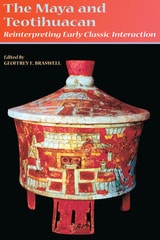
The Maya and Teotihuacan
Reinterpreting Early Classic InteractionEdited by Geoffrey E. Braswell
University of Texas Press, 2003
The contributors to this volume present extensive new evidence from archaeology, iconography, and epigraphy to offer a more nuanced understanding of the interaction between the Early Classic Maya and Teotihuacan.
Winner, Choice Outstanding Academic Book, 2005
Since the 1930s, archaeologists have uncovered startling evidence of interaction between the Early Classic Maya and the great empire of Teotihuacan in Central Mexico. Yet the exact nature of the relationship between these two ancient Mesoamerican civilizations remains to be fully deciphered. Many scholars have assumed that Teotihuacan colonized the Maya region and dominated the political or economic systems of certain key centers—perhaps even giving rise to state-level political organizations. Others argue that Early Classic rulers merely traded with Teotihuacan and skillfully manipulated its imported exotic goods and symbol sets to increase their prestige.
Moving beyond these traditional assumptions, the contributors to this volume present extensive new evidence from archaeology, iconography, and epigraphy to offer a more nuanced understanding of the interaction between the Early Classic Maya and Teotihuacan. Investigating a range of Maya sites, including Kaminaljuyu, Copán, Tikal, Altun Ha, and Oxkintok, they demonstrate that the influence of Teotihuacan on the Maya varied in nature and duration from site to site, requiring a range of models to explain the patterns of interaction. Moreover, they show that the interaction was bidirectional and discuss how the Maya in turn influenced Teotihuacan.
The Neighborhood as a Social and Spatial Unit in Mesoamerican Cities
Edited by M. Charlotte Arnauld, Linda R. Manzanilla, and Michael E. Smith
University of Arizona Press, 2012
The contributions gathered here provide fieldwork data to document the existence of sociopolitically distinct neighborhoods within ancient Mesoamerican settlements, building upon recent advances in multi-scale archaeological studies of these communities. Chapters illustrate the cultural variation across Mesoamerica, including data and interpretations on several different cities with a thematic focus on regional contrasts. This topic is relatively new and complex, and this book is a strong contribution for three interwoven reasons. First, the long history of research on the “Teotihuacan barrios” is scrutinized and withstands the test of new evidence and comparison with other Mesoamerican cities. Second, Maya studies of dense settlement patterns are now mature enough to provide substantial case studies. Third, theoretical investigation of ancient urbanization all over the world is now more complex and open than it was before, giving relevance to Mesoamerican perspectives on ancient and modern societies in time and space.
This volume will be of interest not only to scholars and student specialists of the Mesoamerican past but also to social scientists and urbanists looking to contrast ancient cultures worldwide.
The Teotihuacan Trinity
The Sociopolitical Structure of an Ancient Mesoamerican CityBy Annabeth Headrick
University of Texas Press, 2007
Northeast of modern-day Mexico City stand the remnants of one of the world's largest preindustrial cities, Teotihuacan. Monumental in scale, Teotihuacan is organized along a three-mile-long thoroughfare, the Avenue of the Dead, that leads up to the massive Pyramid of the Moon. Lining the avenue are numerous plazas and temples, which indicate that the city once housed a large population that engaged in complex rituals and ceremonies. Although scholars have studied Teotihuacan for over a century, the precise nature of its religious and political life has remained unclear, in part because no one has yet deciphered the glyphs that may explain much about the city's organization and belief systems.
In this groundbreaking book, Annabeth Headrick analyzes Teotihuacan's art and architecture, in the light of archaeological data and Mesoamerican ethnography, to propose a new model for the city's social and political organization. Challenging the view that Teotihuacan was a peaceful city in which disparate groups united in an ideology of solidarity, Headrick instead identifies three social groups that competed for political power—rulers, kin-based groups led by influential lineage heads, and military orders that each had their own animal insignia. Her findings provide the most complete evidence to date that Teotihuacan had powerful rulers who allied with the military to maintain their authority in the face of challenges by the lineage heads. Headrick's analysis also underscores the importance of warfare in Teotihuacan society and clarifies significant aspects of its ritual life, including shamanism and an annual tree-raising ceremony that commemorated the Mesoamerican creation story.