Results by title

10 books match the query 'Terms and phrases'
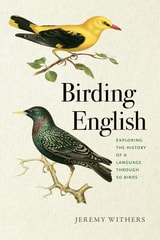
cover of Birding English: Exploring the History of a Language Through 50 Birds

Birding English

Exploring the History of a Language Through 50 Birds

Jeremy Withers

University of Iowa Press, 2026
What do words like unkindness, haggard, asparagus, jizz, and the singular they have to do with birds? Quite a lot, actually. From Old English roots and Shakespearean idioms to Victorian slang and modern online lingo, Birding English charts a dynamic course through English’s past, present, and future by admiring the plumage of falcons, the songs of sparrows, and the flight of ducks. With each of his fifty mini essays, Jeremy Withers uses birds as a point of entry into a key moment in the development of English: its origins in the Proto-Indo-European and Proto-Germanic languages, the influence of writers like Geoffrey Chaucer and William Shakespeare, the creation of English’s first dictionaries and grammar books, and the arrival of rhyming slang and portmanteaus. Ideal for word nerds and bird nerds alike, this book will enchant anyone who’s ever been captivated by the song of a bird or the song of a word.
[more]
cover of Critical Terms for Art History, Second Edition

Critical Terms for Art History, Second Edition

Edited by Robert S. Nelson and Richard Shiff

University of Chicago Press, 2003

"Art" has always been contested terrain, whether the object in question is a medieval tapestry or Duchamp's Fountain. But questions about the categories of "art" and "art history" acquired increased urgency during the 1970s, when new developments in critical theory and other intellectual projects dramatically transformed the discipline. The first edition of Critical Terms for Art History both mapped and contributed to those transformations, offering a spirited reassessment of the field's methods and terminology.

Art history as a field has kept pace with debates over globalization and other social and political issues in recent years, making a second edition of this book not just timely, but crucial. Like its predecessor, this new edition consists of essays that cover a wide variety of "loaded" terms in the history of art, from sign to meaning, ritual to commodity. Each essay explains and comments on a single term, discussing the issues the term raises and putting the term into practice as an interpretive framework for a specific work of art. For example, Richard Shiff discusses "Originality" in Vija Celmins's To Fix the Image in Memory, a work made of eleven pairs of stones, each consisting of one "original" stone and one painted bronze replica.

In addition to the twenty-two original essays, this edition includes nine new ones—performance, style, memory/monument, body, beauty, ugliness, identity, visual culture/visual studies, and social history of art—as well as new introductory material. All help expand the book's scope while retaining its central goal of stimulating discussion of theoretical issues in art history and making that discussion accessible to both beginning students and senior scholars.

Contributors: Mark Antliff, Nina Athanassoglou-Kallmyer, Stephen Bann, Homi K. Bhabha, Suzanne Preston Blier, Michael Camille, David Carrier, Craig Clunas, Whitney Davis, Jas Elsner, Ivan Gaskell, Ann Gibson, Charles Harrison, James D. Herbert, Amelia Jones, Wolfgang Kemp, Joseph Leo Koerner, Patricia Leighten, Paul Mattick Jr., Richard Meyer, W. J. T. Mitchell, Robert S. Nelson, Margaret Olin, William Pietz, Alex Potts, Donald Preziosi, Lisbet Rausing, Richard Shiff, Terry Smith, Kristine Stiles, David Summers, Paul Wood, James E. Young
[more]
cover of Critical Terms for Literary Study, Second Edition

Critical Terms for Literary Study, Second Edition

Edited by Frank Lentricchia and Thomas McLaughlin

University of Chicago Press, 1995

An essential primer and guide to literary studies for students and scholars

Critical Terms for Literary Study is an essential handbook and introduction to the work of literary theory. Covering a broad range of key terms that include popular culture, diversity, imperialism, ethics, desire, class, gender, race, canon, representation, and much more through essays by leading scholars, it provides a concise history of each term alongside a critical exploration of the issues and questions for the field that it raises, followed by demonstrations of reading strategies driven by the term.

Exploring the concepts that shape the way we read, the essays combine to provide an extraordinary introduction to the work of literature and literary study, as the nation's most distinguished scholars put the tools of critical practice vividly to use.
[more]
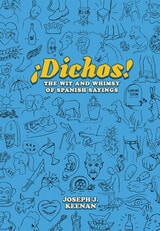
cover of Dichos! The Wit and Whimsy of Spanish Sayings

Dichos! The Wit and Whimsy of Spanish Sayings

By Joseph J. Keenan

University of Texas Press, 2019

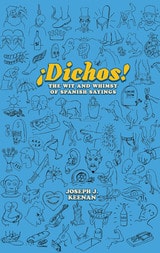
One of the most challenging—and entertaining—aspects of learning another language is the idiom. Those quirky phrases, steeped in metaphor and colorful cultural references, enliven conversation and make your cross-cultural communication familiar, fun, and meaningful. ¡Dichos! (Sayings) brings us a vibrant compendium of both age-old and brand-new expressions from across Latin America, compiled by the language enthusiast whose Breaking Out of Beginner’s Spanish transformed thousands of readers’ interactions with the Spanish language.

¡Dichos! is divided into thematic sections covering topics ranging from games and relaxation to politics, macho men, and Mondays. Spanish speakers can also use the book to identify the spot-on/best slangy English equivalent for a Spanish-language idiom. Packed with gems like La barba me huele a tigre, y yo mismo me tengo miedo (My beard smells of tiger, and I’m even afraid of myself) and Para todo mal, mezcal; para todo bien, también (For everything bad, mezcal; for everything good, likewise), this book is the ultimate tool for taking your language skills to the next level as you navigate nuance with humor and linguistic agility.
[more]
cover of Dichos! The Wit and Whimsy of Spanish Sayings

Dichos! The Wit and Whimsy of Spanish Sayings

By Joseph J. Keenan

University of Texas Press, 2019

One of the most challenging—and entertaining—aspects of learning another language is the idiom. Those quirky phrases, steeped in metaphor and colorful cultural references, enliven conversation and make your cross-cultural communication familiar, fun, and meaningful. ¡Dichos! (Sayings) brings us a vibrant compendium of both age-old and brand-new expressions from across Latin America, compiled by the language enthusiast whose Breaking Out of Beginner’s Spanish transformed thousands of readers’ interactions with the Spanish language.

¡Dichos! is divided into thematic sections covering topics ranging from games and relaxation to politics, macho men, and Mondays. Spanish speakers can also use the book to identify the spot-on/best slangy English equivalent for a Spanish-language idiom. Packed with gems like La barba me huele a tigre, y yo mismo me tengo miedo (My beard smells of tiger, and I’m even afraid of myself) and Para todo mal, mezcal; para todo bien, también (For everything bad, mezcal; for everything good, likewise), this book is the ultimate tool for taking your language skills to the next level as you navigate nuance with humor and linguistic agility.
[more]
cover of Direct Reference, Indexicality, and Propositional Attitudes

Direct Reference, Indexicality, and Propositional Attitudes

Edited by Wolfgang Künne, Albert Newen, and Martin Anduschus

CSLI, 1997

This volume is a compilation of revised versions of papers presented at a conference held in spring 1994 at the Centre for Interdisciplinary Research (ZiF) in Bielefeld, Germany.
[more]
cover of Inside the Antisemitic Mind: The Language of Jew-Hatred in Contemporary Germany

Inside the Antisemitic Mind

The Language of Jew-Hatred in Contemporary Germany

Monika Schwarz-Friesel and Jehuda Reinharz

Brandeis University Press, 2017

Antisemitism never disappeared in Europe. In fact, there is substantial evidence that it is again on the rise, manifest in violent acts against Jews in some quarters, but more commonly noticeable in everyday discourse in mainstream European society. This innovative empirical study examines written examples of antisemitism in contemporary Germany. It demonstrates that hostility against Jews is not just a right-wing phenomenon or a phenomenon among the uneducated, but is manifest among all social classes, including intellectuals. Drawing on 14,000 letters and e-mails sent between 2002 and 2012 to the Central Council of Jews in Germany and to the Israeli embassy in Berlin, as well as communications sent between 2010 and 2011 to Israeli embassies in Austria, Switzerland, Belgium, England, Ireland, the Netherlands, Sweden, and Spain, this volume shows how language plays a crucial role in activating and re-activating antisemitism. In addition, the authors investigate the role of emotions in antisemitic argumentation patterns and analyze “anti-Israelism” as the dominant form of contemporary hatred of Jews.
[more]
cover of Just the Job: How Trades got their Names

Just the Job

How Trades got their Names

Alexander Tulloch

Bodleian Library Publishing, 2020

What did a gongfarmer do? How is a chaperone connected to a bird of prey? What is the etymology behind cloud architect? Is there a link between secretaries and secrets?

The story behind these (and many more) job titles is rarely predictable and often fascinating. In this highly original book, linguist Alexander Tulloch examines the etymology behind a selection of trades and professions, unearthing intriguing bits of historical information along the way. Here readers will find explanations of common surnames, such as Spencer, Hayward, and Fletcher; obsolete jobs such as pardoner, cordwainer, or telegraph boy; and roles for the modern era, such as wedding planner, pundit, and sky marshal. Packed with additional etymological information and literary quotations, this book will appeal not only to linguists, but to anyone interested in the quirky twists and turns of meaning that have led to the familiar job titles of today.
[more]
cover of New South African Keywords

New South African Keywords

Nick Shepherd

Ohio University Press, 2008

New South African Keywords sets out to do two things. The first is to provide a guide to the key words and key concepts that have come to shape public and political thought and debate in South Africa since 1994. The second purpose is to provide a compendium of cutting-edge thinking on the new society. In this respect some of the most exciting thinkers and commentators on South Africa have tried to capture the complexity of current debates. The result is a concise and insightful guide to postapartheid South Africa, which should be useful to students, citizens, tourists, business managers, decision makers—in fact, to anyone wanting to make sense of South African society today.
[more]
cover of Tippecanoe and Tyler Too: Famous Slogans and Catchphrases in American History

Tippecanoe and Tyler Too

Famous Slogans and Catchphrases in American History

Jan R. Van Meter

University of Chicago Press, 2008

“By necessity, by proclivity, by delight,” Ralph Waldo Emerson said in 1876, “we all quote.” But often the phrases that fall most readily from our collective lips—like “fire when ready,”  “speak softly and carry a big stick,” or “nice guys finish last”—are those whose origins and true meanings we have ceased to consider. Restoring three-dimensionality to more than fifty of these American sayings, Tippecanoe and Tyler Too turns clichés back into history by telling the life stories of the words that have served as our most powerful battle cries, rallying points, laments, and inspirations.

In individual entries on slogans and catchphrases from the early seventeenth to the late twentieth century, Jan Van Meter reveals that each one is a living, malleable entity that has profoundly shaped and continues to influence our public culture. From John Winthrop’s “We shall be as a city upon a hill” and the 1840 Log Cabin Campaign’s “Tippecanoe and Tyler Too” to Martin Luther King Jr.’s “I have a dream” and Ronald Reagan’s “Mr. Gorbachev, tear down this wall,” each of Van Meter’s selections emerges as a memory device for a larger political or cultural story. Taken together in Van Meter’s able hands, these famous slogans and catchphrases give voice to our common history even as we argue about where it should lead us.

“As Van Meter argues, these are important ‘memory devices for a larger story.’ . . . The author has thoroughly researched all the catchphrases . . . . This book would make delightful in-flight reading or a nice gift for a trivia buff. Recommended.”—Choice

[more]