Results by title
22 books match the query 'Testing & Measurement'
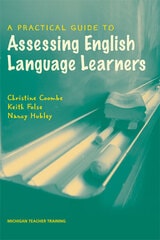
A Practical Guide to Assessing English Language Learners
Christine Coombe, Keith Folse, and Nancy Hubley
University of Michigan Press, 2007
Tips to improve students’ test-taking strategies are offered, and each chapter ends with a helpful list of Ten Things to Remember, as well as informative case studies featuring two teachers and their assessment decisions. Incorporating its own principles, A Practical Guide to Assessing English Language Learners opens with a short quiz for the reader called Are You Testwise? that quickly determines how each teacher will benefit from this indispensable guide.
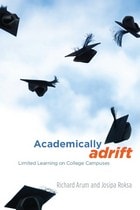
Academically Adrift
Limited Learning on College CampusesRichard Arum and Josipa Roksa
University of Chicago Press, 2010
In spite of soaring tuition costs, more and more students go to college every year. A bachelor’s degree is now required for entry into a growing number of professions. And some parents begin planning for the expense of sending their kids to college when they’re born. Almost everyone strives to go, but almost no one asks the fundamental question posed by Academically Adrift: are undergraduates really learning anything once they get there?
For a large proportion of students, Richard Arum and Josipa Roksa’s answer to that question is a definitive no. Their extensive research draws on survey responses, transcript data, and, for the first time, the state-of-the-art Collegiate Learning Assessment, a standardized test administered to students in their first semester and then again at the end of their second year. According to their analysis of more than 2,300 undergraduates at twenty-four institutions, 45 percent of these students demonstrate no significant improvement in a range of skills—including critical thinking, complex reasoning, and writing—during their first two years of college. As troubling as their findings are, Arum and Roksa argue that for many faculty and administrators they will come as no surprise—instead, they are the expected result of a student body distracted by socializing or working and an institutional culture that puts undergraduate learning close to the bottom of the priority list.
Academically Adrift holds sobering lessons for students, faculty, administrators, policy makers, and parents—all of whom are implicated in promoting or at least ignoring contemporary campus culture. Higher education faces crises on a number of fronts, but Arum and Roksa’s report that colleges are failing at their most basic mission will demand the attention of us all.
An Age of Accountability
How Standardized Testing Came to Dominate American Schools and Compromise EducationJohn L. Rury
Rutgers University Press, 2024
Assessing Deaf Adults
Critical Issues in Testing and EvaluationJudith L. Mounty
Gallaudet University Press, 2005
Section I frames the contexts facing deaf and hard of hearing individuals and those who test them, including a telling historical perspective. In Section II, chapters explore how deaf and hard of hearing candidates can meet the rigors of test-taking, how to level the playing field with a new approach to assessment, and what to consider to develop fully accessible licensing tests. The final chapter in this part examines the psychometric properties of intellectual assessments when used with deaf and hard of hearing people. Administrative Issues constitute Section III, beginning with legal considerations related to equity testing for deaf adults. An exploration of the potential of sign language interpretation in the testing environment follows.
Section IV provides case studies of deaf and hard of hearing adults from a variety of professions, including certification testing for therapeutic recreation, preparation strategies for university students, and ways to maximize access to licensure for social workers. A separate chapter addresses the impact of recent federal mandates on assessment of deaf and hard of hearing teachers and teaching candidates. The final section summarizes the current situation and presents recommendations to manage it, concluding with an epilogue on directions for the future.
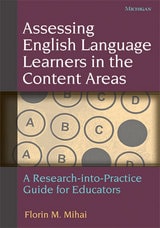
Assessing English Language Learners in the Content Areas
A Research-into-Practice Guide for EducatorsFlorin M. Mihai
University of Michigan Press, 2010
Assessing English Language Learners in the Content Areas: A Research-into-Practice Guide for Educators seeks to provide guidance to classroom teachers, staff developers, and test-item designers who want to improve ELL assessment outcomes, particularly in the areas of math, science and social studies. The first two chapters of the book establish the background for the discussion of content-area assessment for ELLs, examining several important characteristics of this rapidly growing student population (as well as critical legislation affecting ELLs) and providing a description of various forms of assessment, including how ELL assessment is different from the assessment of English-proficient students. Important assessment principles that educators should use in their evaluation of tests or other forms of measurement are provided.
Other chapters review ELL test accommodations nationwide (because, surprisingly, most teachers do not know what they can and cannot allow) and the research on the effectiveness of these types of accommodations. The book analyzes the characteristics of alternative assessment; it discusses three popular alternative assessment instruments (performance assessment, curriculum-based measurement, and portfolios) and makes recommendations as to how to increase the validity, reliability, and practicality of alternative assessments. The book proposes fundamental assessment practices to help content area teachers in their evaluation of their ELL progress.
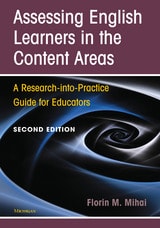
Assessing English Learners in the Content Areas, Second Edition
A Research-into-Practice Guide for EducatorsFlorin M. Mihai
University of Michigan Press, 2017
Significant modifications in education legislation since the publication of the first edition have necessitated this new volume, which includes updated EL demographics as they relate to the Common Core Standards and Every Student Succeeds Act and revised state-by-state test accommodation information. New to this edition is information about the assessment of language arts (in addition to math, science, and social studies). The Second Edition also features new research-based recommendations for large-scale and classroom-based assessments.
Like the previous edition, the first two chapters of the book establish the background for the discussion of content-area assessment for ELs, examining several important characteristics of this rapidly growing student population and providing a description of various forms of assessment, including how EL assessment is different from the assessment of English-proficient students. Important assessment principles that educators should use in their evaluation of tests or other forms of measurement are provided.
Other chapters review EL test accommodations nationwide (because, surprisingly, most teachers do not know what they can and cannot allow) and the research on the effectiveness of these types of accommodations. The book analyzes the characteristics of alternative assessment and makes recommendations as to how to increase the validity, reliability, and practicality of alternative assessments. The book proposes fundamental assessment practices to help content area teachers in their evaluation of their students’ progress. Two extensive appendixes outline TESOL Proficiency Standards and academic vocabulary for the content areas.
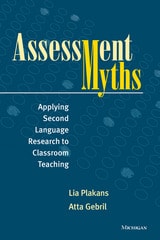
Assessment Myths
Applying Second Language Research to Classroom TeachingLia Plakans and Atta Gebril
University of Michigan Press, 2015
The book opens with an introduction that reviews many key assessment terms and concepts.
The myths examined in this book are:
- Assessment is just writing tests and using statistics.
- A comprehensive final exam is the best way to evaluate students.
- Scores on performance assessments are preferable because of their accuracy and authenticity.
- Multiple choice tests are inaccurate measures of language but are easy to write.
- We should test only one skill at a time.
- A test’s validity can be determined by looking at it.
- Issues of fairness are not a concern with standardized testing.
- Teachers should never be involved in preparing students for tests.
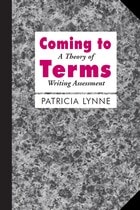
Coming To Terms
A Theory of Writing AssessmentPatricia Lynne
Utah State University Press, 2004
In a provocative book-length essay, Patricia Lynne argues that most programmatic assessment of student writing in U.S. public and higher education is conceived in the terms of mid-20th century positivism. Since composition as a field had found its most compatible home in constructivism, she asks, why do compositionists import a conceptual frame for assessment that is incompatible with composition theory?
By casting this as a clash of paradigms, Lynne is able to highlight the ways in which each theory can and cannot influence the shape of assessment within composition. She laments, as do many in composition, that the objectively oriented paradigm of educational assessment theory subjugates and discounts the very social constructionist principles that empower composition pedagogy. Further, Lynne criticizes recent practice for accommodating the big business of educational testing—especially for capitulating to the discourse of positivism embedded in terms like "validity" and "reliability." These terms and concepts, she argues, have little theoretical significance within composition studies, and their technical and philosophical import are downplayed by composition assessment scholars.
There is a need, Lynne says, for terms of assessment that are native to composition. To open this needed discussion within the field, she analyzes cutting-edge assessment efforts, including the work of Broad and Haswell, and she advances a set of alternate terms for evaluating assessment practices, a set of terms grounded in constructivism and composition.
Coming to Terms is ambitious and principled, and it takes a controversial stand on important issues. This strong new volume in assessment theory will be of serious interest to assessment specialists and their students, to composition theorists, and to those now mounting assessments in their own programs.
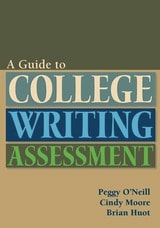
Guide to College Writing Assessment
Peggy O'Neill, Cindy Moore, and Brian Huot
Utah State University Press, 2009
A Guide to College Writing Assessment is designed as an introduction and source book for WPAs, department chairs, teachers, and administrators. Always cognizant of the critical components of particular teaching contexts, O’Neill, Moore, and Huot have written sophisticated but accessible chapters on the history, theory, application and background of writing assessment, and they offer a dozen appendices of practical samples and models for a range of common assessment needs.
Because there are numerous resources available to assist faculty in assessing the writing of individual students in particular classrooms, A Guide to College Writing Assessment focuses on approaches to the kinds of assessment that typically happen outside of individual classrooms: placement evaluation, exit examination, programmatic assessment, and faculty evaluation. Most of all, the argument of this book is that creating the conditions for meaningful college writing assessment hinges not only on understanding the history and theories informing assessment practice, but also on composition programs availing themselves of the full range of available assessment practices.
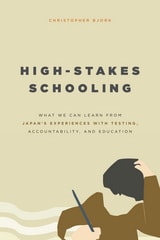
High-Stakes Schooling
What We Can Learn from Japan's Experiences with Testing, Accountability, and Education ReformChristopher Bjork
University of Chicago Press, 2015
Bjork asks a variety of important questions related to testing and reform: Does testing overburden students? Does it impede innovation and encourage conformity? Can a system anchored by examination be reshaped to nurture creativity and curiosity? How should any reforms be implemented by teachers? Each chapter explores questions like these with careful attention to the actual effects policies have had on schools in Japan and other Asian settings, and each draws direct parallels to issues that US schools currently face. Offering a wake-up call for American education, Bjork ultimately cautions that the accountability-driven practice of standardized testing might very well exacerbate the precise problems it is trying to solve.
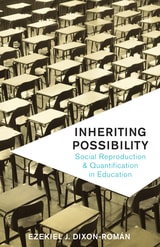
Inheriting Possibility
Social Reproduction and Quantification in EducationEzekiel J. Dixon-Román
University of Minnesota Press, 2017
How has the dominant social scientific paradigm limited our understanding of the impact of inherited economic resources, social privilege, and sociocultural practices on multigenerational inequality? In what ways might multiple forces of social difference haunt quantitative measurements of ability such as the SAT? Building on new materialist philosophy, Inheriting Possibility rethinks methods of quantification and theories of social reproduction in education, demonstrating that test performance results and parenting practices convey the impact of materially and historically contingent patterns of differential possibility.
Ezekiel J. Dixon-Román explores the dualism of nature and culture that has undergirded theories of inheritance, social reproduction, and human learning and development. Research and debate on the reproduction of power relations have rested on a premise that nature is made up of fixed universals on which the creative, intellective, and discursive play of culture are based. Drawing on recent work in the physical and biological sciences, Dixon-Román argues that nature is culture. He contends that by assuming a rigid nature/culture binary, we ultimately limit our understanding of how power relations are reproduced.
Through innovative analyses of empirical data and cultural artifacts, Dixon-Román boldly reconsiders how we conceptualize the processes of inheritance and approach social inquiry in order to profoundly sharpen understanding and address the reproducing forces of inequality.
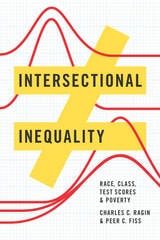
Intersectional Inequality
Race, Class, Test Scores, and PovertyCharles C. Ragin and Peer C. Fiss
University of Chicago Press, 2016
Ragin and Fiss begin by taking up the controversy regarding the relative importance of test scores versus socioeconomic background on life chances, a debate that has raged since the 1994 publication of Richard Herrnstein and Charles Murray’s TheBell Curve. In contrast to prior work, Ragin and Fiss bring an intersectional approach to the evidence, analyzing the different ways that advantages and disadvantages combine in their impact on life chances. Moving beyond controversy and fixed policy positions, the authors propose sophisticated new methods of analysis to underscore the importance of attending to configurations of race, gender, family background, educational achievement, and related conditions when addressing social inequality in America today.
Linking Assignments to Assessments
A Guide for TeachersDeborah Crusan and Todd Ruecker
University of Michigan Press, 2022
The book shares foundational information on the importance of assessment literacy and on how language acquisition, student backgrounds, and language standards need to be considered. Linking Assignments to Assessments offers step-by-step instructions on creating effective assessments for listening and reading, speaking and writing, grammar and vocabulary. Teachers are provided context for understanding standardized assessments and strategies to advocate for and prepare English learners in high-stakes assessment contexts. Each chapter includes activities, discussion questions, and strategies for developing an assessment philosophy to help educators link their theory and practice.
Machine Scoring of Student Essays
Truth and Consequencesedited by Patricia Freitag Ericsson & Rich Haswell
Utah State University Press, 2006
The current trend toward machine-scoring of student work, Ericsson and Haswell argue, has created an emerging issue with implications for higher education across the disciplines, but with particular importance for those in English departments and in administration. The academic community has been silent on the issue—some would say excluded from it—while the commercial entities who develop essay-scoring software have been very active.
Machine Scoring of Student Essays is the first volume to seriously consider the educational mechanisms and consequences of this trend, and it offers important discussions from some of the leading scholars in writing assessment.
Reading and evaluating student writing is a time-consuming process, yet it is a vital part of both student placement and coursework at post-secondary institutions. In recent years, commercial computer-evaluation programs have been developed to score student essays in both of these contexts. Two-year colleges have been especially drawn to these programs, but four-year institutions are moving to them as well, because of the cost-savings they promise. Unfortunately, to a large extent, the programs have been written, and institutions are installing them, without attention to their instructional validity or adequacy.
Since the education software companies are moving so rapidly into what they perceive as a promising new market, a wider discussion of machine-scoring is vital if scholars hope to influence development and/or implementation of the programs being created. What is needed, then, is a critical resource to help teachers and administrators evaluate programs they might be considering, and to more fully envision the instructional consequences of adopting them. And this is the resource that Ericsson and Haswell are providing here.
Organic Writing Assessment
Dynamic Criteria Mapping in ActionBob Broad, Linda Adler-Kassner, Barry Alford, Jane Detweiler, Heidi Estrem, Susanmarie Harrington, Maureen McBride, Eric Stalions, and Scott Weeden
Utah State University Press, 2009
For the authors of Organic Writing Assessment, the DCM experience provided not only an authentic assessment of their own programs, but a nuanced language through which they can converse in the always vexing, potentially divisive realm of assessment theory and practice. Of equal interest are the adaptations these writers invented for Broad’s original process, to make DCM even more responsive to local needs and exigencies.
Organic Writing Assessment represents an important step in the evolution of writing assessment in higher education. This volume documents the second generation of an assessment model that is regarded as scrupulously consistent with current theory; it shows DCM’s flexibility, and presents an informed discussion of its limits and its potentials.
Teachers and Testing
David A. Goslin
Russell Sage Foundation, 1967
The IQ Mythology
Class, Race, Gender, and InequalityElaine Mensh and Harry Mensh
Southern Illinois University Press, 1991
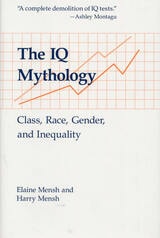
Ever since Alfred Binet carried out a 1904 commission from France’s minister of public instruction to devise a means for deciding which pupils should be sent to what would now be called special education classes, IQ scores have been used to label and track children. Those same scores have been cited as "proof" that different races, classes, and genders are of superior and inferior intelligence.
The Menshes make clear that from the beginning IQ tests have been fundamentally biased. Offered as a means for seeking solutions to social problems, the actual measurements have been used to maintain the status quo. Often the most telling comments are from the test-makers themselves, whether Binet ("little girls weak in orthography are strong in sewing and capable in the instruction concerning housekeeping; and, all things considered, this is more important for their future") or Wigdor and Garner ("naive use of intelligence tests . . . to place children of linguistic or racial minority status in special education programs will not be defensible in court").
Among the disturbing facts that the authors share is that there is mounting political pressure for more tests and testing despite a court trial in which the judge stated that "defendants’ expert witnesses, even those clearly affiliated with the companies that devise and distribute the standardized intelligence tests, agreed, with one exception, that we cannot truly define, much less measure, intelligence." The testing firms have responded to this carefully orchestrated need with new products that extend even to the IQ testing of three-month-old infants. The authors stress that, if the testers prevail, there is little doubt that these and similar tests would be used "ad infinitum to justify superior and inferior education along class and racial lines."
The Myth of Achievement Tests
The GED and the Role of Character in American LifeEdited by James J. Heckman, John Eric Humphries, and Tim Kautz
University of Chicago Press, 2013
The Myth of Achievement Tests shows that achievement tests like the GED fail to measure important life skills. James J. Heckman, John Eric Humphries, Tim Kautz, and a group of scholars offer an in-depth exploration of how the GED came to be used throughout the United States and why our reliance on it is dangerous. Drawing on decades of research, the authors show that, while GED recipients score as well on achievement tests as high school graduates who do not enroll in college, high school graduates vastly outperform GED recipients in terms of their earnings, employment opportunities, educational attainment, and health. The authors show that the differences in success between GED recipients and high school graduates are driven by character skills. Achievement tests like the GED do not adequately capture character skills like conscientiousness, perseverance, sociability, and curiosity. These skills are important in predicting a variety of life outcomes. They can be measured, and they can be taught.
Using the GED as a case study, the authors explore what achievement tests miss and show the dangers of an educational system based on them. They call for a return to an emphasis on character in our schools, our systems of accountability, and our national dialogue.
Contributors
Eric Grodsky, University of Wisconsin–Madison
Andrew Halpern-Manners, Indiana University Bloomington
Paul A. LaFontaine, Federal Communications Commission
Janice H. Laurence, Temple University
Lois M. Quinn, University of Wisconsin–Milwaukee
Pedro L. Rodríguez, Institute of Advanced Studies in Administration
John Robert Warren, University of Minnesota, Twin Cities
The Test Drive
Avital Ronell
University of Illinois Press, 2004
The Testing Charade
Pretending to Make Schools BetterDaniel Koretz
University of Chicago Press, 2017
For decades we’ve been studying, experimenting with, and wrangling over different approaches to improving public education, and there’s still little consensus on what works, and what to do. The one thing people seem to agree on, however, is that schools need to be held accountable—we need to know whether what they’re doing is actually working. But what does that mean in practice?
High-stakes tests. Lots of them. And that has become a major problem. Daniel Koretz, one of the nation’s foremost experts on educational testing, argues in The Testing Charade that the whole idea of test-based accountability has failed—it has increasingly become an end in itself, harming students and corrupting the very ideals of teaching. In this powerful polemic, built on unimpeachable evidence and rooted in decades of experience with educational testing, Koretz calls out high-stakes testing as a sham, a false idol that is ripe for manipulation and shows little evidence of leading to educational improvement. Rather than setting up incentives to divert instructional time to pointless test prep, he argues, we need to measure what matters, and measure it in multiple ways—not just via standardized tests.
Right now, we’re lying to ourselves about whether our children are learning. And the longer we accept that lie, the more damage we do. It’s time to end our blind reliance on high-stakes tests. With The Testing Charade, Daniel Koretz insists that we face the facts and change course, and he gives us a blueprint for doing better.
Wad-Ja-Get?
The Grading Game in American Education, 50th Anniversary EditionHoward Kirschenbaum, Rodney Napier, and Sidney B. Simon; With a new introduction by Professor Barry Fishman
Michigan Publishing Services, 2020
Grades and grading are an accepted part of modern education. But why? Why do we accept a system that is more focused on ranking students than on learning? Why do we accept the negative effects of standard grading approaches, including turning students off from learning, increasing stress, creating winners and losers, and perpetuating racial and economic inequality? Why do we accept these things when there are better alternatives?
Wad-Ja-Get? is a unique discussion of grading and its effects on students. The book was written by three education professors who have had first-hand contact with the problems of grading in all its forms. Written in the form of a novel, the topic is explored through the eyes of students, teachers, and parents in one high school embroiled in a controversy around grading. Possible alternatives to the grading system are examined in detail and the research on grading is summarized in an appendix. This 50th anniversary edition of the book includes a new introduction by Professor Barry Fishman, updating the research and setting the original book in the context of today’s educational and societal challenges. Wad-Ja-Get? remains timely five decades after its original publication, and will be inspiring to students, parents, educators, and policymakers.
What We Really Value
Beyond Rubrics in Teaching and Assessing WritingBob Broad
Utah State University Press, 2003
What We Really Value traces the origins of traditional rubrics within the theoretical and historical circumstances out of which they emerged, then holds rubrics up for critical scrutiny in the context of contemporary developments in the field. As an alternative to the generic character and decontextualized function of scoring guides, he offers dynamic criteria mapping, a form of qualitative inquiry by which writing programs (as well as individual instructors) can portray their rhetorical values with more ethical integrity and more pedagogical utility than rubrics allow.
To illustrate the complex and indispensable insights this method can provide, Broad details findings from his study of eighty-nine distinct and substantial criteria for evaluation at work in the introductory composition program at "City University." These chapters are filled with the voices of composition instructors debating and reflecting on the nature, interplay, and relative importance of the many criteria by which they judged students' texts. Broad concludes his book with specific strategies that can help writing instructors and programs to discover, negotiate, map, and express a more robust truth about what they value in their students' rhetorical performances.