Results by title

4 books match the query 'Thatcher, Margaret'
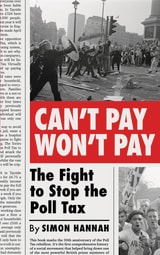
cover of Can't Pay, Won't Pay: The Fight to Stop the Poll Tax

Can't Pay, Won't Pay

The Fight to Stop the Poll Tax

Simon Hannah

Pluto Press, 2020

Thirty years ago, a social movement helped bring down one of the most powerful British Prime Ministers of the 20th Century. For the 30th anniversary of the Poll Tax rebellion, Simon Hannah looks back on those tumultuous days of resistance, telling the story of the people that beat the bailiffs, rioted for their rights and defied a government.

Starting in Scotland where the 'Community Charge' was first trialled, Can't Pay, Won't Pay immerses the reader in the gritty history of the rebellion. Amidst the drama of large scale protests and blockaded estates a number of key figures and groups emerge: Neil Kinnock and Tommy Sheridan; Militant, Class War and the Metropolitan Police. 

Assessing this legacy today, Hannah demonstrates the centrality of the Poll Tax resistance as a key chapter in the history of British popular uprisings, Labour Party factionalism, the anti-socialist agenda and failed Tory ideology.
[more]
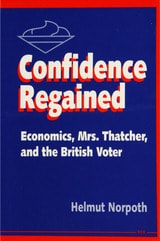
cover of Confidence Regained: Economics, Mrs. Thatcher, and the British Voter

Confidence Regained

Economics, Mrs. Thatcher, and the British Voter

Helmut Norpoth

University of Michigan Press, 1992
Elected to office at the end of a decade of economic decline, Prime Minister Margaret Thatcher set out to cure Britain's ills with daring new free-market policies. Putting financial stability first on the agenda of macroeconomic priorities, the Thatcher government pursued this goal with rare tenacity. In Confidence Regained, Helmut Norpoth examines the electoral risks and rewards of this economic strategy.Professor Norpoth paints a vivid picture of the fierce battle over the economic policies and record of the Thatcher government. Using electoral surveys, Norpoth reveals how British voters sorted out the competing claims of economists and politicians in their various partisan choices. Turning from election outcomes to government popularity between elections, Professor Norpoth charts the rise and decline of Margaret Thatcher's approval ratings and Conservative party support, showing how responsive these ratings were to economic performance. The statistical evidence presented shows that economic views significantly affected voter choices in the Thatcher elections. But the author reveals that the Conservatives under Mrs. Thatcher owed their ability to regain the confidence of the British electorate not only to the nation’s economic success, but also, in large measure, to the British victory in the Falkland Islands.Confidence Regained is an invaluable source to scholars of electoral politics, especially of British elections, but it will also interest historians of Thatcherism and scholars studying the role of macroeconomics in elections.
[more]
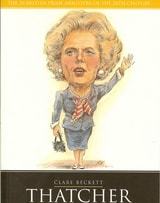
cover of Thatcher

Thatcher

Clare Beckett

Haus Publishing, 2006

Britain's first woman prime minister, friend of Ronald Reagan and the longest serving head of government in the 20th century (1979-90), but also the only one to be removed from office in peacetime by pressure from within her own party
[more]
cover of The Free Economy and the Strong State

The Free Economy and the Strong State

Andrew Gamble

Duke University Press, 1988

A new politics emerged in the 1970s in response to the world recession, the exhaustion of Fordism (the theory, traced to Henry Ford, that well-paid industrial workers fuel continuous capitalist growth), and the breakdown of American hegemony. Thatcherism, one expression of this new politics, acquired its distinctive characteristics through the exceptional and deep-seated crisis of state authority that developed in Britain in the mid-1970s.

By 1987, the Conservatives under Thatcher's leadership had won their third successive election victory over a divided opposition and enjoyed a degree of political and ideological dominance that led many commentators to speak of the end of the socialist era and the emergence of a new consensus in Britain. A new word—Thatcherism—had entered the political lexicon. It has come to signify a broad-ranging and distinctive program aimed at promoting economic recovery through the privatization of public enterprise and restoring the authority of the state. The Free Economy and the Strong State explores the roots of Thatcherism and its relationship to the Conservative tradition, to the economic liberal ideology of the New Right, and to the "new politics" which emerged from the recession and crisis of the world order in the mid 1970s.

[more]