Results by title
4 books match the query 'Theatrical companies'
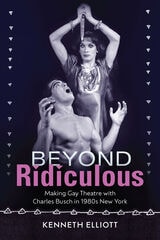
Beyond Ridiculous
Making Gay Theatre with Charles Busch in 1980s New YorkKenneth Elliott
University of Iowa Press, 2023
Beyond Ridiculous tells the story of Theatre-in-Limbo, a downtown band of actors formed in 1984 by director Kenneth Elliott and playwright and drag legend Charles Busch. They launched Vampire Lesbians of Sodom at the Limbo Lounge, a raffish club in the fringes of the East Village, but it would later become the longest-running non-musical in off-Broadway history. From 1984 to 1991, Busch starred in eight Limbo productions, always in outrageously fabulous drag.
In Beyond Ridiculous, Elliott narrates in first-person the company’s Cinderella tale of fun, heartbreak, and dishy drama. At the center of the book is a young Charles Busch, an unforgettable personality fighting to be seen, be heard, and express his unique style as a writer-performer in plays such as Psycho Beach Party and The Lady in Question. The tragedy of AIDS among treasured friends in the company, the struggle for mainstream acceptance of LGBTQ+ theatre during the reign of President Ronald Reagan, and the exploration of new ways of being a gay theatre artist make the book a bittersweet and joyous ride.
In Beyond Ridiculous, Elliott narrates in first-person the company’s Cinderella tale of fun, heartbreak, and dishy drama. At the center of the book is a young Charles Busch, an unforgettable personality fighting to be seen, be heard, and express his unique style as a writer-performer in plays such as Psycho Beach Party and The Lady in Question. The tragedy of AIDS among treasured friends in the company, the struggle for mainstream acceptance of LGBTQ+ theatre during the reign of President Ronald Reagan, and the exploration of new ways of being a gay theatre artist make the book a bittersweet and joyous ride.
[more]
Monuments Askew
An Elliptical History of the Factory of the Eccentric ActorMaria Corrigan
Rutgers University Press, 2025
Monuments Askew: An Elliptical History of the Factory of the Eccentric Actor presents a cultural history of the Factory of the Eccentric Actor (FEKS), an avant-garde collective of Ukrainian artists whose unique approach to monumental history generated a new kind of cinema for a modernizing Soviet era. Often lost in the shuffle of this period, FEKS’s vibrant and experimental cinematic output initiated a youthful and cheeky overhaul of Soviet revolutionary culture. Monuments Askew reveals the foundational role of this understudied group of artists—including Grigori Kozintsev and Leonid Trauberg—and uses their own theoretical contributions to undo the “foundations” of our understanding of Soviet media and arts. As a counter to a solely cinema-focused conceptualization of this era, Corrigan develops a transnational media theory of eccentricity. Defining eccentric circles as warped, irregular orbits that force a realignment of centers, Monuments Askew shows how FEKS’s body of work inspires an eccentric realignment of the pillars of Soviet visual culture, and indeed of monumentality itself.
[more]
Repertory of Shakespeare's Company, 1594–1613
Roslyn Lander Knutson
University of Arkansas Press, 1991
Knutson demystifies Shakespeare and his company by providing a clear vision of the dynamics of repertory management and play-going in Shakespeare's England.
[more]
Stage for Action
U.S. Social Activist Theatre in the 1940sChrystyna Dail
Southern Illinois University Press, 2016
Drawing on underexplored and only recently available archives, author Chrystyna Dail examines the influence of Stage for Action, a theatre group founded in 1943, on social activist theatre in the 1940s, early 1950s, and beyond. The group embraced subjects not taken up by earlier activist theatre companies—advocating for the rights of Puerto Ricans, calling attention to the lack of child care for working mothers, and demanding the cessation of all nuclear warfare.
Exploring the intersection between performance and politics and the direct impact of the arts on social activism, Dail argues Stage for Action is a theatrical reflection of progressivism and the pro-working-class theatrical aesthetic of the 1940s. The theatre group, which used performance to encourage direct action and personal responsibility for change, eventually would function as the theatrical voice of the United States Progressive Party in the failed presidential campaign of former vice president Henry A. Wallace.
Calling into question the widely held belief that U.S. theatre in the early years of the Cold War was indifferent to activism, Stage for Action offers historians a new interpretation of social activist performance at midcentury.
[more]