Results by title
8 books match the query 'Threshold'
Life at Swift Water Place
Northwest Alaska at the Threshold of European ContactEdited by Doug D. Anderson and Wanni W. Anderson
University of Alaska Press, 2019
On the Threshold
Short StoriesDušan Mitana
Seagull Books, 2024
An unhappily married woman is impregnated by her elderly neighbor who lives in a building across the street and with whom she has never had any physical contact. Just as his attention creates life within her, his own life waxes and wanes with her gaze and attention.
A man finds himself trapped in a pub on a sweltering afternoon after refusing to buy a beer with his cigarettes. Guarded by a vigilante bartender and his beer-obsessed patrons, his every attempt at escape is foiled until their life-giving elixir, the beer, runs out.
This collection introduces English-language readers to the work of Dušan Mitana, a cult figure in contemporary Central European literature. In Mitana’s stories, appearing in English for the first time, the rational and the irrational are indistinguishable. His tales infect a banal, quotidian realism with mystical and supernatural distortions. Tinged with Hitchcockian paranoia and full of unexpected turns, the seventeen stories collected here offer a glimpse into Mitana’s trademark absurdist style.
Standing at the Threshold
Working through Liminality in the Composition and Rhetoric TAshipWilliam J. Macauley
Utah State University Press, 2021
These authors enrich the TA experience by supporting agency and self-efficacy, encouraging TAs to take active roles in understanding their positions and making the most of that experience. Many chapters are written by current or former TAs who are writing as a means of preparing, informing, and guiding new rhet/comp TAs, encouraging them to make choices about how they want to think through and participate in their teaching work.
The first work on the market to delve deeply into the TAship itself and what it means for the larger discipline, Standing at the Threshold provides a rich new theorizing based in the real experiences and liminalities of teaching assistants in composition and rhetoric, approached from a productive array of perspectives.
Contributors: Lew Caccia, Lillian Campbell, Rachel Donegan, Jaclyn Fiscus-Cannady, Jennifer K. Johnson, Ronda Leathers Dively, Faith Matzker, Jessica Restaino, Elizabeth Saur, Megan Schoettler, Kylee Thacker Maurer

Threshold
James Longenbach
University of Chicago Press, 1998
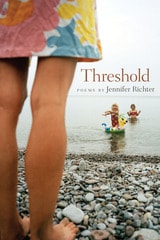
Threshold
Jennifer Richter
Southern Illinois University Press, 2010
Jennifer Richter presents a series of poems that explore the many facets of the term "threshold." Throughout the collection, the narrator experiences several acts of threshing, or separating—from birth and the small yet profound distances that part a mother and child, to the separation caused by illness and its toll on relationships. At the same time, she is progressively gathering, piecing together the remnants of her life, collecting her children into her arms, and welcoming a future without pain. Pain is often present in these poems, as the narrator frequently confronts her own threshold for enduring a ravaging illness. Her harrowing struggle through recovery is chronicled by a poem at the end of each section, tracing her powerful journey from deep suffering to a fragile yet steadfast sense of hope.
These gripping lyric and prose poems explore duality in its many forms: the private, contemplative world versus a world of action; the mirror sides of health and sickness; the warmth of a June sun and the deep, long nights of winter; mother and child; collecting and letting go. From the comfort of a morning bed at home to the desperate streets of Hanoi, Threshold is a searing portrait of healing, the courage it takes to bridge the gulfs that divide, and the wonder of the ties that bind.
What Is My Body Without You?
My son’s pajamas unsnapped
on the floor: small husk
of his body relaxing on its back,
legs and sleeves still filled
with his rush. This part of him
hasn’t outgrown my arms
and sometimes lets me lift
him up our steep stairs,
carry him to bed and pull
his shade against the gray
thin winter sky like milk
my daughter wakes up wanting.
In the last days of lifting her
to my breast, I fill her less
than the air already gone
from my son’s flat shape.
Twice like that I have lain back,
the doctor opening me
along the same clean seam.
Each time I was watching:
with a few tugs the child
was out, naked and heading
toward other hands, each child
cut loose before I knew it.
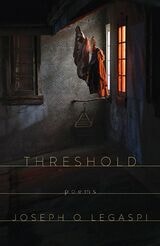
Threshold
Joseph O. Legaspi
CavanKerry Press, 2017
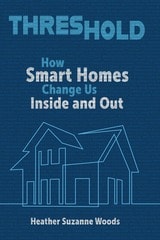
Threshold
How Smart Homes Change Us Inside and OutHeather Suzanne Woods
University of Alabama Press, 2024
An urgent and cautionary examination of the totalizing effect of smart home technology on the lives of those who live in them—and those who don’t
Smart homes are here—domestic spaces bristling with networked technologies that appear to enhance work, entertainment, logistics, health, and security. But these technologies may also extract a cost in attention, money, and privacy. In Threshold, communication and technology expert Heather Suzanne Woods applies rhetorical theory to answer the urgent question of how swiftly proliferating smart homes alter those who inhabit them.
Building on extensive research into smart homes in the United States, Woods recounts how smart homes arose and predicts the trajectory of their future form. She pulls back the curtain on the technology, probes who is in control, and questions whether a home can be too smart. She reveals how smart homes incentivize ubiquitous computing as a daily practice, priming smart home occupants for permanent transactional existence largely controlled by corporate interests.
Woods suggests a dynamic cultural framework for understanding smart homes that takes into account sociotechnical variables such as gender, class, income, race, criminal justice, and more through which smart homes shape human life. Woods’s framework reveals how smart homes both reflect social norms about technology as well as whet consumer appetites for an ever more totalizing relationship with technology. She argues that this progression leads to “living in digitality,” a cultural state of constant use and reliance on technology.
Written for homeowners, policymakers, technology enthusiasts, and scholars, Threshold interweaves meticulously researched critical analysis with matter-of-fact graphics that map relationships between digital tools and social life. Readers will appreciate this bracing assessment of smart technologies that empowers smart home users to make informed decisions about their dwellings.

Two NATO Allies at the Threshold of War
Parker T. Hart
Duke University Press, 1990
Hart has relied on his own papers from the period, as well as on United Nations sources from the Lyndon B. Johnson Presidential Library, and on the papers of the other key participants in the Crisis, Ambassador to Greece Phillips Talbot, Ambassador to Cyprus Taylor G. Belcher, and Cyrus Vance, to provide a rare play-by-play analysis of the crisis and its resolution.