Results by title

27 books match the query 'Theological anthropology'
cover of A Thomistic Introduction to Modern Psychology

A Thomistic Introduction to Modern Psychology

Leslie Kelley

Catholic University of America Press, 2026
Modern psychology has garnered an abundance of data, but how do the dis­crete studies of psychology fit together into a clear picture of the human person. Chesterton quips, “. . . what is pompously called induction is simply collecting more of the data. And Aristotle or Aquinas, or anybody in his five wits, would of course agree that the conclusion could only be true if the premises were true; and that the more true premises there were the better.” A Thomistic philosophical framework can provide important insights into the meaning and value of modern psychological theories and research. Thomistic anthropology allows us to develop a holistic vision of the human person, avoiding the modern tendencies toward determinism and reductionism. St. Thomas provides clear direction regarding the role and purpose of man’s var­ious powers, and using a Thomistic philosophical framework allows for ob­jectivity in our understanding of human adaptive and dysfunctional behavior, and helps to specify the unique and unified roles of body and mind. The place of psychology, in relation to philosophy and the natural sciences has been unclear throughout psychology’s short history, and Thomistic distinctions can clarify the distinctive position of psychology. In addition to describing Thomistic anthropology as a framework for modern psychology, Leslie Kelly also demonstrates examples of evidence from the social sciences that supports the Thomistic view of the human person. And last of all, a Thomistic frame­work allows investigators of psychology to develop a teleological perspective, so as to see the results of modern research in relation to the final end of the human person. Whether you are academically seasoned or a beginner, you will enjoy this fresh take on modern psychology through the perspective of St. Thomas.
[more]
cover of Adam's Sin, Our Humanity, and Christ's Redemption in Cyril of Alexandria: An Eastern Christian Theological Anthropology

Adam's Sin, Our Humanity, and Christ's Redemption in Cyril of Alexandria

An Eastern Christian Theological Anthropology

Anthony Bibawy

Catholic University of America Press, 2026
As a result of the neo-patristic movement of the early twentieth century, the teachings of original sin and atonement as understood in the West were questioned and reformulated based on what was believed to be early Eastern Christian patristic thought. This new paradigm proposed that humanity inherited death and corruption, but not sin, from Adam and that the purpose of the incarnation and salvific work of Christ was to restore humanity from death and corruption, but not an inherent sinfulness. In contrast to this popular and seemingly dogmatic paradigm and false dichotomy between Western and Eastern teaching on sin and redemption, this book proposes that the writings of many Eastern fathers of the early fifth century incorporate many, if not the majority, of the terms and teachings behind what have been labeled as Western departures concerning the relationship between Adam’s sin, humanity, and its redemption in Christ. Through a comprehensive analysis of the writings of Cyril of Alexandria and some of his contemporaries in the early fifth century East during the time of the Pelagian controversy, this book demonstrates that a central and consistent theme of their soteriology revolves around the sinfulness and guilt of all humanity that is rooted in Adam’s sin and is resolved only through recapitulation into the new root, the second Adam, the impeccable Christ. Christ’s impeccability is necessary to correct the state of sinfulness and guilt in humanity through his incarnation and spotless sacrifice on the cross as a ransom and substitute on behalf of and in exchange of all to satisfy the divine justice and to restore humanity to its original state in the divine image.
[more]
cover of An Ocean Full of Angels: The Autobiography of 'Isa Ben Adam

An Ocean Full of Angels

The Autobiography of 'Isa Ben Adam

Peter Kreeft

St. Augustine's Press, 2011
[more]
cover of Aquinas and the Theology of the Body

Aquinas and the Theology of the Body

Thomas Petri

Catholic University of America Press, 2016
Pope John Paul's Theology of the Body catecheses has garnered tremendous popularity in theological and catechetical circles. Students of the Theology of the Body have generally interpreted it as innovative not only in its presentation of the Church's teaching on marriage and sexuality, but also as radically advancing that teaching. Aquinas and the Theology of the Body offers a somewhat different interpretation. Fr. Thomas Petri argues that the philosophy and theology of Thomas Aquinas substantially contributed to John Paul's intellectual formation, which he never abandoned. A correct interpretation of the Theology of the Body requires, therefore, a thorough understanding of Thomistic anthropology and theology, which has been mostly lacking in commentaries on the pope's important contributions on the subject of marriage and sexuality.
[more]
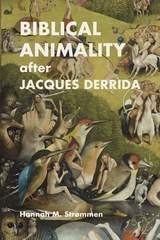
cover of Biblical Animality after Jacques Derrida

Biblical Animality after Jacques Derrida

Hannah M. Strømmen

SBL Press, 2018

A new theoretical and exegetical angle on the Bible and animal studies

According to Genesis, humans are made in God's image but animals are not. Hannah M. Strømmen challenges this view by critiquing the boundary between humans and animals in the Bible through the work of philosopher Jacques Derrida. Building on Derrida's The Animal That Therefore I Am, Strømmen brings to light significant moments where the lines between the divine, human, and animal are ambiguous in a rich range of biblical texts, from Noah as the first carnivorous man in Genesis 9 to Revelation's beasts.

Features

  • A contribution to research on Jacques Derrida and deconstruction
  • An examination of Derrida's work on the human/animal boundary
  • Critical engagement with the way the Bible is frequently held up as a point of blame for anthropocentrism
[more]
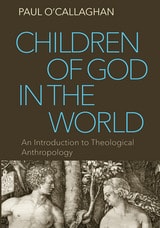
cover of Children of God in the World

Children of God in the World

Paul O'Callaghan

Catholic University of America Press, 2016
Children of God in the World is a textbook of theological anthropology structured in four parts. The first attempts to clarify the relationship between theology, philosophy and science in their respective approaches to anthropology, and establishes the fundamental principle of the text, stated in Vatican II's Gaudium et spes, n. 22, "Christ manifests man to man." The second part provides a historical overview of the doctrine of grace: in Scripture (especially the teaching of the book of Genesis on humans 'made in the image of God', as well as Paul and John), among the Fathers (in particular the oriental doctrine of 'divinization' and Augustine), during the Middle Ages (especially Thomas Aquinas) and the Reformation period (centered particularly on Luther and the Council of Trent), right up to modern times. The third part of the text, the central one, provides a systematic understanding of Christian grace in terms of the God's life present in human believers by which they become children of God, disciples, friends and brothers of Christ, temples of the Holy Spirit. This section also provides a reflection on the theological virtues (faith, hope and charity), on the relationship between grace and human freedom, on the role of the Church and Christian apostolate in the communication of grace, and on the need humans have for divine grace. After considering the relationship between the natural and the supernatural order, the fourth and last part deals with different philosophical aspects of the human condition, in the light of Christian faith: the union between body and soul, humans as free, historical, social, sexual and working beings. The last chapter concludes with a consideration of the human person, Christianity's greatest and most enduring contribution to human thought.
[more]
cover of Christian faith & human understanding: studies on the Eucharist, Trinity, and the human person

Christian faith & human understanding

studies on the Eucharist, Trinity, and the human person

Robert Sokolowski

Catholic University of America Press, 2006
In this collection of essays, renowned philosopher Robert Sokolowski illustrates how Christian faith is not an alternative to reason, but rather an enhancement of it.
[more]
cover of Habits and Holiness: Ethics, Theology, and Biopsychology

Habits and Holiness

Ethics, Theology, and Biopsychology

Ezra, OP Sullivan

Catholic University of America Press, 2021
The topic of habitus is one of Thomas Aquinas’s greatest contributions to moral theology, but it has been generally neglected in theological scholarship until now. Habits and Holiness is the first work in English to explore Aquinas’s rich theology of habit in all of its grandeur and depth. Habits and Holiness shows that most facets of human life and behavior are greatly influenced by habits, which Thomas appraises as an analogous concept that is much broader than previous scholarship has recognized. Habits and Holiness accomplishes three tasks. First, it gives a complete and coherent account of Aquinas’s account of habitus. Most accounts of Aquinas’s view of habitus focus almost exclusively on “Treatise on Habits” in the Summa Theologiae I-II, qq. 49-54, and speak of habitus in reference to the virtues. However, Aquinas speaks of habitus in many other places, especially his commentaries on Aristotle’s works and his commentaries on Sacred Scripture. Aquinas employs the concept of habitus to explain a wide variety of human inclinations, such as instincts, personal and societal custom, acquired skills and virtues, original sin, grace, infused virtues, and Gifts of the Holy Spirit. Second, this book indicates how biological psychology illuminates and enriches Aquinas’s account of habit, and vice versa. Finally, Habits and Holiness provides readers with a framework for interpreting and utilizing the vast amount of practical habit literature that exists: it offers a practical analysis of habit development found in Aquinas’s works and those of empirical studies. The topic of habits is a golden thread that helps readers find their way through Aquinas’s extensive writings on morals. By describing the many kinds of habits we possess, and their widespread but often hidden effects in our lives, this book offers a new and unique reevaluation of many issues central to the moral life. It addresses childhood development, pagan virtue, akrasia, circumstances that limit free choice, how heroic virtue operates, and more. By seeing habits in general as a prism for understanding human action and its influences, Habits and Holiness provides a unique and appealing synthesis of Thomistic virtue theory, the contemporary science of habits, and best practices for eliminating bad habits and living good habits.
[more]
cover of Human Nature in Its Wholeness: A Roman Catholic Perspective

Human Nature in Its Wholeness

A Roman Catholic Perspective

Daniel N. Robinson

Catholic University of America Press, 2006
[more]
cover of Human Nature: Reflections on the Integration of Psychology and Christianity

Human Nature

Reflections on the Integration of Psychology and Christianity

Malcolm Jeeves

Templeton Press, 2006

College and university professors have been demanding that this book, out of print for several years, be made available again, as it is unique in its field. This new edition, which includes a new preface and guidance to current literature, offers a balanced study of the implications of scientific developments in psychology and neuroscience for traditional Christian beliefs.

Malcolm Jeeves, former editor-in-chief of Neuropsychologia, a leading international scientific journal in behavioral and cognitive neuroscience, explores the intersection of science and faith in defining what it means to be human. He reports on recent scientific research on consciousness and the link between mind, brain, and behavior. He examines issues such as determinism by indicating the possible relevance of chaos theory to enduring concerns about freedom and responsibility. He looks at similarities and differences between human nature and animal nature. He reexamines traditional dualist views of soul and body in the light of contemporary research on mind and brain and argues for a wholistic model. This leads to addressing questions such as: does spiritual awareness depend on the intactness of our brains or does spirituality stand apart from our biological substrate?

Jeeves' insightful analysis of the ways recent findings in psychology relate to certain Christian beliefs about people expands the global science religion dialogue.
[more]
cover of Imago Dei

Imago Dei

Thomas Albert Howard

Catholic University of America Press, 2013
Imago Dei will serve as an indispensable resource for those wishing to deepen their grasp of the theological bases for Christian views of human dignity, as well as for those who believe that Christ's words "that they be one" (John 17:21) remain a theological imperative today
[more]
cover of Incarnation: A Philosophy of Flesh

Incarnation

A Philosophy of Flesh

Michel Henry; Translated from the French by Karl Hefty

Northwestern University Press, 2015

In his book Incarnation: A Philosophy of the Flesh, Michel Henry starts with the opposition of the sensible and living flesh, as we experience it permanently from the inside, to our inert and material body, as we can see it from the outside, similar to the other objects we can find in the world. The flesh doesn’t fit at all in his terminology with the soft part of our material and objective body, by opposition to the bones for example, but to what he called in his previous books our subjective body. For Michel Henry, an object doesn’t possess interiority, it is not living, it doesn’t feel itself and doesn’t feel that it is touched; it doesn’t do the subjective experience of being touched.

After having placed the difficult problem of the incarnation in an historical perspective going back to the thought of the Fathers of the Church, he makes in this book a critical review of the phenomenological tradition that leads to the reversal of phenomenology. He then proposes to elaborate a phenomenology of the flesh which leads to the notion of a not constituted original flesh given in the "Arch-revelation" of Life, as well as a phenomenology of Incarnation.

Although the flesh is traditionally understood as the place of sin, it is also in Christianity the place of salvation, which consists in the deification of man, that’s to say in the fact of becoming Son of God, to come back to the eternal and absolute Life we had forgotten getting lost in the world, caring only about things and ourselves. In the fault, we make the tragic experience of our powerlessness to do the good we would like to do and of our inability to avoid the evil. In this way in front of the magic body of the other, that’s the anguished desire to meet the life in it that leads to the fault. In the night of the lovers, the sexual act couples two impulsive movements, but the erotic desire fails to reach the pleasure of the other where it is experienced, in a total loving fusion. The erotic relation is however doubled by a pure affective relation, foreign to the carnal coupling, a relation made of mutual gratitude or of love. That’s this affective dimension that is denied in this way of violence that is pornography, which extracts the erotic relation from the pathos of life to abandon it to the world, and which consists in a real profanation of life.
[more]
cover of Intersexual Persons and Theology of the Body: A Limit Case for John Paul II's Theological Anthropology

Intersexual Persons and Theology of the Body

A Limit Case for John Paul II's Theological Anthropology

Beth Zagrobelny Lofgren

Catholic University of America Press, 2026

Intersexual Persons and Theology of the Body offers an interpretation of John Paul II’s theology of the body that demonstrates how it can encompass intersexual bodies. Intersexuality has been used to challenge binary anthropologies, such as the late pope’s. Beth Zagrobelny Lofgren theorizes that John Paul II’s anthropology answers the “frequency dilemma,” by learning from male and female bodies while respecting the humanity of people with ambiguous bodies. To argue this, Intersexual Persons and Theology of the Body offers biological, psychological, and theological literature on intersexuality (focusing on the anthropologies of Susannah Cornwall and Megan DeFranza), followed by the late pope’s anthropology (focusing on original solitude, the spousal meaning of the body, and the semiotic meanings of the body). This volume demonstrate that intersexual bodies have a spousal meaning, although obscured, and use original solitude to show that John Paul II attributes to the human body meaning not dependent on sexual difference: the first man learns from his solitary body that he is relational. This relationality is fundamental to the imago Dei and undergirds the imago Dei found in communion. Intersexual bodies share human nature and thus the bodily call to relationship. Finally, Lofgren argues that John Paul II’s eschatology involves a transformation of humankind that fulfills the semiotic value of the body. The sign gives way to the mystery: the person fully realized as self-gift. Because the mystery does not depend on the sign, this vision includes intersexual bodies. This discussion leads to a brief consideration of celibacy and marriage for persons with intersexual conditions. This is currently the only application of John Paul II’s theology of the body to these complex situations.
[more]
cover of John Paul II on the Vulnerable

John Paul II on the Vulnerable

Jeffrey Tranzillo

Catholic University of America Press, 2013
In John Paul II on the Vulnerable, Jeffrey Tranzillo provides a lucid introduction to John Paul II's philosophical and theological understanding of the human person.
[more]
cover of Maimonides and Spinoza: Their Conflicting Views of Human Nature

Maimonides and Spinoza

Their Conflicting Views of Human Nature

Joshua Parens

University of Chicago Press, 2012

Until the last century, it was generally agreed that Maimonides was a great defender of Judaism, and Spinoza—as an Enlightenment advocate for secularization—among its key opponents. However, a new scholarly consensus has recently emerged that the teachings of the two philosophers were in fact much closer than was previously thought. In his perceptive new book, Joshua Parens sets out to challenge the now predominant view of Maimonides as a protomodern forerunner to Spinoza—and to show that a chief reason to read Maimonides is in fact to gain distance from our progressively secularized worldview.
Turning the focus from Spinoza’s oft-analyzed Theologico-Political Treatise, this book has at its heart a nuanced analysis of his theory of human nature in the Ethics. Viewing this work in contrast to Maimonides’s Guide of the Perplexed, it makes clear that Spinoza can no longer be thought of as the founder of modern Jewish identity, nor should Maimonides be thought of as having paved the way for a modern secular worldview. Maimonides and Spinoza dramatically revises our understanding of both philosophers.
[more]
cover of Personalist Papers

Personalist Papers

John F. Crosby

Catholic University of America Press, 2004
In Personalist Papers, John F. Crosby continues the discussion of Christian personalism begun in his highly acclaimed book, The Selfhood of the Human Person.
[more]
cover of Religious Affects: Animality, Evolution, and Power

Religious Affects

Animality, Evolution, and Power

Donovan O. Schaefer

Duke University Press, 2015
In Religious Affects Donovan O. Schaefer challenges the notion that religion is inextricably linked to language and belief, proposing instead that it is primarily driven by affects. Drawing on affect theory, evolutionary biology, and poststructuralist theory, Schaefer builds on the recent materialist shift in religious studies to relocate religious practices in the affective realm—an insight that helps us better understand how religion is lived in conjunction with systems of power. To demonstrate religion's animality and how it works affectively, Schaefer turns to a series of case studies, including the documentary Jesus Camp and contemporary American Islamophobia. Placing affect theory in conversation with post-Darwinian evolutionary theory, Schaefer explores the extent to which nonhuman animals have the capacity to practice religion, linking human forms of religion and power through a new analysis of the chimpanzee waterfall dance as observed by Jane Goodall. In this compelling case for the use of affect theory in religious studies, Schaefer provides a new model for mapping relations between religion, politics, species, globalization, secularism, race, and ethics.
 
[more]
cover of Revelations of Humanity: Anthropological Dimensions of Theological Controversies

Revelations of Humanity

Anthropological Dimensions of Theological Controversies

Richard Schenk, OP

Catholic University of America Press, 2022
Revelations of Humanity brings together essays into the history and actuality of how our searches for God and for our own humanity are interwoven. They argue that the revelation of God is possible only when accompanied by a revelation of what it means to be a human being. Revelation implies that the truth is not fully evident in either case. This quest is aided in many of the essays by a recollection of the thought of Thomas Aquinas. As opposed to simple memory, recollection implies that memory has been lost or become clouded, here by the misrepresentation of Thomas’ view of humanity’s relation to God as harmonistic, at best semi-Pelagian, often even naturalistic. This difficult recovery is made possible by historical research that alone can escape the easy systematic alienation that supporters and critics of Thomas have often brought to their interpretation of his works. Thomas’s sense of a real but finite capacity of human beings for God, his grace and revelation, anticipates in more ways than is commonly known much of contemporary suspicion about human capacities, but in ways that are open to God. That programmatic insight into the historical Thomas, keenly aware of human entanglements, limits and hopes, offers on many contemporary issues a ressourcement of systematic thought. Revelations of Humanity revolves around three clusters of issues. The first asks about the reality and limits of the human capacity for truth: in metaphysical, moral and political matters and in relation to the disputed issues of analogous reason and faith. The second cluster is structured around the four involvements that the Second Vatican Council identified as the human face of genuine Christian existence: participation in the legitimate joys, hopes, sorrows and fears of the contemporary world. These are refracted in the broken light of the human proprium of risibility, the abiding uncertainty addressed by hope, the disputed question of a suffering God and the recollection of Christ’s anxiety in the face of death. The final cluster brings together anthropological dimensions of current ecumenical and interreligious disputes: the need to complement affirmation with admonition in ecumenical conversation, exemplified by the ambivalence towards sacrifice in a genuinely Catholic theology and the need to avoid the excesses of univocity, equivocity or an all too facile analogy in the determination of interreligious relationalities.
[more]
cover of The Augustinian Person

The Augustinian Person

Peter Burnell

Catholic University of America Press, 2005
Through careful analysis of Augustine's writings, Burnell concludes that Augustine conceives of human nature as a unity at every level--socially, morally, and in basic constitution--despite very common objections that he fails to achieve such a conception
[more]
cover of The Complementarity of Women and Men: Philosophy, Theology, Psychology, and Art

The Complementarity of Women and Men

Philosophy, Theology, Psychology, and Art

Paul C. Vitz

Catholic University of America Press, 2021
The Complementarity of Women and Men provides a Catholic Christian case that men and women are in certain respects quite different but also have a positive, synergistic complementary relationship. Although differences and their mutually supporting relationships are focused on throughout the volume, men and women are assumed to have equal dignity and value. This underlying interpretation comes from the familiar, basic theological position in Genesis that both sexes were made in the image of God. After a cogent philosophical introduction to complementary differences by J. Budziszewski, this position is developed from theological, philosophical, and historical perspectives by Sr. Prudence Allen. Next Deborah Savage, building upon the writings of St. John Paul II, gives a strong theological basis for complementarity. This is followed by Elizabeth Lev’s chapter presenting new and surprising art history evidence from the paintings of Michelangelo in the Sistine Chapel supporting the complementarity interpretation. A final chapter by Paul Vitz documents and summarizes the scientific evidence supporting sexual difference and complementarity in the disciplines of psychology and neuroscience. As a consequence of both the individual chapters and the integrated understanding they present The Complementarity of Women and Men is a significant contribution to the important, complex, contemporary debate about men, women, sex, and gender.
[more]
cover of The Enlightenment and Original Sin

The Enlightenment and Original Sin

Matthew Kadane

University of Chicago Press, 2024

An eloquent microhistory that argues for the centrality of the doctrine of original sin to the Enlightenment.
 
What was the Enlightenment? This question has been endlessly debated. In The Enlightenment and Original Sin, historian Matthew Kadane advances the bold claim that the Enlightenment is best defined through what it set out to accomplish, which was nothing short of rethinking the meaning of human nature.
 
Kadane argues that this project centered around the doctrine of original sin and, ultimately, its rejection, signaling the radical notion that an inherently flawed nature can be overcome by human means. Kadane explores this and other wide-ranging themes through the story of a previously unknown figure, Pentecost Barker, an eighteenth-century purser and wine merchant. By examining Barker’s personal diary and extensive correspondence with a Unitarian minister, Kadane tracks the transformation of Barker’s consciousness from a Puritan to an Enlightenment outlook, revealing through one man’s journey the large-scale shifts in self-understanding whose philosophical reverberations have shaped debates on human nature for centuries.
[more]
cover of The Human Person

The Human Person

Steven J. Jensen

Catholic University of America Press, 2018
The Human Person presents a brief introduction to the human mind, the soul, immortality, and free will. While delving into the thought of Thomas Aquinas, it addresses contemporary topics, such as skepticism, mechanism, animal language research, and determinism. Steven J. Jensen probes the primal questions of human nature. Are human beings free or determined? Is the capacity to reason distinctive to human beings or do animals also have some share of reason? Have animals really been taught to use language?
[more]
cover of The Indiscrete Image: Infinitude and Creation of the Human

The Indiscrete Image

Infinitude and Creation of the Human

Thomas A. Carlson

University of Chicago Press, 2008

Humanity’s creative capacity has never been more unsettling than it is at our current moment, when it has ushered us into new technological worlds that challenge the very definition of “the human.” Those anxious to safeguard the human against techno-scientific threats often appeal to religious traditions to protect the place and dignity of the human. But how well do we understand both theological tradition and today’s technological culture? In The Indiscrete Image, Thomas A. Carlson challenges our common ideas about both, arguing instead that it may be humanity’s final lack of definition that first enables, and calls for, human creativity and its correlates—including technology, tradition, and their inextricable interplay within religious existence.
Framed in response to Martin Heidegger’s influential account of the relation between technological modernity and theological tradition, The Indiscrete Image builds an understanding of creativity as conditioned by insurmountable unknowing and incalculable possibility through alternative readings of Christian theological tradition and technological culture—and the surprising resonance between these two. Carlson concludes that the always ongoing work of world creation, tied essentially to human self-creation, implies neither an idol’s closure nor an icon’s transcendence, but the “indiscrete image” whose love makes possible—by keeping open—both the human and its world.
[more]
cover of The Irreducibility of the Human Person: A Catholic Synthesis

The Irreducibility of the Human Person

A Catholic Synthesis

Mark K. Spencer

Catholic University of America Press, 2022
Catholic philosophical anthropologists have defended views of the human person on which we are irreducible to anything non-personal. For example, it is not the case that we are nothing but matter, souls, or parts of society. But many Catholic anthropologies have overlooked ways in which we are irreducible and so have not given an adequate account of the uniqueness of each human person. This book presents a philosophical portrait of human persons that depicts each way in which we are irreducible, with the goal of guiding the reader to perceive, wonder at, and love all the unique features of human persons. It builds this portrait by showing how claims from many strands of the Catholic tradition can be synthesized. These strands include Thomism, Scotism, phenomenology, personalism, nouvelle théologie, analytic philosophy, and Greek and Russian thought. The book focuses on how these traditions’ claims are grounded in experience and on how they help us to perceive irreducible features of persons. While many metaphysical claims about persons are defended, the picture of persons that ultimately emerges is one on which persons are best grasped not through abstract concepts but through aesthetic perception and love, as unique kinds of beauty. This book also explores irreducible features of our subjectivity, senses, intellect, freedom, and affections, and of our souls, bodies, and activities. It includes discussions of divine simplicity and causality, and of the nature of angels, matter, organisms, and artifacts, all of which must be understood to fully grasp our irreducibility. In showing how to synthesize various traditions’ claims, the book also offers new solutions to a number of debates in Catholic philosophy. These include debates over natural law, the natural desire to see God, the separated soul, integralism and personalism, idealist and realist phenomenology, and scholastic accounts of the act of existence.
[more]
cover of The New Gods

The New Gods

E. M. Cioran

University of Chicago Press, 1974
Dubbed “Nietzsche without his hammer” by literary critic James Wood, the Romanian philosopher E. M. Cioran is known as much for his profound pessimism and fatalistic approach as for the lyrical, raging prose with which he communicates them. Unlike many of his other works, such as On the Heights of Despair and Tears and Saints, The New Gods eschews his usual aphoristic approach in favor of more extensive and analytic essays.
 
Returning to many of Cioran’s favorite themes, The New Gods explores humanity’s attachment to gods, death, fear, and infirmity, in essays that vary widely in form and approach. In “Paleontology” Cioran describes a visit to a museum, finding the relatively pedestrian destination rife with decay, death, and human weakness. In another chapter, Cioran explores suicide in shorter, impressionistic bursts, while “The Demiurge” is a shambolic exploration of man’s relationship with good, evil, and God. All the while, The New Gods reaffirms Cioran’s belief in “lucid despair,” and his own signature mixture of pessimism and skepticism in language that never fails to be a pleasure. Perhaps his prose itself is an argument against Cioran’s near-nihilism: there is beauty in his books.

[more]
cover of The Quest for God and the Good Life

The Quest for God and the Good Life

Mark T. Miller

Catholic University of America Press, 2013
Throughout this introductory text, progress, decline, and redemption constitute a systematic framework for examining the central terms of Catholic theology, as well as key notions in Lonergan's theology. The book provides a firm foundation for students of Lonergan as well as anyone interested in understanding Catholic theology and applying it to ministry, education, and other fields.
[more]
cover of Treatise on Human Nature: The Complete Text (Summa Theologiae I, Questions 75-102)

Treatise on Human Nature

The Complete Text (Summa Theologiae I, Questions 75-102)

Thomas Aquinas

St. Augustine's Press, 2010

St. Thomas Aquinas’s Treatise on Human Nature occupies questions 75-102 of Part 1 of the Summa Theologiae. It contains St. Thomas’s most mature statement of his philosophical and theological anthropology, i.e., his account of what human beings are and of their origin as distinctive creatures made in the image of God. This translation, moreover, is the only complete edition of all the material St. Thomas envisaged as being part of the Treatise.

The treatise begins with two long and complex questions on the metaphysical status of the human soul and its relation to the human organism. Here St. Thomas tries to show how the human being is both an animal and an animal who transcend the other animals. In doing so he marks out a distinctive Christian/Aristotelian conceptual space between “materialist” accounts of human nature that reduce human beings to mere collections of physical or chemical or biological components and “dualistic” accounts of human nature, such as those propounded by Plato and, later on, Descartes, that identify human beings with their immaterial souls.

The next thirteen questions deal with the powers of the soul, especially those higher intellective powers of understanding and willing that distinguish human beings from the other animals. Here we are given a philosophical framework for the findings of the human sciences.

Finally, the last thirteen questions have to do with human origins, the creation of the first man and first woman, the state of our first parents, and their status as beings created in the image of God. In essence, this is St. Thomas’s philosophically attuned commentary on the parts of Genesis 1–2 that deal specifically with the creation of the human species. These thirteen questions, though an integral part of the Treatise, are not included in other translations of the Treatise on Human Nature.

[more]