Results by title

46 books match the query 'Theology, Doctrinal'
cover of A Basic Christian Theology

A Basic Christian Theology

A. J. Conyers

St. Augustine's Press, 2019

A. J. Conyers was an evangelical, Baptist theologian who helped found Truett Seminary at Baylor university. Conyers’s theology drank deeply from the wells of the Christian tradition. In this volume, he provides what he found to be the most basic elements of Christian theology and demonstrates a methodology that is biblically informed, traditionally grounded, and contextually aware. this revised edition makes this excellent work available again, with some modified study questions, additional unpublished material from Conyers’s archives, and helpful reflection and tributes from two of Conyers’s best students—Brian Brewer and Brad Green—who carry on his legacy
[more]
cover of Amen

Amen

Patrick J. Ryan SJ

Catholic University of America Press, 2018
Amen: Jews, Christians, and Muslims Keep Faith with God examines faith as it is understood by Jews, Christians and Muslims; it does not aim to be a work of systematic theology or a lengthy explication of the contents of different faith traditions. It offers Jews, Christians and Muslims several approaches to faith as a category of human experience open to God: a faithful God who reaches out to grasp the faithful human being at the same time that the faithful human being reaches out to grasp a faithful God. This two-sided faith, divine and human, lies at the center of each faith tradition. The book examines faith as one might examine a gem, gazing at different facets in turn.
[more]
cover of Aquinas's Summa: background, structure, & reception

Aquinas's Summa

background, structure, & reception

Jean-Pierre Torrell

Catholic University of America Press, 2005
In this concise new volume by the acclaimed author of the biography of Saint Thomas Aquinas, Jean-Pierre Torrell brings his expertise to bear on Aquinas's Summa Theologiae.
[more]
cover of Blessed Rage for Order: The New Pluralism in Theology

Blessed Rage for Order

The New Pluralism in Theology

David Tracy

University of Chicago Press, 1995
In Blessed Rage for Order, David Tracy examines the cultural context in which theological pluralism emerged. Analyzing orthodox, liberal, neo-orthodox, and radical models of theology, Tracy formulates a new 'revisionist' model. He considers which methods promise the most certain results for a revisionist theology and applies his model to the principal questions in contemporary theology, including the meanings of religion, theism, and of christology.
[more]
cover of Catholic Dogmatic Theology: A Synthesis: Book 1, On the Trinitarian Mystery of God

Catholic Dogmatic Theology

A Synthesis: Book 1, On the Trinitarian Mystery of God

Jean Herve Nicolas, OP

Catholic University of America Press, 2021
Every discipline, including theology, requires a synthetic overview of its acquisitions and open questions, a kind of “topography” to guide the new student and refresh the gaze of specialists. In his Synthèse dogmatique, Fr. Jean-Hervé Nicolas, OP (1910-2001) presents just such a map of Thomistic theology, focusing on the central topics of Dogmatic Theology: The One and Triune God, Christology, Mariology, Ecclesiology, the Sacraments, and the Last Things. Drawing on decades of research and teaching, Fr. Nicolas synthetically presents these topics from a faithfully Thomistic perspective. While broadly and genially engaging the theological literature of the 20th century, he nonetheless remains deeply indebted to the Thomistic school that would have formed him in his youth as a theologian. This provides the reader with an unparalleled theological vision, masterfully bringing forth, at once, what is new and what is classical. Catholic Theology: A Dogmatic Synthesis will be published in English as a multi-volume work. In this volume, Fr. Nicolas discusses the nature of theological science and the mystery of the Triune God. At once historically-informed and speculatively-detailed, this volume carefully introduces the reader to classical Thomistic positions concerning the theological articulation of the Trinitarian mystery, including the topic of the divine missions, that is, the sending of the Son and the Spirit in the economy of salvation, thereby providing an important connection between the dogmatic portion of theology and its spiritual / moral concerns. Given the central luminosity of the Trinitarian mystery in the life of faith and in theology, this volume is a pivotal chapter in theological reflection. Indeed, objectively speaking, it is the most important discussion in all of theology. Serving as a professor for decades, including at the University of Fribourg, Fr. Nicolas was at once a profound scholar and a masterful pedagogue. Gathering the work of a lifetime into a single pedagogical narrative, Fr. Nicolas’s Catholic Theology: A Dogmatic Synthesis provides a resource for students and scholars alike. In view of the hyper-specialization of theology today, this series of volumes provides readers with a synthetic and sapiential overview of the fundamentals of dogmatic theology from a robust and profound Thomistic perspective.
[more]
cover of Christ and Spirituality in St. Thomas Aquinas

Christ and Spirituality in St. Thomas Aquinas

Jean-Pierre Torrell

Catholic University of America Press, 2011
The studies in this volume investigate themes of particular spiritual relevance in Aquinas's theology: friendship, charity, prayer, configuration to Christ, priesthood, preaching.
[more]
cover of Continuing the Reformation: Essays on Modern Religious Thought

Continuing the Reformation

Essays on Modern Religious Thought

B. A. Gerrish

University of Chicago Press, 1993

Modern Christian religious thought, B. A. Gerrish argues, has constantly revised the inherited faith. In these twelve essays, written or published in the 1980s, one of the most distinguished historical theologians of our time examines the changes that occurred as the Catholic tradition gave way to the Reformation and an interest in the phenomenon of believing replaced adherence to unchanging dogma.

Gerrish devotes three essays to each of four topics: Martin Luther and the Reformation; religious belief and the Age of Reason; Friedrich Schleiermacher and the renewal of Protestant theology; and Schleiermacher's disciple Ernst Troeltsch, for whom the theological task was to give a rigorous account of the faith prevailing in a particular religious community at a particular time. Gerrish shows how faith itself has become a primary object of inquiry, not only in the newly emerging philosophy of religion but also in a new style of church theology which no longer assumes that faith rests on immutable dogmas. For Gerrish, the new theology of Protestant liberalism takes for its primary object of inquiry the changing forms of the religious life. This important book will interest scholars of systematic Christian theology, modern intellectual and cultural history, and the history and philosophy of religion.
[more]
cover of Early Syriac Theology

Early Syriac Theology

Chorbishop Seely Joseph Beggiani

Catholic University of America Press, 2014
Presents the insights of St. Ephrem and Jacob of Serugh, two of the earliest representatives of the theological world-view of the Syriac church.
[more]
cover of Eric Voegelin and the Problem of Christian Political Order

Eric Voegelin and the Problem of Christian Political Order

Jeffrey C. Herndon

University of Missouri Press, 2007

  Although some critics of Eric Voegelin’s later work have faulted his failure to deal with the historical Jesus and to address the implications of Christianity for social and political life, the recent publication of Voegelin’s History of Political Ideas has allowed a more complete assessment of his position regarding the Christian political order. This book addresses that criticism through an analysis of Voegelin’s early work.

            In Eric Voegelin and the Problem of Christian Political Order, Jeffrey C. Herndon analyzes the development of Voegelin’s thought regarding the origins of Christianity in the person of Jesus, the development of the church in the works of Paul, and the relationship between an immanent institutional order symbolizing the divine presence and the struggle for social and political order. Focusing on the tension between a spiritual phenomenon based on Pauline faith and the institutionalization of that experience in the church, Herndon offers one of the first examinations of the relationship of the History of Political Ideas to Voegelin’s larger body of work.

            In his wide-ranging study, Herndon explores Voegelin’s examination of the problem of Christian political order from the inception of Christianity through the Great Reformation. He also presents a clarification of Voegelin’s theory of civilizational foundation and of Voegelin’s philosophy of history with regard to Christianity and Western political order.

            Herndon addresses not only the nagging problem in Voegelin scholarship regarding his relationship with the historical Jesus but also the “Pauline compromises with the world” that enabled Christianity to become the instrument by which the West was civilized. He also shows that Voegelin’s interpretation of the historical pressures released by the Great Reformation is important to an understanding of his later work regarding the negative effect of Christian symbols in the creation of ideological disorder.

            Eric Voegelin and the Problem of Christian Political Order clarifies issues in Voegelin studies regarding the intersection between political theory and Christian concerns, addressing the relation of religious experience to the public sphere of political life in the West and helping to explain Voegelin’s contention that the death of the spirit is the price of progress. It offers scholars a perspective heretofore lacking in Voegelin scholarship and a clearer view of Voegelin’s understanding of the Christian dispensation and its influence on the course of Western development, history, and philosophy.
[more]
cover of Evagrius's Kephalaia Gnostika: A New Translation of the Unreformed Text from the Syriac

Evagrius's Kephalaia Gnostika

A New Translation of the Unreformed Text from the Syriac

Ilaria L.E. Ramelli

SBL Press, 2015

A new English translation for scholars and students of church history

Evagrius exerted a striking impact on the development of spirituality, of Origenism, and of the spiritual interpretation of the Bible in Greek, Syriac, and Latin Christianity. This English translation of the most complete Syriac version of Kephalaia Gnostika makes Evagrius Ponticus's thoughts concerning reality, God, protology, eschatology, anthropology, and allegorical exegesis of Scripture widely available.

Features:

  • English translation of the longer Syriac version discovered by Antoine Guillaumont
  • Commentary provides an integrated analysis of Evagrius's ascetic and philosophical writings
  • Extensive introduction on the importance of Evagrius and the context of his writings
[more]
cover of Faith in the World: Post-Secular Readings of Hannah Arendt

Faith in the World

Post-Secular Readings of Hannah Arendt

Ludger Hagedorn and Rafael Zawisza

Campus Verlag, 2021

Explores the relationship between Hannah Arendt’s thought and theology.

This volume is a manifold approach to a less evident and much-neglected undercurrent in the work of Hannah Arendt, namely her ambiguous relation to the Judeo-Christian religious heritage. It contains discussions about strictly theological motives—like salvation or original sin—but it also explores topics such as forgiveness, love, natality, and the world within the religious aura.


[more]
cover of Festal Letters 1-12

Festal Letters 1-12

St. Cyril of Alexandria

Catholic University of America Press, 2013
No description available
[more]
cover of Festal Letters 13-30

Festal Letters 13-30

St. Cyril of Alexandria

Catholic University of America Press, 2013
Twenty-nine in all, these letters cover all but three of Cyril's years as a bishop. The first twelve were published in 2009 (Fathers of the Church 118). The present volume completes the set. Festal letters were used in Alexandria primarily to announce the beginning of Lent and the date of Easter. They also served a catechetical purpose, however, allowing the Patriarch an annual opportunity to write pastorally not just about issues facing the entire see, but also about the theological issues of the day.
[more]
cover of Hagar's Vocation

Hagar's Vocation

L. James Long

Catholic University of America Press, 2015

Please fill in marketing copy
[more]
cover of Intro Summa Theologiae Thomas Aquinas: John Of St. Thomas

Intro Summa Theologiae Thomas Aquinas

John Of St. Thomas

John Of St. Thomas

St. Augustine's Press, 2004
[more]
cover of John of St. Thomas [Poinsot] on Sacred Science: Cursus Theologicus I, Question 1, Disputation 2

John of St. Thomas [Poinsot] on Sacred Science

Cursus Theologicus I, Question 1, Disputation 2

John Of St. Thomas

St. Augustine's Press, 2012

This volume offers an English translation of John of St. Thomas’s Cursus theologicus I, question I, disputation 2. In this particular text, the Dominican master raises questions concerning the scientific status and nature of theology. At issue, here, are a number of factors: namely, Christianity’s continual coming to terms with the “Third Entry” of Aristotelian thought into Western Christian intellectual culture – specifically the Aristotelian notion of ‘science’ and sacra doctrina’s satisfaction of those requirements – the Thomistic-commentary tradition, and the larger backdrop of the Iberian Peninsula’s flourishing “Second Scholasticism.” 
    In this latter context, John of St. Thomas applies the theological principles of Thomas Aquinas to the Scholastic disputes preoccupying Thomist, Franciscan, and Jesuit theologians, such as Cajetan, Bañez, Luis de Molina, Vazquez, Suárez – to name only a few – in a tour de force of theological thinking throughout the entire period of Scholasticism. In the process – and not insignificantly – the status quaestionis of theology’s scientific character is clearly framed and answered according to John’s satisfaction. 
    Key to John of St. Thomas’s resolution of the question is his understanding of the continuity of the     power of human reason with the super-intelligibility of divine revelation spelled out in terms of what he calls “virtual revelation.” This text presented in this volume is a quintessential example of the deep and abiding harmony that flourished between faith and reason as well as grace and nature within the golden era of Baroque Scholasticism.
[more]
cover of Kneeling Theology

Kneeling Theology

Anton Strukelj

Catholic University of America Press, 2022
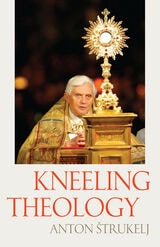
Anton Štrukelj, in this English edition of his book Kneeling Theology, which was published in German, Italian, Polish, Russian and Slovenian, based his theme on the concept first developed by Hans Urs von Balthasar. This Swiss intellectual is considered one of the most important theologians of the 20th century. Štrukelj sees as his task, through a synthetic survey of questions, to seek from his subjects a holistic perspective regarding the role of the theologian, without doing a critical analysis of all their work. Kneeling Theology analyzes the process and its consequences that gave rise to the religious and cultural developments of the past and the present. It is his thesis that the essence of theology should flow from holiness. He relies for his evidence on the life and work of Hans Urs von Balthasar (which included the insights of Adrienne von Speyr, physician and mystic), Cardinal Joseph Ratzinger (Pope Benedict XVI), the Slovenian theologian Anton Strle (now servant of God) and Anton Vovk, former Archbishop of Ljubljana, fearless witness of Christ and his Church, also servant of God. Štrukelj's purpose with this book is to point out that Catholic theology is best served, not only by competent research and a thorough knowledge of Church tradition, but by theologians who approach their work prayerfully and on their knees. The rich theological and pastoral heritage that has been bequeathed to us by a small group of special people in this book has come about because of their scholarship and their holiness. They have, each in their own way, demonstrated what it means to do theology on their knees, and they have shared their scholarship and insights with us.
[more]
cover of Newman, Canon Law and Development: Quarrying Granite Rocks with Razors

Newman, Canon Law and Development

Quarrying Granite Rocks with Razors

David P. Long

Catholic University of America Press, 2024
John Henry Newman is well-known as a theologian, philosopher, historian, writer, University rector, and poet, but can he also be associated with the field of canon law? When Newman first proposed the possibility of doctrinal development as proof that the Catholic faith was free from corruption and error, he claimed “the Church is declared to be the great and special support of the Truth, her various functionaries are said to be means towards the settlement of diversities and of uncertainty of doctrine, and securing unity of faith.” For Newman, these various functionaries included not only apostles, prophets, evangelists, and pastors, but also theologians and, as is argued in this work, canon lawyers. While Newman and doctrinal development have become well-explored topics in the field of theology, there has been little scholarship on how Newman’s thoughts on doctrinal development can influence current canon law and Church governance. David Long addresses that lacuna by offering a systematic analysis of Newman’s concept of development within current canonical practice. It starts by tracing Newman’s notions of personal judgment, public discussion, and episcopal moderation, followed by a presentation of the current canonical understanding of the theologian, and finally an application of the connection between Newman’s theory on development and present canonical legislation as it involves the role of the theologian. By undertaking such an application, and by creating a model for discussion that preserves both development and Tradition, this work humbly proposes a valuable model for understanding the theologian’s contribution within the life of the contemporary Church in ways not previously explored.
[more]
cover of On Love and Charity: Readings from the Commentary on the Sentences of Peter Lombard (Thomas Aquinas in Translation)

On Love and Charity

Readings from the Commentary on the Sentences of Peter Lombard (Thomas Aquinas in Translation)

Saint Thomas Aquinas

Catholic University of America Press, 2008
No description available
[more]
cover of Reassessing Reform

Reassessing Reform

Christopher M. Bellitto

Catholic University of America Press, 2012
Now, in celebration of the fiftieth anniversaries of the publication of The Idea of Reform and the Second Vatican Council, Reassessing Reform explores and critiques the enduring significance of Ladner's study, surveying new avenues and insights of more recent reform scholarship, especially concerning the long Middle Ages.
[more]
cover of Rewriting Maya Religion: Domingo de Vico, K’iche’ Maya Intellectuals, and the Theologia Indorum

Rewriting Maya Religion

Domingo de Vico, K’iche’ Maya Intellectuals, and the Theologia Indorum

Garry G. Sparks

University Press of Colorado, 2019

In Rewriting Maya Religion Garry Sparks examines the earliest religious documents composed by missionaries and native authors in the Americas, including a reconstruction of the first original, explicit Christian theology written in the Americas—the nearly 900-page Theologia Indorum (Theology for [or of] the Indians), initially written in Mayan languages by Friar Domingo de Vico by 1554. Sparks traces how the first Dominican missionaries to the Maya repurposed native religious ideas, myths, and rhetoric in their efforts to translate a Christianity and how, in this wake, K’iche’ Maya elites began to write their own religious texts, like the Popol Vuh. This ethnohistory of religion critically reexamines the role and value of indigenous authority during the early decades of first contact between a Native American people and Christian missionaries.
 
Centered on the specific work of Dominicans among the Highland Maya of Guatemala in the decades prior to the arrival of the Catholic Reformation in the late sixteenth century, the book focuses on the various understandings of religious analyses—Hispano-Catholic and Maya—and their strategic exchanges, reconfigurations, and resistance through competing efforts of religious translation. Sparks historically contextualizes Vico’s theological treatise within both the wider set of early literature in K’iche’an languages and the intellectual shifts between late medieval thought and early modernity, especially the competing theories of language, ethnography, and semiotics in the humanism of Spain and Mesoamerica at the time.
 
Thorough and original, Rewriting Maya Religion serves as an ethnohistorical frame for continued studies on Highland Maya religious symbols, discourse, practices, and logic dating back to the earliest documented evidence. It will be of great significance to scholars of religion, ethnohistory, linguistics, anthropology, and Latin American history.
 
[more]
cover of Statesmanship and Party Government: A Study of Burke and Bolingbroke

Statesmanship and Party Government

A Study of Burke and Bolingbroke

Harvey C. Mansfield

University of Chicago Press, 1965

In this incisive look at early modern views of party politics, Harvey C. Mansfield examines the pamphlet war between Edmund Burke and the followers of Henry St. John, First Viscount Bolingbroke during the mid-eighteenth century. In response to works by Bolingbroke published posthumously, Burke created his most eloquent advocacy of the party system. Taking an interdisciplinary approach to the material, Mansfield shows that present-day parties must be understood in the light of the history of party government. The complicated organization and the public actions of modern parties are the result, he contends, and not the cause of a great change in opinion about parties.

Mansfield points out that while parties have always existed, the party government that we know today is possible only because parties are now considered respectable. In Burke’s day, however, they were thought by detractors to be a cancer in a free polity. Even many supporters of the parties viewed them as a dangerous instrument, only to be used cautiously by statesmen in dire times. Burke, however, was an early champion of the party system in Britain and made his arguments with a clear-eyed realism. In Statesmanship and Party Government, Mansfield provides a skillful evaluation of Burke’s writings and sheds light present-day party politics through a profound understanding of the historical background of the their inception.
[more]
cover of Summa Theologiae, Prima Pars: Volume 1, The One God, QQ 1-26: With the Commentary of Cardinal Cajetan

Summa Theologiae, Prima Pars

Volume 1, The One God, QQ 1-26: With the Commentary of Cardinal Cajetan

Thomas Aquinas

Catholic University of America Press, 2023
When Leo XII promulgated Aeterni Patris in 1879, he stipulated that the “Leonine,” or official, edition of the Summa should always be printed in conjunction with Cajetan’s Commentary. For five hundred years they were studied together. Generations were trained by reading through the Summa article by article with Cajetan’s commentaries in hand. Early printed editions of the Summa typically included them in a Talmudic arrangement, as marginal text running around each article by Aquinas. This edition imitates that example. Recently, serious thinkers of all denominations – and none – have found new reasons to be interested in St. Thomas. His text is deceptively simple, yet important issues are handled in every article, sometimes below the surface. Cajetan extracts these hidden issues, and explains and elaborates on them with remarkable affinity to modern analytical philosophy. Part of that affinity lies in the use of modal logic, a tool whose importance was overlooked between the Renaissance and the twentieth century. The time is ripe for an analytically-inspired translation of Thomas: hence this volume. Never until now has Cajetan’s Commentary been put into English in its entirety. William Marshner’s translation is consistent with fidelity to the technical force of the original. The translator’s footnotes acknowledge what empirical science has made obsolete in the work of St. Thomas, and also make clear how much today’s science would have saved Thomas useless labor. This volume will, for the first time, make Cajetan’s help available to the modern reader.
[more]
cover of Summa Theologiae, Prima Pars: Volume 2, On the Holy Trinity and Creation in General, QQ 27-74: With the Commentary of Cardinal Cajetan

Summa Theologiae, Prima Pars

Volume 2, On the Holy Trinity and Creation in General, QQ 27-74: With the Commentary of Cardinal Cajetan

Thomas Aquinas

Catholic University of America Press, 2023
When Leo XII promulgated Aeterni Patris in 1879, he stipulated that the “Leonine,” or official, edition of the Summa should always be printed in conjunction with Cajetan’s Commentary. For five hundred years they were studied together. Generations were trained by reading through the Summa article by article with Cajetan’s commentaries in hand. Early printed editions of the Summa typically included them in a Talmudic arrangement, as marginal text running around each article by Aquinas. This edition imitates that example. Recently, serious thinkers of all denominations – and none – have found new reasons to be interested in St. Thomas. His text is deceptively simple, yet important issues are handled in every article, sometimes below the surface. Cajetan extracts these hidden issues, and explains and elaborates on them with remarkable affinity to modern analytical philosophy. Part of that affinity lies in the use of modal logic, a tool whose importance was overlooked between the Renaissance and the twentieth century. The time is ripe for an analytically-inspired translation of Thomas: hence this volume. Never until now has Cajetan’s Commentary been put into English in its entirety. William Marshner’s translation is consistent with fidelity to the technical force of the original. The translator’s footnotes acknowledge what empirical science has made obsolete in the work of St. Thomas, and also make clear how much today’s science would have saved Thomas useless labor. This volume will, for the first time, make Cajetan’s help available to the modern reader.
[more]
cover of Summa Theologiae, Prima Pars: Volume 3, Human Beings and God's Governance of Creation, QQ 75-119: With the Commentary of Cardinal Cajetan

Summa Theologiae, Prima Pars

Volume 3, Human Beings and God's Governance of Creation, QQ 75-119: With the Commentary of Cardinal Cajetan

Thomas Aquinas

Catholic University of America Press, 2023
When Leo XII promulgated Aeterni Patris in 1879, he stipulated that the “Leonine,” or official, edition of the Summa should always be printed in conjunction with Cajetan’s Commentary. For five hundred years they were studied together. Generations were trained by reading through the Summa article by article with Cajetan’s commentaries in hand. Early printed editions of the Summa typically included them in a Talmudic arrangement, as marginal text running around each article by Aquinas. This edition imitates that example. Recently, serious thinkers of all denominations – and none – have found new reasons to be interested in St. Thomas. His text is deceptively simple, yet important issues are handled in every article, sometimes below the surface. Cajetan extracts these hidden issues, and explains and elaborates on them with remarkable affinity to modern analytical philosophy. Part of that affinity lies in the use of modal logic, a tool whose importance was overlooked between the Renaissance and the twentieth century. The time is ripe for an analytically-inspired translation of Thomas: hence this volume. Never until now has Cajetan’s Commentary been put into English in its entirety. William Marshner’s translation is consistent with fidelity to the technical force of the original. The translator’s footnotes acknowledge what empirical science has made obsolete in the work of St. Thomas, and also make clear how much today’s science would have saved Thomas useless labor. This volume will, for the first time, make Cajetan’s help available to the modern reader.
[more]
cover of Systematic Theology, Volume 1

Systematic Theology, Volume 1

Paul Tillich

University of Chicago Press, 1951

This is the first part of Paul Tillich's three-volume Systematic Theology, one of the most profound statements of the Christian message ever composed and the summation and definitive presentation of the theology of the most influential and creative American theologian of the twentieth century.

In this path-breaking volume Tillich presents the basic method and statement of his system—his famous "correlation" of man's deepest questions with theological answers. Here the focus is on the concepts of being and reason. Tillich shows how the quest for revelation is integral to reason itself. In the same way a description of the inner tensions of being leads to the recognition that the quest for God is implied in finite being.

Here also Tillich defines his thought in relation to philosophy and the Bible and sets forth his famous doctrine of God as the "Ground of Being." Thus God is understood not as a being existing beside other beings, but as being-itself or the power of being in everything. God cannot be made into an object; religious knowledge is, therefore, necessarily symbolic.
[more]
cover of Systematic Theology, Volume 2

Systematic Theology, Volume 2

Paul Tillich

University of Chicago Press, 1957
In this volume, the second of his three-volume reinterpretation of Christian theology, Paul Tillich comes to grips with the central idea of his system—the doctrine of the Christ. Man's predicament is described as the state of "estrangement" from himself, from his world, and from the divine ground of his self and his world. This situation drives man to the quest for a new state of things, in which reconciliation and reunion conquer estrangement. This is the quest for the Christ.
[more]
cover of Systematic Theology, Volume 3

Systematic Theology, Volume 3

Paul Tillich

University of Chicago Press, 1963

In this volume, the third and last of his Systematic Theology, Paul Tillich sets forth his ideas of the meaning of human life, the doctrine of the Spirit and the church, the trinitarian symbols, the relation of history to the Kingdom of God, and the eschatological symbols. He handles this subject matter with powerful conceptual ability and intellectual grace.

The problem of life is ambiguity. Every process of life has its contrast within itself, thus driving man to the quest for unambiguous life or life under the impact of the Spritual Presence. The Spritual Presence conquers the negativities of religion, culture, and morality, and the symbols anticipating Eternal Life present the answer to the problem of life.
[more]
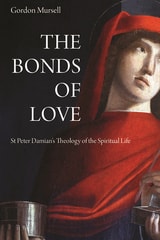
cover of The Bonds of Love: St. Peter Damian's Theology of the Spiritual Life

The Bonds of Love

St. Peter Damian's Theology of the Spiritual Life

Gordon Mursell

Catholic University of America Press, 2022
St Peter Damian (1007-1072) is an exceptional example of a paradox that is found in many saints and thinkers through the ages (St Jerome, St Bernard, St Bridget of Sweden, St Teresa of Avila and Thomas Merton come to mind) – of a lifelong tension between two competing vocations: the call to solitude and holiness and the call to prophetic social and ecclesial engagement. The author has explored this tension throughout his adult life, both in his published work and in his own life as an Episcopalian/Anglican priest and later bishop. Damian’s “The Book of ‘The Lord be with you’” is a profound exploration of the spirituality of solitude, whereas his “Book of Gomorrah” is an intense attack on clerical sexual abuse which has helped to give Damian a new recent prominence in the light of the huge challenges facing the Church today. The Bonds of Love shows that the paradox at the heart of Damian's life and everything he cared about was rooted in the remarkable theology of love which finds expression across the whole of his work and gives it both coherence and dynamism. His life and spirituality are of far more than academic interest, and will make a major contribution, not only to those committed to ecclesial reform and renewal, but to all who struggle to live with the kind of competing tensions that made St. Peter Damian who he was.
[more]
cover of The Christian Tradition: A History of the Development of Doctrine, Volume 1: The Emergence of the Catholic Tradition (100-600)

The Christian Tradition

A History of the Development of Doctrine, Volume 1: The Emergence of the Catholic Tradition (100-600)

Jaroslav Pelikan

University of Chicago Press, 1971


The first volume of a magisterial survey of the entire history of the Christian tradition, this volume focusing on the emergence of Catholicism

In this five-volume opus Jaroslav Pelikan traces the development of Christian doctrine from the first century to the twentieth.
 
[more]
cover of The Christian Tradition: A History of the Development of Doctrine, Volume 2: The Spirit of Eastern Christendom (600-1700)

The Christian Tradition

A History of the Development of Doctrine, Volume 2: The Spirit of Eastern Christendom (600-1700)

Jaroslav Pelikan

University of Chicago Press, 1974

The line that separated Eastern Christendom from Western on the medieval map is similar to the "iron curtain" of recent times. Linguistic barriers, political divisions, and liturgical differences combined to isolate the two cultures from each other. Except for such episodes as the schism between East and West or the Crusades, the development of non-Western Christendom has been largely ignored by church historians. In The Spirit of Eastern Christendom, Jaroslav Pelikan explains the divisions between Eastern and Western Christendom, and identifies and describes the development of the distinctive forms taken by Christian doctrine in its Greek, Syriac, and early Slavic expression.

"It is a pleasure to salute this masterpiece of exposition. . . . The book flows like a great river, slipping easily past landscapes of the utmost diversity—the great Christological controversies of the seventh century, the debate on icons in the eighth and ninth, attitudes to Jews, to Muslims, to the dualistic heresies of the high Middle Ages, to the post-Reformation churches of Western Europe. . . . His book succeeds in being a study of the Eastern Christian religion as a whole."—Peter Brown and Sabine MacCormack, New York Review of Books

"The second volume of Professor Pelikan's monumental work on The Christian Tradition is the most comprehensive historical treatment of Eastern Christian thought from 600 to 1700, written in recent years. . . . Pelikan's reinterpretation is a major scholarly and ecumenical event."—John Meyendorff

"Displays the same mastery of ancient and modern theological literature, the same penetrating analytical clarity and balanced presentation of conflicting contentions, that made its predecessor such an intellectual treat."—Virgina Quarterly Review
[more]
cover of The Christian Tradition: A History of the Development of Doctrine, Volume 3: The Growth of Medieval Theology (600-1300)

The Christian Tradition

A History of the Development of Doctrine, Volume 3: The Growth of Medieval Theology (600-1300)

Jaroslav Pelikan

University of Chicago Press, 1978

"A magnificent history of doctrine."—New York Review of Books

"In this volume Jaroslav Pelikan continues the splendid work he has done thus far in his projected five-volume history of the development of Christian doctrine, defined as 'what the Church believes, teaches, and confesses on the basis of the word of God.' The entire work will become an indispensable resource not only for the history of doctrine but also for its reformulation today. Copious documentation in the margins and careful indexing add to its immense usefulness."—E. Glenn Hinson, Christian Century

"This book is based on a most meticulous examination of medieval authorities and the growth of medieval theology is essentially told in their own words. What is more important, however, then the astounding number of primary sources the author has consulted or his sovereign familiarity with modern studies on his subject, is his ability to discern form and direction in the bewildering growth of medieval Christian doctrine, and, by thoughtful emphasis and selection, to show the pattern of that development in a lucid and persuasive narrative. No one interested in the history of Christianity or theology and no medievalist, whatever the field of specialization, will be able to ignore this magnificent synthesis."—Bernhard W. Scholz, History

"The series is obviously the indispensable text for graduate theological study in the development of doctrine, and an important reference for scholars of religious and intellectual history as well. . . . Professor Pelikan's series marks a significant departure, and in him we have at last a master teacher."—Marjorie O'Rourke Boyle, Commonweal
[more]
cover of The Christian Tradition: A History of the Development of Doctrine, Volume 4: Reformation of Church and Dogma (1300-1700)

The Christian Tradition

A History of the Development of Doctrine, Volume 4: Reformation of Church and Dogma (1300-1700)

Jaroslav Pelikan

University of Chicago Press, 1984

This penultimate volume in Pelikan's acclaimed history of Christian doctrine—winner with Volume 3 of the Medieval Academy's prestigious Haskins Medal—encompasses the Reformation and the developments that led to it.

"Only in America, and in this case from a Lutheran scholar, could we expect an examination so lacking in parti pris, a survey so perceptive, so free—and, one must say, the result of so much immense labor, so rewardingly presented."—John M. Todd, New York Times Book Review

"Never wasting a word or losing a plot line, Pelikan builds on an array of sources that few in our era have the linguistic skill, genius or ambition to master."—Martin E. Marty, America

"The use of both primary materials and secondary sources is impressive, and yet it is not too formidable for the intelligent layman."—William S. Barker, Eternity
[more]
cover of The Christian Tradition: A History of the Development of Doctrine, Volume 5: Christian Doctrine and Modern Culture (since 1700)

The Christian Tradition

A History of the Development of Doctrine, Volume 5: Christian Doctrine and Modern Culture (since 1700)

Jaroslav Pelikan

University of Chicago Press, 1989

Jaroslav Pelikan begins this volume with the crisis of orthodoxy that confronted all Christian denominations by the beginning of the eighteenth century and continues through the twentieth century in its particular concerns with ecumenism. The modern period in the history of Christian doctrine, Pelikan demonstrates, may be defined as the time when doctrines that had been assumed more than debated for most of Christian history were themselves called into question: the idea of revelation, the uniqueness of Christ, the authority of Scripture, the expectation of life after death, even the very transcendence of God.

"Knowledge of the immense intellectual effort invested in the construction of the edifice of Christian doctrine by the best minds of each successive generation is worth having. And there can hardly be a more lucid, readable and genial guide to it than this marvellous work."—Economist

"This volume, like the series which it brings to a triumphant conclusion, may be unreservedly recommended as the best one-stop introduction currently available to its subject."—Alister E. McGrath, Times Higher Education Supplement

"Professor Pelikan's series marks a significant departure, and in him we have at last a master teacher."—Marjorie O'Rourke Boyle, Commonweal

"Pelikan's book marks not only the end of a dazzling scholarly effort but the end of an era as well. There is reason to suppose that nothing quite like it will be tried again."—Harvey Cox, Washington Post Book World
[more]
cover of The Development of Dogma: A Systematic Account

The Development of Dogma

A Systematic Account

Guy Mansini, OSB

Catholic University of America Press, 2023
The Development of Dogma examines the nature of dogmatic statements and the causes of development. It devotes particular attention to the emergence of the form of dogmatic statements at the Council of Nicaea, but notes how this form is anticipated in the New Testament. It situates dogma and its development within the matrix of the great fundamental theological realities of Scripture, Tradition, and Magisterium. Fr. Mansini examines at some length how the Church comes to recognize a development as a genuine development rather than as a distortion of the word of God. The Development of Dogma is especially valuable today for its discussion and defense of the philosophical presuppositions of dogma, which are often simply presupposed but should not be ignored in a complete account of development. These presuppositions touch on fundamental philosophical issues, including the nature of knowledge, the objectivity and trustworthiness of names, and the various logical forms employed in understanding how development is related to a closed revelation. The historicity of human knowledge is also addressed, and the role of dogma itself in heading off the extreme relativism the historical nature of man is supposed to imply for ecclesial faith and life. The Church's dogma about dogma enunciated at the First Vatican Council is also examined. The role of certain fundamental concepts in understanding the possibility of the irreformability of dogma it speaks of is expressly addressed—concepts in principle accessible to all human beings and that enable a trans-cultural, trans-temporal proposal and reception of revealed truth.
[more]
cover of The Essential Tillich

The Essential Tillich

Paul Tillich

University of Chicago Press, 1999

An essential collection of the best work by renowned Christian theologian Paul Tillich
 
In his lifetime, Paul Tillich became that rarest of things: a famous theologian. Known for marrying an approachable personal and intellectual manner with rigorous religious thought and analysis, Tillich was as influential as any writer on religion at mid-century, listened to not just by parishioners and students but by political leaders, intellectuals, artists, and scientists as well. 

This volume collects Tillich's best and most important work. Editor F. Forrester Church has structured the book around eight key areas of Tillich's thought, titled: Ultimate Concern; Symbols of Faith; The Protestant Principle; Addressing the Situation; Love, Power, and Justice; The Courage to Be; The Future of Religions; and Living on the Boundary. Through them we get a clear picture of the work of a man whom Church describes as “a man of rare genius and perspecuity, a modern man whose heart was in Jerusalem, whose spirit was with the ancient Greeks, and whose soul was committed to a better future.”
[more]
cover of The Fathers of the Church in Christian Theology

The Fathers of the Church in Christian Theology

Catholic University of America Press, 2019
The main purpose of The Fathers of the Church in Christian Theology is to argue that Patristic studies still has much to contribute to theological reflections in our time. Throughout history, the reading of the Fathers of the Church has made major contributions to Christian thinking. This fecundity was notably verified in the 20th century through the work of theologians like Henri de Lubac and Hans Urs von Balthasar. It was as well manifested broadly in the life of the church that, with the Vatican II council, drew from the patristic tradition a source of inspiration for its own renewal. However, even though the research and work on early Christianity has experienced considerable growth for several decades, Christian theology is today confronted with new questions. Thus, what status to recognize in the exegesis of the Fathers? Has not the distance from the heritage of patristic thinking been widened? More radically, do not the demands of contextual theologies on diverse continents compel a distancing away from some traditions that formerly were principally limited to Mediterranean and European regions? If these questions must be taken into account, they, nevertheless, cannot dispense with Christian theology being, today as yesterday, inspired and made fecund by the writings of the Fathers. Michel Fédou attempts to shed light on what, in our own era, justifies the necessity of a patristic theology. He shows how the reading of the Fathers contributes to the understanding of the faith in the different fields of Christian thinking. It highlights the importance of their writings for the spiritual life and the valuable nourishment that they thus offer to our times.
[more]
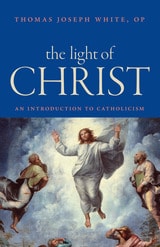
cover of The Light of Christ: An Introduction to Catholicism

The Light of Christ

An Introduction to Catholicism

Thomas Joseph White, OP

Catholic University of America Press, 2017

The Light of Christ provides an accessible presentation of Catholicism that is grounded in traditional theology, but engaged with a host of contemporary questions or objections. Inspired by the theologies of Iranaeus, Thomas Aquinas and John Henry Newman, and rooted in a post-Vatican II context, Fr. Thomas Joseph White presents major doctrines of the Christian religion in a way that is comprehensible for non-specialists: knowledge of God, the mystery of the Trinity, the Incarnation and the atonement, the sacraments and the moral life, eschatology and prayer.

At the same time, The Light of Christ also addresses topics such as evolution, the modern historical study of Jesus and the Bible, and objections to Catholic moral teaching. Touching on the concerns of contemporary readers, Fr. White examines questions such as whether Christianity is compatible with the findings of the modern sciences, do historical Jesus studies disrupt or confirm the teaching of the faith, and does history confirm the antiquity of Catholic claims.

This book serves as an excellent introduction for young professionals with no specialized background in theology who are interested in learning more about Catholicism, or as an introduction to Catholic theology. It will also serve as a helpful text for theology courses in a university context.

As Fr. White states in the book’s introduction: “This is a book that offers itself as a companion. I do not presume to argue the reader into the truths of the Catholic faith, though I will make arguments. My goal is to make explicit in a few broad strokes the shape of Catholicism. I hope to outline its inherent intelligibility or form as a mystery that is at once visible and invisible, ancient and contemporary, mystical and reasonable.”
[more]
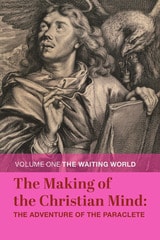
cover of The Making of the Christian Mind: The Adventure of the Paraclete: Volume I: The Waiting World

The Making of the Christian Mind

The Adventure of the Paraclete: Volume I: The Waiting World

James Patrick

St. Augustine's Press, 2020

Dr. James Patrick has spent his life teaching, and in this book he seeks to tell on a larger scale the story of the Christian mind as it developed according to what he refers to as the “adventure” of the Holy Spirit. Indeed, the Christian mind moved from faithful intuition to writing and composing original ideas of concrete truths, and this in turn led to inspired foundations upon which a new kind of world became possible. Patrick does not wish the reader to think the Christian mind has ever intended to create utopia on earth or to proselytize, rather that the dynamic Christian intellect indicates a human heart made new and from this newness still spring horizons of hope and culture. 

This is not a history of dogma or systematic account of the building of doctrine. It is a narrative that follows the major moments wherein the Christian heart so in tune with the Paraclete has rendered the seminal texts and literature of this new culture, from the Didache to the Rule of Saint Benedict and The Consolation of Philosophy. Patrick succeeds in presenting a narrative that reads more like the experience lived by those directly involved in its realization, and although he cannot include every individual accomplishment of the major Christian writers, he illuminates the context in which Christianity was born and how faith grew and allowed itself to be shaped by its participation in the “adventure” and its grasp of objective truth. The Christian mind is, says Patrick, not only inspired and moved by the restless Paraclete, but revolves around the event of Jesus Christ. Christian history is therefore best understood not simply as chronology of events but as the vision of “the new heart in time,” one that strives to be like that of the one who sent the Spirit into history.

Patrick writes with a voice of a teacher, and although this work is very well referenced and accurate he does not intend this work to be a scholarly presentation of data and careful arguments, nor does he include every aspect of this intellectual faith journey of Christianity found in writing. As a comprehensive review, Patrick acknowledges the limitations of his own project to tell a complete story. Nevertheless, The Making of the Christian Mind accomplishes the no less formidable feat of illustrating the vivacious quality of the authentic Christian intellectual life. “Christianity is a survivor, not because it possessed the instruments of power but because, as Jesus of Nazareth said before Pilate, the foundation of the Kingdom is truth, its instruments of conquest are its renewing gifts, its consequences are the substitution of truth for error and ignorance, of faith for skepticism, humility for pride, and of charity and friendship for emulation, all this realized never perfectly but always as possibilities having the power to make all things new.”

This work is divided into three volumes, of which the present work is the first. Highlights of this first volume, The Waiting World, include following revelation as it first moved uncertain hearts to write and then to offer explicit witness. In this first installment, Patrick sets the groundwork for following the faith and history of Israel to Justin Martyr’s great claim that what is true belongs to Christians. 
[more]
cover of The Opuscula and the Dispute with Pyrrhus: The Theological and Polemical Works

The Opuscula and the Dispute with Pyrrhus

The Theological and Polemical Works

Kevin M. St. Maximus the Confessor

Catholic University of America Press, 2026
Maximus the Confessor (d. 662), regarded by certain of his contemporaries as a sword of division, has become a bridge between East and West in our time. He lived at a time of theological and political upheaval, coming under intense scrutiny from imperial authorities in the final decades of his life. His conflict with Constantinople led him to engage in a theological and polemical campaign to equip his associates around the Mediterranean to respond to certain innovative doctrines. Maximus saw these new teachings as disconnected from the thought of the approved Fathers and theologically linked with prior heresies. This volume contains significant theological and polemical works— The Small Theological and Polemical Works, also known as the Opuscula, and the Dispute with Pyrrhus—refuting monenergism and monotheletism, the notions that Christ had only one activity or only one will. The Small Theological and Polemical Works are offered here for the first time in a complete English translation, built upon critical scholarship from the past century with key additions from Sergey Epifanovich included. Regarded as the most iconic work associated with Maximus, the famed Dispute with Pyrrhus, the deposed Patriarch of Constantinople, took place in Carthage in July 645. The record of this dialogue reflects Maximus’s mature Christology, while it is also a noteworthy prelude to his journey to Rome, where he worked with Pope Martin at the 649 Lateran Synod, uniting their voices and sealing their fates.
[more]
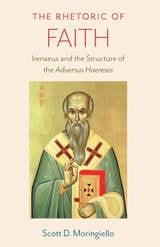
cover of The Rhetoric of Faith: Irenaeus and the Structure of the Adversus Haereses

The Rhetoric of Faith

Irenaeus and the Structure of the Adversus Haereses

Scott D. Moringiello

Catholic University of America Press, 2019

The Rhetoric of Faith argues that the structure of Irenaeus’s opus magnum, the Adversus Haereses, is the argument of the Adversus Haereses. Through a close reading of the Irenaeus’s text, as well as through a comparison with Greco-Roman rhetorical texts, Scott Moringiello argues that Irenaeus structured his argument around the articles of the faith of the Church and that this structure builds on tropes found in the Greco-Roman rhetorical tradition.

The argument focuses on the Adversus Haereses, although it does begin with some discussion to put Irenaeus in the context of second century Christian literature. Moringiello concludes with a discussion of Irenaeus’s Demonstration of the Apostolic Preaching.Other scholars have provided introductions to Irenaeus’s work, and other scholars have argued for the structural unity of the Adversus Haereses. No other scholar, though, has argued that the faith of the Church is the basis of Irenaeus’s argument. This argument, then, presents an important contribution to the field of Irenaeus studies.
[more]
cover of Theology and the Cartesian Doctrine of Freedom

Theology and the Cartesian Doctrine of Freedom

Etienne Gilson

St. Augustine's Press, 2015
[more]
cover of Thomas Aquinas on the Cardinal Virtues: A Summa of the Summa on Prudence, Justice, Temperance, and Courage

Thomas Aquinas on the Cardinal Virtues

A Summa of the Summa on Prudence, Justice, Temperance, and Courage

Christopher Kaczor

Catholic University of America Press, 2020
Thomas Aquinas on the Cardinal Virtues provides essential passages from Thomas's treatment of the cardinal virtues in the Summa theologiae, edited and explained for classroom use or the independent reader. Arranged for beginners, this book contains passages from the Summa theologiae of great historical import, contemporary relevance, or intrinsic interest combined with abundant footnotes aiding the modern reader. Each individual article is arranged so that the question, e.g. “Is capital punishment moral?” is followed directed by Thomas’s answer. Then the first objection is raised, followed immediately by Thomas’s response, the second objection is raised and then Thomas answers it, and so forth. The abundant footnotes help first time readers navigate key theological and philosophical terms which may be unfamiliar. In addition, the notes provide biographical information about key authors cited by Thomas, such as Tully, Vegetius, and Gregory the Great. The footnotes sometimes look back at the sources and philosophical roots of what Thomas teaches. Other notes note how authors after Aquinas including theologians, church councils, and popes developed, synthesized, and sometimes rejected what Thomas teaches. In sum, this book seeks to illuminate Thomas’s teaching on the cardinal virtues such as a teacher might do in the classroom.
[more]
cover of Three Christological Treatises

Three Christological Treatises

Catholic University of America Press, 2014
Twenty-nine in all, these letters cover all but three of Cyril's years as a bishop. The first twelve were published in 2009 (Fathers of the Church 118). The present volume completes the set. Festal letters were used in Alexandria primarily to announce the beginning of Lent and the date of Easter. They also served a catechetical purpose, however, allowing the Patriarch an annual opportunity to write pastorally not just about issues facing the entire see, but also about the theological issues of the day. Thus, in these letters we catch a glimpse of Cyril the pastor writing about complex theology in an uncomplicated way. These letters also illuminate other realities of the ancient church in Alexandria, especially the relationship with the Jewish community and the rising influence of asceticism.
[more]
cover of Trinitarian Explorations in Systematic Theology: Unpacking Lonergan's Four-Point Hypothesis

Trinitarian Explorations in Systematic Theology

Unpacking Lonergan's Four-Point Hypothesis

Neil Ormerod

Catholic University of America Press, 2026
In his Latin theological textbook, Bernard Lonergan proposed a way of correlating the four trinitarian relations (paternity, filiation, active spiration and passive spiration) with four distinct participations in the divine nature vis. the Incarnation, the beatific vision, sanctifying grace and the habit of charity. This book uncovers the genetic origins of this hypothesis in Augustine and Aquinas, its significance in terms of the grace-nature debate, and the insights it provides to key Christian doctrines such as Christology, ecclesiology, the nature of holiness, and the beatific vision. The author engages with contemporary theological literature to demonstrate the explanatory power of Lonergan’s construct in relation to competing proposals. Vatican I taught that the role of systematic theology is to understand divine mysteries through analogy and through the nexus between these mysteries. This work argues that Lonergan’s hypothesis perfectly fulfils the second of these tasks and thus provides a needed unification of the diverse topics that confront systematic theologians. Each individual chapter has appeared in leading theological journals: Theological Studies, Irish Theological Quarterly and Louvain Studies. The chapters are ordered here not in terms of publication date, but in such a way as to guide the reader through a more synthetic grasp of the issues involved.
[more]
cover of Wisdom in Bonaventure's <i>Hexameron</i>: Philosophical Problems, Theological Solutions

Wisdom in Bonaventure's <i>Hexameron</i>

Philosophical Problems, Theological Solutions

Benjamin Winter

Catholic University of America Press, 2024

This book presents Saint Bonaventure as a cutting-edge thinker who engaged with natural philosophy on its own terms. His final academic project was an unfinished collection of scholastic sermons titled Collationes in Hexaëmeron. At this moment in history, academics were clashing over the limits of cognition and the definition of science (scientia). Much has been written detailing how the incorporation of Aristotle’s philosophy into university curricula eventually prompted the Condemnations of 1270 and 1277. But perhaps it is incorrect to conceive of these events in a frame of escalating tensions leading to collapse. Perhaps a new perspective can be found by venturing back to 1273, to see Aristotle through the eyes of a theologian who was both magister and minister, bishop and brother—one who respected the academy’s rigor but also challenged its tendency toward self-absorption. Guiding readers through vision one of Collationes in Hexaëmeron, Benjamin Winter argues that Bonaventure’s rejection of certain philosophical errors ought to be understood within the context of the virtuous person’s journey to wisdom. Propositions such as the eternity of the world, the unicity of the intellect, and fated necessity are not variables in a zero-sum equation “balanced out” by truths of faith. Instead, Bonaventure sees these propositions as opportunities to reflect charitably on nature and grace, emphasizing that just as knowledge is empty without love, understanding is insufficient without humility. Rather than renounce Aristotle or stifle scientific inquiry, Collationes in Hexaëmeron wholeheartedly acknowledges the affective and communal dimensions of philosophical knowledge. Bonaventure creates a magnificent and enduring text with powerful applications today.
[more]