Results by title
493 books match the query 'Theory' and 43 start with a
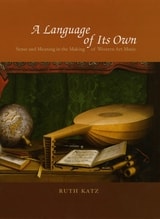
A Language of Its Own
Sense and Meaning in the Making of Western Art MusicRuth Katz
University of Chicago Press, 2009
The Western musical tradition has produced not only music, but also countless writings about music that remain in continuous—and enormously influential—dialogue with their subject. With sweeping scope and philosophical depth, A Language of Its Own traces the past millennium of this ongoing exchange.
Ruth Katz argues that the indispensible relationship between intellectual production and musical creation gave rise to the Western conception of music. This evolving and sometimes conflicted process, in turn, shaped the art form itself. As ideas entered music from the contexts in which it existed, its internal language developed in tandem with shifts in intellectual and social history. Katz explores how this infrastructure allowed music to explain itself from within, creating a self-referential and rational foundation that has begun to erode in recent years.
A magisterial exploration of a frequently overlooked intersection of Western art and philosophy, A Language of Its Own restores music to its rightful place in the history of ideas.
A Postcapitalist Politics
J. K. Gibson-Graham
University of Minnesota Press, 2006
A Postcapitalist Politics reveals a prolific landscape of economic diversity—one that is not exclusively or predominantly capitalist—and examines the challenges and successes of alternative economic interventions. Gibson-Graham bring together political economy, feminist poststructuralism, and economic activism to foreground the ethical decisions, as opposed to structural imperatives, that construct economic “development” pathways. Marshalling empirical evidence from local economic projects and action research in the United States, Australia, and Asia, they produce a distinctive political imaginary with three intersecting moments: a politics of language, of the subject, and of collective action. In the face of an almost universal sense of surrender to capitalist globalization, this book demonstrates that postcapitalist subjects, economies, and communities can be fostered. The authors describe a politics of possibility that can build different economies in place and over space. They urge us to confront the forces that stand in the way of economic experimentation and to explore different ways of moving from theory to action.
J. K. Gibson-Graham is the pen name of Katherine Gibson and Julie Graham, feminist economic geographers who work, respectively, at the Australian National University in Canberra and the University of Massachusetts Amherst.
A Theory of Argumentation
Charles Arthur Willard
University of Alabama Press, 1989
Establishes a theoretical context for, and to elaborate the implications of, the claim that argument is a form of interaction in which two or more people maintain what they construe to be incompatible positions
The thesis of this book is that argument is not a kind of logic but a kind of communication—conversation based on disagreement. Claims about the epistemic and political effects of argument get their authority not from logic but from their “fit with the facts” about how communication works. A Theory of Communication thus offers a picture of communication—distilled from elements of symbolic interactionism, personal construct theory, constructivism, and Barbara O’Keefe’s provocative thinking about logics of message design. The picture of argument that emerges from this tapestry is startling, for it forces revisions in thinking about knowledge, rationality, freedom, fallacies, and the structure and content of the argumentation discipline.

A Theory of Assembly
From Museums to MemesKyle Parry
University of Minnesota Press, 2022
A vital reckoning with how we understand the basic categories of cultural expression in the digital era
Digital and social media have transformed how much and how fast we communicate, but they have also altered the palette of expressive strategies: the cultural forms that shape how citizens, activists, and artists speak and interact. Most familiar among these strategies are storytelling and representation. In A Theory of Assembly, Kyle Parry argues that one of the most powerful and pervasive cultural forms in the digital era is assembly.
Whether as subtle photographic sequences, satirical Venn diagrams, or networked archives, projects based in assembly do not so much narrate or represent the world as rearrange it. This work of rearranging can take place at any scale, from a simple pairing of images, undertaken by one person, to the entire history of internet memes, undertaken by millions. With examples ranging from GIFs and paintings to museum exhibitions and social movement hashtags, Parry shows how, in the internet age, assembly has come to equal narrative and representation in its reach and influence, particularly as a response to ecological and social violence. He also emphasizes the ambivalence of assembly—the way it can be both emancipatory and antidemocratic.
As the world becomes ever hotter, more connected, and more algorithmic, the need to map—and remake—assembly’s powers and perils becomes all the more pressing. Interdisciplinary, engaging, and experimental, A Theory of Assembly serves as a playbook of strategies and critical frameworks for artists, activists, and content creators committed to social and environmental justice, ultimately arguing for a collective reenvisioning of which cultural forms matter.
Cover alt text: Letters from the title appear in a jumble, each colored in a blue-orange gradient. Readable title and author sits below the jumble.
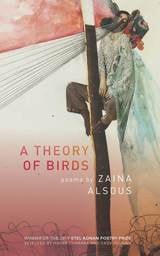
A Theory of Birds
PoemsZaina Alsous
University of Arkansas Press, 2019
Winner of the 2019 Etel Adnan Poetry Prize
Inside the dodo bird is a forest, Inside the forest
a peach analog, Inside the peach analog a woman, Inside
the woman a lake of funerals
This layering of bird, woman, place, technology, and ceremony, which begins this first full-length collection by Zaina Alsous, mirrors the layering of insights that marks the collection as a whole. The poems in A Theory of Birds draw on inherited memory, historical record, critical theory, alternative geographies, and sharp observation. In them, birds—particularly extinct species—become metaphor for the violences perpetrated on othered bodies under the colonial gaze.
Putting ecological preservation in conversation with Arab racial formation, state vernacular with the chatter of birds, Alsous explores how categorization can be a tool for detachment, domination, and erasure. Stretching their wings toward de-erasure, these poems—their subjects and their logics—refuse to stay put within a single category. This is poetry in support of a decolonized mind.
A Theory of ISIS
Political Violence and the Global OrderMohammad-Mahmoud Ould Mohamedou
Pluto Press, 2017
Against these established narratives, Mohammad-Mahmoud Ould Mohamedou now presents his new theory of ISIS. Tracing the genealogy of ISIS and documenting its evolution in Iraq and Syria, he argues that ISIS has actually transcended Osama Bin Laden’s original scheme of Al Qaeda, mutating into a unprecedented hybrid between postcolonial violence, postmodernity, and postglobalization. A Theory of ISIS offers an original take on the militant group. Mohamedou explains the proliferation of terrorist attacks on the West and deepens our understanding of the group's impact on the very nature of contemporary political violence.
A Theory of Knots
Pervin Saket
Seagull Books, 2026
These lyric, unsparing poems stitch together a story of identity, belonging, and dissolution.
A Theory of Knots explores the loops of how identity and belonging are constructed, broken, resurrected, and dissolved. In sections, knots weave DNA and cords, memory and mythology, home and tongue; they draw on desire, Zoroastrian rituals, tradition and transgression, and the legacies of womanhood, asking what connects us, and at what cost.
As layers of identity are examined, Pervin Saket's poems return to language: heirloom, hazard, half-truth. Soon enough, language is both subject and suspect; having exposed the artificial nature of our truths, the poems confront the artificial nature of language itself. At the end, poetry reaches the wilderness of earth, collapses upon itself, dissolving on the page—untangling the final knot.
A Theory of Parody
The Teachings of Twentieth-Century Art FormsLinda Hutcheon
University of Illinois Press, 1985
Hutcheon identifies parody as one of the major forms of modern self-reflexivity, one that marks the intersection of invention and critique and offers an important mode of coming to terms with the texts and discourses of the past. Looking at works as diverse as Tom Stoppard's Rosenkrantz and Guildenstern Are Dead, Brian de Palma's Dressed to Kill, Woody Allen's Zelig, Karlheinz Stockhausen's Hymnen, James Joyce's Ulysses, and Magritte's This Is Not a Pipe, Hutcheon discusses the remarkable range of intent in modern parody while distinguishing it from pastiche, burlesque, travesty, and satire. She shows how parody, through ironic playing with multiple conventions, combines creative expression with critical commentary. Its productive-creative approach to tradition results in a modern recoding that establishes difference at the heart of similarity.
In a new introduction, Hutcheon discusses why parody continues to fascinate her and why it is commonly viewed as suspect-–for being either too ideologically shifty or too much of a threat to the ownership of intellectual and creative property.
A Theory of Regret
Brian Price
Duke University Press, 2017
A Theory of Religion
Stark, Rodney
Rutgers University Press, 1996
A Unified Theory of Collective Action and Social Change
Luis Fernando Medina
University of Michigan Press, 2007
The notion that groups form and act in ways that respond to objective, external costs and benefits has long been the key to accounting for social change processes driven by collective action. Yet this same notion seems to fall apart when we try to explain how collectivities emerge out of the choices of individuals. This book overcomes that dilemma by offering an analysis of collective action that, while rooted in individual decision making, also brings out the way in which objective costs and benefits can impede or foster social coordination. The resulting approach enables us to address the causes and consequences of collective action with the help of the tools of modern economic theory. To illustrate this, the book applies the tools it develops to the study of specific collective action problems such as clientelism, focusing on its connections with economic development and political redistribution; and wage bargaining, showing its economic determinants and its relevance for the political economy of the welfare state.
"Medina's study is a great step forward in the analytics of collective action. He shows the inadequacies of currently standard models and shows that straightforward revisions reconcile rational-choice and structural viewpoints. It will influence all future work."
—Kenneth Arrow, Stanford University
"Olson, Schelling, and now Medina. A Unified Theory deepens our understanding of collective action and contributes to the foundations of our field. A major work."
—Robert H. Bates, Harvard University
"Medina thinks that the main problem of social action is not whether or not to cooperate but how to do it. To this end he has produced an imaginative approach to analyzing strategic coordination problems that produces plausible predictions in a range of circumstances."
—John Ferejohn, Stanford University
Luis Fernando Medina is Associate Professor in the Department of Politics at the University of Virginia.
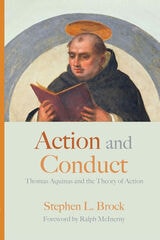
Action and Conduct
Thomas Aquinas and the Theory of ActionStephen Brock
Catholic University of America Press, 2021
"A first-rate book...Brock's lucid and illuminating analysis offers much of value to both intellectual historians and theologians, as well as philosophers."—Theological Studies"Brock's treatment of Aquinas's account of action exhibits a rare combination of rigor and learning. It is, no doubt, the best we have."—The Thomist
Addressing Postmodernity
Kenneth Burke, Rhetoric, and a Theory of Social ChangeBarbara Biesecker
University of Alabama Press, 2000
In Addressing Postmodernity, Barbara Biesecker examines the relationship between rhetoric and social change and the ways human beings transform social relations through the purposeful use of symbols. In discerning the conditions of possibility for social transformation and the role of human beings and rhetoric in it, Biesecker turns to the seminal work of Kenneth Burke.
Through a close reading of Burke's major works, A Grammar of Motives, A Rhetoric of Motives, and The Rhetoric of Religion: Studies in Logology, the author addresses the critical topic of the
fragmentation of the contemporary lifeworld revealing postmodernity will have a major impact on Burkeian scholarship and on the rhetorical critique of social relations in general.
Directly confronting the challenges posed by postmodernity to social theorists and critics alike and juxtaposing the work of Burke and Jurgen Habermas, Biesecker argues that a radicalized rereading of Burke's theory of the negative opens the way toward a resolutely rhetorical theory of social change and human agency.

Adventures in Kate Bush and Theory
Deborah M. Withers
Intellect Books, 2010
Adventures in Kate Bush and Theory presents Kate Bush as you have never seen her before. Encounter the polymorphously perverse Kate, the witchy Kate, the queer Kate; the Kate who moves beyond the mime.
Through in-depth readings of the often critically neglected works of Bush’s career (The Kick Inside, Lionheart, The Dreaming, The Red Shoes and her film The Line, the Cross and the Curve), Withers guides the reader through the complexity of Bush’s art and how it transformed popular culture.
Not just another book about Kate Bush.
Aesthetics and the Theory of Criticism
Selected Essays of Arnold IsenbergArnold Isenberg
University of Chicago Press, 1973
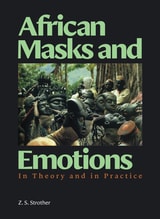
African Masks and Emotions
In Theory and in PracticeZ. S. Strother
J. Paul Getty Trust, The, 0
In this groundbreaking book, Z. S. Strother, inspired by dialogues with African masquerade patrons and performers, disputes assumptions that masks universally hide, reveal, or transform.
In Western European languages, the word mask exerts a powerful presence as a figure of speech. To masquerade is to pretend to be someone or something one is not. By extension, unmasking is a heroic metaphor for exposing a hidden truth. In this volume, art historian Z. S. Strother counters that narrative, using African case studies to offer an alternative vision of masquerading. She explores the aesthetic emotions aroused by masks, or more precisely, by “dances of masks”: joy, wonder, awe, fear, and the release of laughing out loud. She also investigates the uncanny—a sensation of “delicious shiveriness” triggered when familiar spaces and individuals become strange and changeable. Inspired by Strother’s studies in DR Congo, African Masks and Emotions takes a comparative perspective and moves emotion from the periphery to the center of analysis.
Reflecting Getty's commitment to open content, African Masks and Emotions is available for free download in ePub and PDF formats at: https://www.getty.edu/publications-reports/item/2F27A4. This paperback edition is available for sale for readers who wish to have a bound reference copy.
Afroindigenization
A Theory of Grassroots Cultural PracticeCatherine A. John
Duke University Press, 2026
After Parsons
A Theory of Social Action for the Twenty-First CenturyRenee C. Fox
Russell Sage Foundation, 2005
After Strange Texts
The Role of Theory in the Study of LiteratureGregory S. Jay and David L. Miller
University of Alabama Press, 1985
In this collection of essays by seven outstanding American scholars, interests as diverse as feminism, Marxism, deconstruction, and cultural poetics are brought together around a central question: how does the choice of a particular theory alter the practice of reading and do altered practices of reading in turn call forth more theory?
Against Money
J. W. Mason and Arjun Jayadev
University of Chicago Press, 2026
A powerful deconstruction of humanity’s most influential invention, from the acclaimed economists J. W. Mason and Arjun Jayadev.
Money is everywhere in our daily lives. It lurks in the swipe of a card at the grocery store, in looming student-loan debts, in the prices of things we want, and in our subconscious navigation of the modern world. Money is an invisible convenience that saves us, as a society, the hassle of bartering for goods and services—a reflection, in our pockets and on our phones, of the hard facts of scarcity and desire. Or is it something more?
In this revelatory book, economists J. W. Mason and Arjun Jayadev explain how and why money is so deeply misunderstood by the world it dominates—as well as the dangerous social implications of this misunderstanding. Against Money tackles the most dearly held “truths” of economics, arguing that the world of money has never been an impartial representation of the world of things. Instead, its existence in different forms—debt, capital, liquidity, and interest—increasingly shapes events in the real world rather than just reflecting them. Sometimes money enables new forms of cooperation; more oftenit facilitates domination. Human existence is not just facilitated by money but also governed by it.
In the tradition of works by Thomas Piketty and David Graeber, Against Money is an erudite, disruptive exposé of the illusions and tyrannies of money. Mason and Jayadev present a radically different way of thinking about money—imagining a hopeful future in which it no longer dictates the possibilities of our collective existence.
Against Money
J. W. Mason and Arjun Jayadev
University of Chicago Press, 2026
A powerful deconstruction of humanity’s most influential invention, from the acclaimed economists J. W. Mason and Arjun Jayadev.
Money is everywhere in our daily lives. It lurks in the swipe of a card at the grocery store, in looming student-loan debts, in the prices of things we want, and in our subconscious navigation of the modern world. Money is an invisible convenience that saves us, as a society, the hassle of bartering for goods and services—a reflection, in our pockets and on our phones, of the hard facts of scarcity and desire. Or is it something more?
In this revelatory book, economists J. W. Mason and Arjun Jayadev explain how and why money is so deeply misunderstood by the world it dominates—as well as the dangerous social implications of this misunderstanding. Against Money tackles the most dearly held “truths” of economics, arguing that the world of money has never been an impartial representation of the world of things. Instead, its existence in different forms—debt, capital, liquidity, and interest—increasingly shapes events in the real world rather than just reflecting them. Sometimes money enables new forms of cooperation; more oftenit facilitates domination. Human existence is not just facilitated by money but also governed by it.
In the tradition of works by Thomas Piketty and David Graeber, Against Money is an erudite, disruptive exposé of the illusions and tyrannies of money. Mason and Jayadev present a radically different way of thinking about money—imagining a hopeful future in which it no longer dictates the possibilities of our collective existence.
Aging Issues in the United States and Japan
Edited by Seiritsu Ogura, Toshiaki Tachibanaki, and David A. Wise
University of Chicago Press, 2001
Given the undeniable global importance of the Japanese and U.S. economies, these innovative essays shed welcome new light on the complex correlations between aging and economic behavior. This insightful work not only deepens our understanding of the Japanese and American economic landscapes but, through careful examination of the comparative social and economic data, clarifies the complex relation between aging societies, public policies, and economic outcomes.
Altruism, Morality, and Economic Theory
Edmund S. Phelps
Russell Sage Foundation, 1975
Altruistically Inclined?
The Behavioral Sciences, Evolutionary Theory, and the Origins of ReciprocityAlexander J. Field
University of Michigan Press, 2004
Altruistically Inclined? examines the implications of recent research in the natural sciences for two important social scientific approaches to individual behavior: the economic/rational choice approach and the sociological/anthropological. It considers jointly two controversial and related ideas: the operation of group selection within early human evolutionary processes and the likelihood of modularity—domain-specific adaptations in our cognitive mechanisms and behavioral predispositions.
Experimental research shows that people will often cooperate in one-shot prisoner's dilemma (PD) games and reject positive offers in ultimatum games, contradicting commonly accepted notions of rationality. Upon first appearance, predispositions to behave in this fashion could not have been favored by natural selection operating only at the level of the individual organism.
Emphasizing universal and variable features of human culture, developing research on how the brain functions, and refinements of thinking about levels of selection in evolutionary processes, Alexander J. Field argues that humans are born with the rudiments of a PD solution module—and differentially prepared to learn norms supportive of it. His emphasis on failure to harm, as opposed to the provision of affirmative assistance, as the empirically dominant form of altruistic behavior is also novel.
The point of departure and principal point of reference is economics. But Altruistically Inclined? will interest a broad range of scholars in the social and behavioral sciences, natural scientists concerned with the implications of research and debates within their fields for the conduct of work elsewhere, and educated lay readers curious about essential features of human nature.
American Archival Studies
Readings in Theory and PracticeRandall C. Jimerson
Society of American Archivists, 2000

An Equation That Changed the World
Newton, Einstein, and the Theory of RelativityHarald Fritzsch
University of Chicago Press, 1994
"Fritzsch could not give the modern reader a more memorable introduction to the personalities and science of Isaac Newton and Albert Einstein unless somehow he could find the keys to H. G. Wells' time machine. . . . Many readers will applaud Fritzsch for this lively but profoundly insightful book." —Booklist, starred review
"[Fritzsch] has dreamed up a dialogue between the two great physicists, helped along by a fictional modern physicist. . . . The conversation builds up to an explanation of E=mc2, and on the way illuminates the important points where Newtonian and Einsteinian theory diverge." —David Lindley, New York Times Book Review
An Inquiry into the Nature and Causes of the Wealth of Nations
Adam Smith
University of Chicago Press, 1977
Adam Smith's The Wealth of Nations was recognized as a landmark of immediately upon publication in 1776. As the first serious, data-driven argument for the principles of political economy, it is the point of departure for all subsequent economic thought. Smith's argument that human self-interest is the primary driver of economic activity, and that in aggregate that self-interest--acting through a market freed from government intervention-guides markets and economies toward the best outcomes for business and society, remains foundational for contemporary free-market economics.
This edition presents the definitive 1904 version of The Wealth of Nations, painstakingly edited by Edwin Cannan and featuring Cannan's illuminating introduction, and notes, as well as a a full index. An additional preface by distinguished economist George J. Stigler places Smith's book and thought in a contemporary context. The result is the best edition of this classic for students and general readers alike.
An Inquiry into the Nature and Causes of the Wealth of Nations
The Definitive EditionAdam Smith
University of Chicago Press, 0
The book that made the modern world, reissued in its definitive scholarly form and featuring a new foreword from Nobel Prize winner Amartya Sen.
First published in 1776, Adam Smith’s masterwork The Wealth of Nations formalized the first unified theory of modern economies—how human nature, public institutions, and private interests can coalesce in a society greater than the sum of its parts. More than 250 years later, it remains one of humanity’s most defining and lasting literary works.
This definitive edition includes Edwin Cannan’s famous annotations of the original text, accounting for both Smith’s early drafts and his lectures at the University of Glasgow, where he originated the book’s concepts. The result is the most complete edition of the work to date, maintaining unprecedented fidelity to Smith’s ideas and packaging them in fluent and elevating terms.
In a new foreword, Nobel laureate Amartya Sen offers context and contemporary incision for twenty-first-century readers, discussing the uses—and occasional misuses—of Smith’s ideas for the advancement of political agendas. The Wealth of Nations, Sen makes clear, is a book about societies, not just economies. “Smith’s economics accommodated his values,” he writes. As readers of The Wealth of Nations will discover and rediscover, those values prioritized the lives of everyday working people above all else.
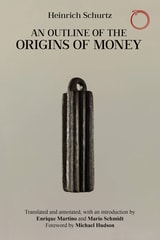
An Outline of the Origins of Money
Heinrich Schurtz
HAU, 2024
“On this subject, I only knew the excellent little book by the late Schurtz”—Marcel Mauss, 1914, Les origines de la notion de monnaie.
Heinrich Schurtz’s 1898 book has been a touchstone for economic historians, anthropologists, and philosophers interested in the nature and origins of money in various societies, including Georg Simmel, Max Weber, Marcel Mauss, and Karl Polanyi. In his brief book, Schurtz experimented with concepts about money, going beyond traditional economic paradigms. Drawing on an extensive range of archaeological and ethnographic sources, he reframed a theory of money to include its materiality, symbolic nature, relationship to forms of property, and its dual origin in “outside money” and “inside money.” While it is not well known today, it was important to the theorization of money in the first half of the 20th century and its innovative synthesis offers galvanizing questions and insights into how value relations are formed and how currency systems are interrelated.
Analyzing NES Music
Harmony, Form, and the Art of Technological ConstraintAndrew Schartmann
Intellect Books, 2025
Faced with severe technological constraints on system memory, composers of the Nintendo Entertainment System (NES) sought ways to disguise repetition in music that repeats extensively. Their efforts gave rise to a set of compositional techniques for creating the illusion of variety.
This book distills these techniques into a theory of harmony and form for the analysis of NES music. It then uses this theory to analyze five landmark scores of the NES era: Super Mario Bros., Dragon Warrior, Metroid, Mega Man 2, and Silver Surfer. The book also includes a detailed description of the NES hardware and its attendant constraints, highlighting the ever-evolving dialogue between technology, commercial demand, and artistic sensibility that characterizes video game music of the 1980s and 1990s.
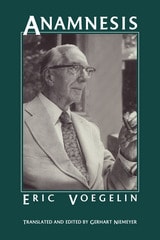
Anamnesis
On the Theory of History and PoliticsEric Voegelin, Edited & Translated by Gerhart Niemeyer
University of Missouri Press, 1990
Anamnesis pulls together those materials that focus most sharply upon the development of Eric Voegelin's philosophy of consciousness. Voegelin is considered one of the most influential and profound philosophers of our time and has had an enormous impact on contemporary intellectual life.

Anarchy Alive!
Anti-Authoritarian Politics From Practice to TheoryUri Gordon
Pluto Press, 2008
Anarchist politics are at the heart of today’s most vibrant and radical social movements. From squatted social centres and community gardens to acts of sabotage and raucous summit blockades, anarchist groups and networks are spreading an ethos of direct action, non-hierarchical organizing and self-liberation that has redefined revolutionary struggle for the 21st century.
Anarchy Alive! is a fascinating, in-depth look at the practice and theory of contemporary anarchism. Uri Gordon draws on his activist experience and on interviews, discussions and a vast selection of recent literature to explore the activities, cultures and agendas shaping today’s explosive anti-authoritarian revival. Anarchy Alive! also addresses some of the most tense debates in the contemporary movement, using a theory based on practice to provocatively reshape anarchist discussions of leadership, violence, technology and nationalism.
This is the ideal book for anyone looking for a fresh, informed and critical engagement with anarchism, as a mature and dynamic political force in the age of globalisation.

Anthropology in the Meantime
Experimental Ethnography, Theory, and Method for the Twenty-First CenturyMichael M. J. Fischer
Duke University Press, 2018
Anticipations of the General Theory?
And Other Essays on KeynesDon Patinkin
University of Chicago Press, 1982
Applications of Research in Music Behavior
Clifford K. Madsen
University of Alabama Press, 1991
Applications of Research in Music Behavior stresses the practical applications and implications of investigating music behavior in a systematic, objective manner. Specifically, the book focuses on factors influencing the teaching of children; efficient methods for instructing future teachers; elements affecting musical perception, likes, and dislikes; and innovative efforts to investigate new areas of study. Recent studies by twenty-six nationally known educators that use objective strategies associated with experimental and behavioral research are presented to illustrate how people learn about music and how people are taught to make music.
The research studies are introduced by an article emphasizing the usefulness of research literature in devising a teaching strategy and are grouped into four sections: Teaching Music to Children, Teaching Future Teachers, Preference and Perception, and New Horizons. The concluding article is an allegorical proposal for balance and perspective in the consideration of music education.

Archaeological Anthropology
Perspectives on Method and TheoryEdited by James M. Skibo, Michael W. Graves, and Miriam T. Stark
University of Arizona Press, 2014
In this collection of twelve new chapters, four generations of Longacre protégés show how they are building upon and developing but also modifying the theoretical paradigm that remains at the core of Americanist archaeology. The contributions focus on six themes prominent in Longacre’s career: the intellectual history of the field in the late twentieth century, archaeological methodology, analogical inference, ethnoarchaeology, cultural evolution, and reconstructing ancient society.
More than a comprehensive overview of the ideas developed by one of the most influential scholars in the field, however, Archaeological Anthropology makes stimulating contributions to contemporary research. The contributors do not unequivocally endorse Longacre’s ideas; they challenge them and expand beyond them, making this volume a fitting tribute to a man whose robust research and teaching career continues to resonate.
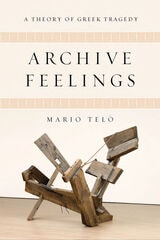
Archive Feelings
A Theory of Greek TragedyMario Telò
The Ohio State University Press, 2020
With bold readings of thirteen plays by Aeschylus, Sophocles, and Euripides, including the Oedipus cycle, the Oresteia,Medea, and Bacchae; an eclectic synthesis of Freud, Lacan, Derrida, Žižek, Deleuze, and other critical theorists; and an engagement with art, architecture, and film, Mario Telò’s Archive Feelings: A Theory of Greek Tragedy locates Greek tragedy’s aesthetic allure beyond catharsis in a vertiginous sense of giddy suspension, in a spiral of life and death that resists equilibrium, stabilization, and all forms of normativity. In so doing, Telò forges a new model of tragic aesthetics.
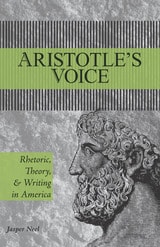
Aristotle's Voice
Rhetoric, Theory, and Writing in AmericaJasper Neel
Southern Illinois University Press, 1994
In this book, Jasper Neel’s sure-to-be-controversial resituating of Aristotle centers around three questions that have been constants in his twenty-two years of teaching experience: What does itmean to teach writing? What should one know before teaching writing? And, if there is such a thing as "research in the teaching of writing," what is it?
Believing that all composition teachers are situated politically and socially, both as part of the institution in which they teach and as beings with lived histories, Neel examines his own life and the life of composition studies as a discipline in the context of Aristotle. Neel first situates the Rhetoric as a political document; he then situates the Rhetoric in the Aristotelian system and describes how professional discourse came to know itself through Aristotle’s way of studying the world; finally, he examines the operation of the Rhetoric inside itself before arguing the need to turn to Aristotle’s notion of sophistry as a way of negating his system.
By pointing out the connections among Aristotelian rhetoric, the contemporary university, and the contemporary writing teacher, Neel shows that Aristotle’s frightening social theories are as alive today as are Aristotelian notions of discourse.
Neel explains that by their very nature teachers must speak with a professional voice. It is through showing how to "hear" one’s professional voice that Neel explores the notion of professional discourse that originates with Aristotle. In maintaining that one must pay a high price in order to speak through Aristotle’s theory or to assume the role of "professional," he argues that no neutral ground exists either for pedagogy or for the analysis of pedagogy. Neel concludes this discussion by proposing that Aristotelian sophistry is both an antidote to Aristotelian racism, sexism, and bigotry and a way of allowing Aristotelian categories of discourse to remain useful.
Finally, as an Aristotelian, a teacher, and a writer, Neel responds both to Aristotle and to professionalism by rethinking the influence of the past and reviving the voice of Aristotelian sophistry.
Art and Freedom
E. E. Sleinis
University of Illinois Press, 2002
What does a life with art offer that a life without art does not? Art and Freedom asserts that the fundamental point of the enterprise of art is the creation and delivery of values that are not singularly available in the nonart world.
E. E. Sleinis discusses visual art, literature, music, theater, and other art forms, arguing that as art both liberates and provides new points of focus and awareness, the art enterprise depends on a positive freeing from the nonart world, rather than on mere addition to it.
Art and Freedom introduces a novel classificatory system for representation, expression, and formalist theories of art. Sleinis argues that a characteristic defect of contemporary theories of art is their neglect of the issue of value. Challenging these reductive, formalist notions of art, he emphasizes the potential, and the need, for art to evolve and make progress in ways comparable to the sciences, albeit on a very different model.
A smart blend of incisive commentary and illuminating philosophy, Art and Freedom provides a useful context for transforming a sometimes baffling medium into a means of fostering personal growth and creating and sharing values.
Aspects of Orality and Formularity in Gregorian Chant
Theodore Karp
Northwestern University Press, 1998
The essays are loosely connected through their bearing on one or more of three themes: the role of orality in the transmission of chant circa 700-1400; varying degrees of stability or instability in the transmission of chant; and the role of the formula in the construction of chant. Throughout, Karp uses 202 musical examples.
The first essay evaluates forms of evidence that may shed light on the nature of orality that led to the surviving notational records of Gregorian chant and assembles evidence that supports the conclusion that fidelity of transmission represented an important goal of the Franks. The second essay treats formulas that cross the boundaries of individual liturgical genres and modes. The third essay defines the varying kinds of musical formulas in chant and proposes a chronological ordering of the genre of second-mode tracts.
The fourth essay treats the transmission of a stable melody and explores the ways in which one basic melody may be adapted to texts of widely differing structures and lengths. The fifth essay deals with a group of unstable melodies that furnished difficulties in modal classification. The sixth essay explores the problems faced by scribes seeking to represent in diastematic notation melodies employing tones not normally admitted into the medieval gamut. The seventh essay takes up the role of the formula in introits, a neumatic genre intended forchoral performance.
The two final essays look at second-mode tracts and at the interrelationship between Roman and Gregorian chant.
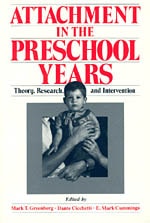
Attachment in the Preschool Years
Theory, Research, and InterventionEdited by Mark T. Greenberg, Dante Cicchetti, and E. Mark Cummings
University of Chicago Press, 1993
"There is a wealth of information and thought in this book; it does not have a weak or uninteresting chapter, starting with the Preface by Emde, and as a whole, it forms a sort of seminar."—John E. Bates, Contemporary Psychology
Attribute-Value Logic and the Theory of Grammar
Mark Johnson
CSLI, 1988
Autolexical Syntax
A Theory of Parallel Grammatical RepresentationsJerrold M. Sadock
University of Chicago Press, 1990
Sadock's principal innovation is the postulation of a uniform set of interface conditions that require the several orthogonal representations of a single natural language expression to match up in certain ways. Through a detailed application of his theory to the twin morphosyntactic problems of cliticization and incorporation, Sadock shows that very straightforward accounts are made possible by the nonderivational model. He demonstrates the empirical success of these accounts by examining more than two dozen morphosyntactic problems in almost as many languages.
Autolexical Syntax will be of interest to those in the fields of theoretical grammar, particularly concerned with the problems of morphology and syntax, as well as philosophers of language, logicians, lexicographers, psychologists of language, and computer scientists.