Results by title
4 books match the query 'Theory applications'

Active Sound and Vibration Control
Theory and applicationsOsman Tokhi
The Institution of Engineering and Technology, 2002
This book presents the established fundamentals in the area of active sound and vibration control (ASVC) as well as exploring the new and emerging technologies and techniques. There has been a considerable amount of effort devoted to the development and realisation of methodologies for the control of sound and vibration, and this book covers the latest theoretical, algorithmic and practical applications including: noise control in 3D propagation, adaptive algorithms, prediction, processing and tuning, neuro-active control, control of microvibrations, and noise reduction in locomotives and vehicles. Topics discussed include multichannel active noise control, adaptive harmonic control, model-free iterative tuning, model-based control design for active vibration control (AVC), ASVC using neural networks, genetic algorithms for ASVC systems, and active noise control (ANC) around the human head. The authors also discuss active control of microvibrations, vibration control of manipulators, and techniques of real-time processing. This book will be essential reading for electrical, mechanical and control engineers, designers and researchers, interested in noise and vibration control.
[more]
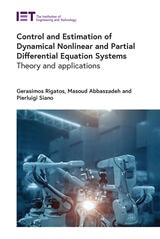
Control and Estimation of Dynamical Nonlinear and Partial Differential Equation Systems
Theory and applicationsGerasimos Rigatos
The Institution of Engineering and Technology, 2022
Robotic and mechatronic systems, autonomous vehicles, electric power systems and smart grids, as well as manufacturing and industrial production systems can exhibit complex nonlinear dynamics or spatio-temporal dynamics which need to be controlled to ensure good functioning and performance.
[more]
Signals and Systems
Theory and ApplicationsFawwaz T. Ulaby and Andrew E. Yagle
Michigan Publishing Services, 2018
This book has been replaced by a new edition. The second edition can be purchased at https://services.publishing.umich.edu/Books/S/Signals-and-Systems2 or accessed online as a free download.
[more]
Signals and Systems
Theory and ApplicationsFawwaz T. Ulaby and Andrew E. Yagle
Michigan Publishing Services, 2018
[From the Preface] This is a signals and systems textbook with a difference: Engineering applications of signals and systems are integrated into the presentation as equal partners with concepts and mathematical models, instead of just presenting the concepts and models and leaving the student to wonder how it all relates to engineering.
The first six chapters of this textbook cover the usual basic concepts of continuous-time signals and systems, including the Laplace and Fourier transforms. Chapters 7 and 8 present the discrete-time version of Chapters 1–6, emphasizing the similarities and analogies, and often using continuous-time results to derive discrete-time results. The two chapters serve to introduce the reader to the world of discrete-time signals and systems. Concepts highlighted in Chapters 1–8 include: compensator feedback configuration (Ch. 4); energy spectral density, group delay, expanded coverage of exponential Fourier series (Ch. 5); filtering of images, Hilbert transform, single-sideband (SSB), zero and first-order hold interpolation (Ch. 6); the Cooley-Tukey FFT (Ch. 7); bilateral z-transform and use for non-minimum-phase deconvolution (Ch. 8). Chapter 9 covers the usual concepts of discrete-time signal processing, including data windows, FIR and IIR filter design, multirate signal processing, and auto-correlation and crosscorrelation. It also includes some nontraditional concepts, including spectrograms, application of multirate signal processing, and the musical circle of fifths to audio signal processing, and some biomedical applications of autocorrelation and cross-correlation. Chapter 10 covers image processing, discrete-time wavelets (including the Smith-Barnwell condition and the Haar and Daubechies discrete-time wavelet expansions), and an introduction to compressed sensing. This is the first sophomore-junior level textbook the authors are aware of that allows students to apply compressed sensing concepts. Applications include: image denoising using 2-D filtering; image denoising using thresholding and shrinkage of image wavelet transforms; image deconvolution using Wiener filters; “valid” image deconvolution using ISTA; image inpainting; tomography and the projection-slice theorem, and image reconstruction from partial knowledge of 2-D DFT values. Problems allow students to apply these techniques to actual images and learn by doing, not by only reading.
The first six chapters of this textbook cover the usual basic concepts of continuous-time signals and systems, including the Laplace and Fourier transforms. Chapters 7 and 8 present the discrete-time version of Chapters 1–6, emphasizing the similarities and analogies, and often using continuous-time results to derive discrete-time results. The two chapters serve to introduce the reader to the world of discrete-time signals and systems. Concepts highlighted in Chapters 1–8 include: compensator feedback configuration (Ch. 4); energy spectral density, group delay, expanded coverage of exponential Fourier series (Ch. 5); filtering of images, Hilbert transform, single-sideband (SSB), zero and first-order hold interpolation (Ch. 6); the Cooley-Tukey FFT (Ch. 7); bilateral z-transform and use for non-minimum-phase deconvolution (Ch. 8). Chapter 9 covers the usual concepts of discrete-time signal processing, including data windows, FIR and IIR filter design, multirate signal processing, and auto-correlation and crosscorrelation. It also includes some nontraditional concepts, including spectrograms, application of multirate signal processing, and the musical circle of fifths to audio signal processing, and some biomedical applications of autocorrelation and cross-correlation. Chapter 10 covers image processing, discrete-time wavelets (including the Smith-Barnwell condition and the Haar and Daubechies discrete-time wavelet expansions), and an introduction to compressed sensing. This is the first sophomore-junior level textbook the authors are aware of that allows students to apply compressed sensing concepts. Applications include: image denoising using 2-D filtering; image denoising using thresholding and shrinkage of image wavelet transforms; image deconvolution using Wiener filters; “valid” image deconvolution using ISTA; image inpainting; tomography and the projection-slice theorem, and image reconstruction from partial knowledge of 2-D DFT values. Problems allow students to apply these techniques to actual images and learn by doing, not by only reading.
[more]