Results by title
3 books match the query 'Theosophy'
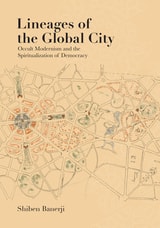
Lineages of the Global City
Occult Modernism and the Spiritualization of DemocracyShiben Banerji
University of Texas Press, 2025
2026 PROSE Award in Architecture & Urban Planning, Association of American Publishers (AAP)
2026 Book Prize Shortlist, Modernist Studies Association (MSA)
The forgotten history of the occult foundations of the early twentieth-century global city.
War, revolution, genocide, rebellion, slump. The economic and political turmoil of the early twentieth century seemed destined to rip asunder the ties that bound colonizers and the colonized to one another. The upheaval represented an opportunity, and not just to nationalists who imagined new homelands or to socialists who dreamed of international brotherhood. For modernists in the orbit of various occultisms, the crisis of empire also represented an opportunity to reveal humanity’s fundamental unity and common fate.
Lineages of the Global City recounts a continuous, if also contentious, transnational exchange among modernists and occultists across the Americas, Europe, South Asia, and Australia between 1905 and 1949. At stake were the feelings and affect of a new global subject who would perceive themselves as belonging to humanity as a unified whole, and the urban environment that would foster their subjectivity. The interventions in this debate, which drew in the period’s most renowned modernists, took the form of a succession of plans for cities, suburbs, and communes, as well as experiments in building, drawing, printmaking, filmmaking, and writing. Weaving together postcolonial, feminist, and Marxist insight on subject formation, Shiben Banerji advances a new way of understanding modernist urban space as the design of subjective effects.
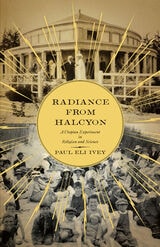
Radiance from Halcyon
A Utopian Experiment in Religion and SciencePaul Eli Ivey
University of Minnesota Press, 2013
In May 1904, the residents of Halcyon—a small utopian community on California’s central coast—invited their neighbors to attend the grand opening of the Halcyon Hotel and Sanatorium. As part of the entertainment, guests were encouraged to have their hands X-rayed. For the founders and members of Halcyon, the X-ray was a demonstration of mysterious spiritual forces made practical to human beings.
Radiance from Halcyon is the story not only of the community but also of its uniquely inventive members’ contributions to religion and science. The new synthesis of religion and science attempted by Theosophy laid the foundation for advances produced by the children of the founding members, including microwave technology and atomic spectral analysis. Paul Eli Ivey’s narrative starts in the 1890s in Syracuse, New York, with the rising of the Temple of the People, a splinter group of the theosophical movement. After developing its ideals for an agricultural and artisanal community, the Temple purchased land in California and in 1903 began to live its dream there.
In addition to an intriguing account of how a little-known utopian religious community profoundly influenced modern science, Ivey offers a wide-ranging cultural history, encompassing Theosophy, novel healing modalities, esoteric architecture, Native American concepts of community, socialist utopias, and innovative modern music.
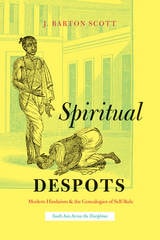
Spiritual Despots
Modern Hinduism and the Genealogies of Self-RuleJ. Barton Scott
University of Chicago Press, 2016
Through this alternative genealogy of the self-ruling subject, Spiritual Despots demonstrates that Hindu reform movements cannot be understood solely within the precolonial tradition, but rather need to be read alongside other movements of their period. The book’s focus moves fluidly between Britain and India—engaging thinkers such as James Mill, Keshub Chunder Sen, Max Weber, Karsandas Mulji, Helena Blavatsky, M. K. Gandhi, and others—to show how colonial Hinduism shaped major modern discourses about the self. Throughout, Scott sheds much-needed light how the rhetoric of priestcraft and practices of worldly asceticism played a crucial role in creating a new moral and political order for twentieth-century India and demonstrates the importance of viewing the emergence of secularism through the colonial encounter.