Results by title

6 books match the query 'Thomas, Deborah A.'
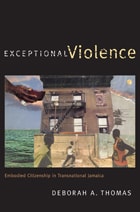
cover of Exceptional Violence: Embodied Citizenship in Transnational Jamaica

Exceptional Violence

Embodied Citizenship in Transnational Jamaica

Deborah A. Thomas

Duke University Press, 2011
Exceptional Violence is a sophisticated examination of postcolonial state formation in the Caribbean, considered across time and space, from the period of imperial New World expansion to the contemporary neoliberal era, and from neighborhood dynamics in Kingston to transnational socioeconomic and political fields. Deborah A. Thomas takes as her immediate focus violence in Jamaica and representations of that violence as they circulate within the country and abroad. Through an analysis encompassing Kingston communities, Jamaica’s national media, works of popular culture, notions of respectability, practices of punishment and discipline during slavery, the effects of intensified migration, and Jamaica’s national cultural policy, Thomas develops several arguments. Violence in Jamaica is the complicated result of a structural history of colonialism and underdevelopment, not a cultural characteristic passed from one generation to the next. Citizenship is embodied; scholars must be attentive to how race, gender, and sexuality have been made to matter over time. Suggesting that anthropologists in the United States should engage more deeply with history and political economy, Thomas mobilizes a concept of reparations as a framework for thinking, a rubric useful in its emphasis on structural and historical lineages.
[more]
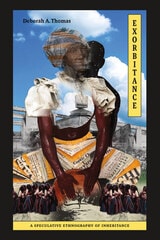
cover of Exorbitance: A Speculative Ethnography of Inheritance

Exorbitance

A Speculative Ethnography of Inheritance

Deborah A. Thomas

Duke University Press, 2025

In Exorbitance, Deborah A. Thomas calls for new approaches to political sovereignty grounded in the embodied forms of autonomy and relation created in daily life. Rather than rooting sovereignty in the violence of the state and its institutions, Thomas conceives of sovereignty as the embodied refusal of law and dominion. Drawing on the insights of Caribbeanist thought and studies of Jamaican social, political, and spiritual life, Thomas proposes an exorbitant sovereignty enacted through a phenomenological notion of inheritance. Such a sovereignty emerges from alternative genealogies of governance, community, and ceremony that exceed Enlightenment expectations of political life. Thomas contends that the articulations of exorbitant sovereignty are emergent, ephemeral, and ultimately, relational. By outlining the perils and promises of our inheritance of colonial logics and the tools to refuse them, Thomas models a collaborative and collective anthropology oriented toward improvisational experimentation rather than ethnographic extraction.
[more]
cover of Globalization and Race: Transformations in the Cultural Production of Blackness

Globalization and Race

Transformations in the Cultural Production of Blackness

Kamari Maxine Clarke and Deborah A. Thomas, eds.

Duke University Press, 2006

Kamari Maxine Clarke and Deborah A. Thomas argue that a firm grasp of globalization requires an understanding of how race has constituted, and been constituted by, global transformations. Focusing attention on race as an analytic category, this state-of-the-art collection of essays explores the changing meanings of blackness in the context of globalization. It illuminates the connections between contemporary global processes of racialization and transnational circulations set in motion by imperialism and slavery; between popular culture and global conceptions of blackness; and between the work of anthropologists, policymakers, religious revivalists, and activists and the solidification and globalization of racial categories.

A number of the essays bring to light the formative but not unproblematic influence of African American identity on other populations within the black diaspora. Among these are an examination of the impact of “black America” on racial identity and politics in mid-twentieth-century Liverpool and an inquiry into the distinctive experiences of blacks in Canada. Contributors investigate concepts of race and space in early-twenty-first century Harlem, the experiences of trafficked Nigerian sex workers in Italy, and the persistence of race in the purportedly non-racial language of the “New South Africa.” They highlight how blackness is consumed and expressed in Cuban timba music, in West Indian adolescent girls’ fascination with Buffy the Vampire Slayer, and in the incorporation of American rap music into black London culture. Connecting race to ethnicity, gender, sexuality, nationality, and religion, these essays reveal how new class economies, ideologies of belonging, and constructions of social difference are emerging from ongoing global transformations.

Contributors. Robert L. Adams, Lee D. Baker, Jacqueline Nassy Brown, Tina M. Campt, Kamari Maxine Clarke, Raymond Codrington, Grant Farred, Kesha Fikes, Isar Godreau, Ariana Hernandez-Reguant, Jayne O. Ifekwunigwe, John L. Jackson Jr., Oneka LaBennett, Naomi Pabst, Lena Sawyer, Deborah A. Thomas

[more]
cover of Modern Blackness: Nationalism, Globalization, and the Politics of Culture in Jamaica

Modern Blackness

Nationalism, Globalization, and the Politics of Culture in Jamaica

Deborah A. Thomas

Duke University Press, 2004

Modern Blackness is a rich ethnographic exploration of Jamaican identity in the late twentieth century and early twenty-first. Analyzing nationalism, popular culture, and political economy in relation to one another, Deborah A. Thomas illuminates an ongoing struggle in Jamaica between the values associated with the postcolonial state and those generated in and through popular culture. Following independence in 1962, cultural and political policies in Jamaica were geared toward the development of a multiracial creole nationalism reflected in the country’s motto: “Out of many, one people.” As Thomas shows, by the late 1990s, creole nationalism was superseded by “modern blackness”—an urban blackness rooted in youth culture and influenced by African American popular culture. Expressions of blackness that had been marginalized in national cultural policy became paramount in contemporary understandings of what it was to be Jamaican.

Thomas combines historical research with fieldwork she conducted in Jamaica between 1993 and 2003. Drawing on her research in a rural hillside community just outside Kingston, she looks at how Jamaicans interpreted and reproduced or transformed on the local level nationalist policies and popular ideologies about progress. With detailed descriptions of daily life in Jamaica set against a backdrop of postcolonial nation-building and neoliberal globalization, Modern Blackness is an important examination of the competing identities that mobilize Jamaicans locally and represent them internationally.
[more]
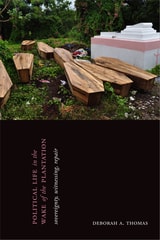
cover of Political Life in the Wake of the Plantation: Sovereignty, Witnessing, Repair

Political Life in the Wake of the Plantation

Sovereignty, Witnessing, Repair

Deborah A. Thomas

Duke University Press, 2019
In 2010, Jamaican police and military forces entered the West Kingston community of Tivoli Gardens to apprehend Christopher “Dudus” Coke, who had been ordered for extradition to the United States on gun and drug-running charges. By the time Coke was detained, somewhere between seventy-five and two hundred civilians had been killed. In Political Life in the Wake of the Plantation, Deborah A. Thomas uses the incursion as a point of departure for theorizing the roots of contemporary state violence in Jamaica and in post-plantation societies in general. Drawing on visual, oral historical, and colonial archives, Thomas traces the long-term legacies of the plantation system and how its governing logics continue to shape and replicate forms of violence. She places affect at the center of sovereignty to destabilize disembodied narratives of liberalism and progress and to raise questions about recognition, repair, and accountability. In tying theories of politics, colonialism, race, and affect together with Jamaica's history, Thomas presents a robust framework for understanding what it means to be human in the plantation's wake.
[more]
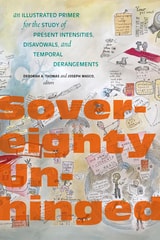
cover of Sovereignty Unhinged: An Illustrated Primer for the Study of Present Intensities, Disavowals, and Temporal Derangements

Sovereignty Unhinged

An Illustrated Primer for the Study of Present Intensities, Disavowals, and Temporal Derangements

Deborah A. Thomas and Joseph Masco, editors

Duke University Press, 2023

Sovereignty Unhinged theorizes sovereignty beyond the typical understandings of action, control, and the nation-state. Rather than engaging with the geopolitical realities of the present, the contributors consider sovereignty from the perspective of how it is lived and enacted in everyday practice and how it reflects people’s aspirations for new futures. In a series of ethnographic case studies ranging from the Americas to the Middle East to South Asia, they examine the means of avoiding the political and historical capture that make one complicit with sovereign authority rather than creating the conditions of possibility to confront it. The contributors attend to the affective dimensions of these practices of world-building to illuminate the epistemological, ontological, and transnational entanglements that produce a sense of what is possible. They also trace how sovereignty is activated and deactivated over the course of a lifetime within the struggle of the everyday. In so doing, they outline how individuals create and enact forms of sovereignty that allow them to endure fast and slow forms of violence while embracing endless opportunities for building new worlds.

Contributors. Alex Blanchette, Yarimar Bonilla, Jessica Cattelino, María Elena García, Akhil Gupta, Lochlann Jain, Purnima Mankekar, Joseph Masco, Michael Ralph, Danilyn Rutherford, Arjun Shankar, Kristen L. Simmons, Deborah A. Thomas, Leniqueca A. Welcome, Kaya Naomi Williams, Jessica Winegar
[more]