Results by title

29 books match the query 'Thomas Aquinas'
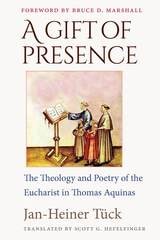
cover of A Gift of Presence: The Theology and Poetry of the Eucharist in Thomas Aquinas

A Gift of Presence

The Theology and Poetry of the Eucharist in Thomas Aquinas

Jan Heiner Tück

Catholic University of America Press, 2018
Jan-Heiner Tück presents a work that explores the sacramental theology, lived spirituality, and Eucharistic poetry of the Church’s doctor communis, St. Thomas Aquinas. Although Aquinas’ Eucharistic poetry has long occupied an important place in the Church’s liturgical prayer and her repertoire of sacred music, the depth of these poems remains hidden until one grasps the rich sacramental theology underlying it. Consequently, Tück first offers a detailed but approachable primer of Aquinas’ theology of the sacraments, before diving deeply into the Angelic Doctor’s theology and poetry of the Eucharist. The Scriptural accounts stand at the heart of the systematic framework developed by Aquinas, and thus significant attention is devoted to showing the harmony between the accounts of Christ’s passion and the detailed exposition of the Summa theologiae. Moreover, the Eucharistic controversies of the ninth and eleventh centuries provide the contrapuntal context in which Aquinas did his thinking, praying, and writing. Not surprisingly, therefore, the response he crafts to these controversies draws upon both speculative powers and contemplative prayer, brought together in the unity of Aquinas’ theology and spirituality. The net result is a twofold treasure for the Church: a careful systematic presentation of Eucharistic theology and the lived devotional expression of the same in the carefully constructed—and now much beloved—stanzas of Pange lingua gloriosi, Lauda Sion, Adoro te devote, etc. By revealing the lively interplay of the saint’s powerful speculative intellect and a heart steeped in love for the Eucharistic Lord, Tück offers a sophisticated exposition of Aquinas’ Eucharistic poetry and the roots it sinks into a wider theological framework. Finally, the contemporary significance and power of Aquinas’ work is drawn out, not only in the rarefied realm of intellectual inquiry but also in the everyday expanse of ordinary life.
[more]
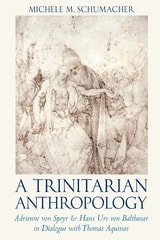
cover of A Trinitarian Anthropology: Adrienne von Speyr & Hans Urs von Balthasar in Dialogue with Thomas Aquinas

A Trinitarian Anthropology

Adrienne von Speyr & Hans Urs von Balthasar in Dialogue with Thomas Aquinas

Michele M. Schumacher

Catholic University of America Press, 2014
In this magisterial work, Michele M. Schumacher seeks to promote dialogue between disciples of the Swiss theologian Hans Urs von Balthasar (d. 1988) and those of the church's common doctor, St. Thomas Aquinas (d. 1274) on a critical theological question. How are analogies and metaphors from the philosophy and theology of the person (anthropology) rightly used to address the mystery of the Trinity? She does so by considering the specific setting of Balthasar's theology: the inseparability of his work from that of the Swiss physician and mystic Adrienne von Speyr (d. 1967).
[more]
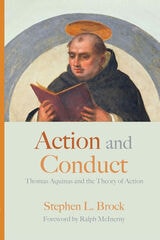
cover of Action and Conduct: Thomas Aquinas and the Theory of Action

Action and Conduct

Thomas Aquinas and the Theory of Action

Stephen Brock

Catholic University of America Press, 2021

"Both Thomistic scholars and analytic philosophers interested in theories of human action and accountability will find this book a welcome addition to their libraries. Truly a substantive addition to both Thomistic scholarship and the ongoing analytic investigation into human action and responsible agency."—American Catholic Philosophical Quarterly

"A first-rate book...Brock's lucid and illuminating analysis offers much of value to both intellectual historians and theologians, as well as philosophers."—Theological Studies"Brock's treatment of Aquinas's account of action exhibits a rare combination of rigor and learning. It is, no doubt, the best we have."—The Thomist
[more]
cover of Ethica Thomistica: The Moral Philosophy of Thomas Aquinas

Ethica Thomistica

The Moral Philosophy of Thomas Aquinas

Ralph McInerny

Catholic University of America Press, 1997

First published fifteen years ago, Ethica Thomistica is widely recognized as one of the finest introductions to St. Thomas's moral philosophy. Though the book has been out of print for several years, scholars and students still refer to it as the standard resource on Thomistic ethics. In this much-anticipated, revised edition, Ralph McInerny revisits the basics of Thomas's teachings and offers a brief, intelligible, and persuasive summary.


Chapters: Morality and Human Life; The Good for Man; Ultimate End and Moral Principles; The Structure of the Human Act; Good and Evil Action; Character and Decision; Prudence and Conscience; Religion and Morality ABOUT THE AUTHOR:


Ralph McInerny is Michael P. Grace Professor of Medieval Studies and director of the Jacques Maritain Center at the University of Notre Dame, where he has taught since 1955. He is founder and publisher of Catholic Dossier magazine; cofounder of Crisis magazine; and author of several books published by CUA Press, including Aquinas on Human Action (1992), The Question of Christian Ethics (1993), and Aquinas and Analogy (1996).


PRAISE FOR THE BOOK:


"Remarkable for its moderation and common sense. . . . [McInerny] rapidly sketches selected themes from Thomistic moral thinking: what distinguishes the moral activities of man, what is distinctive of moral goodness (in Aristotle and in Aquinas), an analysis of practical reason in relation to natural law, the bases for judging good and evil moral actions, the roles of intellect and will in voluntary activity, the work of virtues as components of moral character, the functions of prudence and conscience, and finally the relation of ethics to religious belief. . . . For the person who desires a quick and understandable introduction to this subject, this little book can be recommended as readable and reliable."—Vernon J. Bourke, Speculum "An important contribution both to moral philosophy and to its teaching. . . . [McInerny] has put us all in his debt by writing it."—Alasdair MacIntyre, Teaching Philosophy "A clear, thorough and readable introduction to the thought of one of the intellectual giants of the Catholic moral tradition."—National Catholic Register
[more]
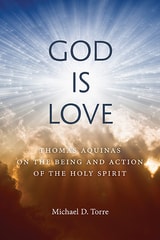
cover of God Is Love: Thomas Aquinas on the Being and Action of the Holy Spirit

God Is Love

Thomas Aquinas on the Being and Action of the Holy Spirit

Michael D. Torre

Catholic University of America Press, 2026
This book dedicates three essays each to three different theological problems regarding the Holy Spirit: In God and for Us (The "Filioque" and "Uncreated Grace"); Thomas's Understanding (Not His Commentators) of the Relation between nature and sanctifying grace; and our ability (and that of the angels at their creation) in fact to resist God' grace and thus be the first cause of sin. This later problem is developed in an "excursus" on the way God moves the free will, one that takes into consideration much recent work on this issue and situates the essays' position in relation to it. The book ends with a brief epilogue on the credibility of God, again giving Thomas's account of this. The principal aim throughout is to understand the doctrine of Thomas Aquinas. It places his views in relation to three audiences: chiefly to the orthodox regarding the first issue; to Catholics in relation to the second; and to Protestants in relation to the third. Thus, its second aim is to join "ecumenical debate" about these matters. The essays were mostly written to be delivered orally, to an informed audience of philosophers and theologians., but one that consisted of "generalists" and serious students of Thomas, as well as of "professional" philosophers and theologians. All three of the debated issues discussed have generated an enormous amount of disagreement and debate, not a little of it being quite "technical." Thus, each issue would easily require a long and significant book to be addressed as it deserves. The essays do not do this, but they do indicate what Torre holds is the "directive line" of Thomas's thought that deserves to be defended and developed in each case, and, in each case, this line is held to be markedly different than many have thought it to be.
[more]
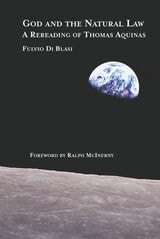
cover of God and the Natural Law: Reading of Thomas Aquinas

God and the Natural Law

Reading of Thomas Aquinas

Fulvio Di Blasi

St. Augustine's Press, 2006

It seems that to retain credibility in a post-Kantian and analytic world, contemporary natural law theory has tried to show its independence both from God and from human nature. But can there be a natural-law theory without the “natural” – not grounded in facts of nature – and without “law” – not in need of a Legislator? In God and the Natural Law, Fulvio Di
Blasi begins with an original analysis of the current debate in ethics, jurisprudence, and politics in order to set the stage for a sound understanding of the concept of natural law. This leads to the heart of the book: a recovery of the authentic meaning of the two main concepts of classical natural-law theory as synthesized by Thomas Aquinas – the will of God and the order of nature.
 
The wide revival of practical philosophy and ethics of objective-values in recent decades has involved a robust rediscovery of classical natural-law theory. This rediscovery is marked by two main traits: an emphasis on the autonomy of practical reason (as a reaction to modern voluntarism centered on the external will of the legislator); and an emphasis on the originality of practical reason (as a reaction to the idea of a rational deduction of
moral truths from the facts of nature). Without denying an autonomous character to ethics, or the need for a strong critique of moral rationalism, Di Blasi argues that Aquinas’s thought remains unintelligible if we remove from it either God or the metaphysical understanding of
nature.
 
[more]
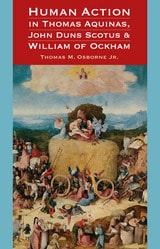
cover of Human Action in Thomas Aquinas, John Duns Scotus, and William of Ockham

Human Action in Thomas Aquinas, John Duns Scotus, and William of Ockham

Thomas M. Osborne Jr.

Catholic University of America Press, 2014
This book sets out a thematic presentation of human action, especially as it relates to morality, in the three most significant figures in Medieval Scholastic thought: Thomas Aquinas, John Duns Scotus, and William of Ockham
[more]
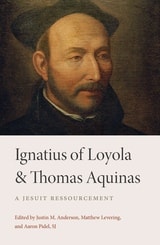
cover of Ignatius of Loyola and Thomas Aquinas: A Jesuit Ressourcement

Ignatius of Loyola and Thomas Aquinas

A Jesuit Ressourcement

Justin M. Anderson

Catholic University of America Press, 2023
Though the relationship between Jesuits and Dominicans has historically been marked by theological controversy, Ignatius of Loyola, the founder of the Jesuits, shows remarkable affinity for the Thomistic tradition, the tradition advanced above all by the Dominican order. When writing the Jesuit Constitutions, in fact, Ignatius made Thomas Aquinas’s Summa Theologiae the primary textbook for Jesuit theological formation. The contributions to this volume—originating from Jesuits, Dominicans, and lay scholars alike—explore different aspects of the complex yet illuminating relationship between Ignatius and Thomas. The themes range from the general relationship between the early Jesuits and scholastic theology to the attempts by Francisco de Toledo, the first Jesuit cardinal, to apply Thomistic reasoning to the religious and legal status of Jewish converts to Christianity. Other contributions compare Ignatius and Thomas on topics of significant interest for dogmatic, sacramental, and spiritual theology: spiritual experience, the ordering of the passions, the use of the imagination, prudence and discernment of spirits, frequent communion, Mariology, the “hierarchical church,” and the limits of obedience. Students of Ignatius of Loyola, Thomas Aquinas, second scholasticism, Christian-Jewish relations, and spiritual theology in general will find this volume an invaluable contribution.
[more]
cover of Liturgical Theology in Thomas Aquinas: Sacrifice and Salvation History

Liturgical Theology in Thomas Aquinas

Sacrifice and Salvation History

Franck Quoex

Catholic University of America Press, 2023
In this volume, Fr. Franck Quoëx responds to Joseph Ratzinger’s call for a renewed appreciation of liturgical rite. A student of Pierre Gy, OP, he brings to this study of Aquinas’s liturgical theology a rare combination of expert knowledge of liturgical sources and history and the best of modern historical-critical research guided by sound theological judgment. Fr. Quoëx frames his study with an overview of the problem of rite in modern theological-anthropological discourse, before turning to Aquinas’ theory of worship in the treatise on the virtue of religion. He then explores Aquinas’ doctrine on the cultic dimensions of the Eucharist and other sacraments in his sacramental theology more broadly, finishing with a close study of the mass commentary of the Tertia Pars. Although there has been increasing attention to Thomas’s treatment of religion as a virtue, none have approached him from an anthropological angle with a focus on the nature of liturgical rite, or fully exploited the perspectives of liturgical scholarship to shed light on sacramental theology. Quoëx’s work, as the work of a Thomist, liturgist, and medievalist well versed in medieval liturgical development and in the genre of often-allegorical liturgical commentary, opens up this crucial but neglected facet of Aquinas’ theological synthesis. Few books have been published on Aquinas’s liturgical theology. Now that interest in Aquinas’s virtue theory and sacramental theology is growing rapidly, Quoëx’s studies are an invitation to further reflection on the topic of Aquinas’s liturgical theology with its manifold ramifications for and connections with other theological topics in his Summa, including his theological anthropology, his soteriology, his treatment of the Old and New Laws, and his account of the virtue of religion in connection with the other virtues.
[more]
cover of Metaphysical Themes in Thomas Aquinas

Metaphysical Themes in Thomas Aquinas

John F. Wippel

Catholic University of America Press, 1995
In this volume, John Wippel has collected a number of his essays dealing with Aquinas's metaphysical thought. The volume begins with a presentation and critical evaluation of certain twentieth-century attempts to describe the philosophical thought of Thomas Aquinas as a "Christian philosophy."
[more]
cover of On Creation [Quaestiones Disputatae de Potentia Dei, Q. 3]

On Creation [Quaestiones Disputatae de Potentia Dei, Q. 3]

Catholic University of America Press, 2011
No description available
[more]
cover of Peace in the Thought of Thomas Aquinas: Philosophy, Theology, and Ethics

Peace in the Thought of Thomas Aquinas

Philosophy, Theology, and Ethics

John M. Meinert

Catholic University of America Press, 2024
What does Aquinas have to teach us on the topic of peace? Looking over the scholarly literature, one would think very little. Most Thomists ignore Aquinas’s thought on peace. Most peace researchers summarily dismiss Aquinas. Peace in the Thought of Thomas Aquinas challenges both these trends and offers the first book length study of peace in Aquinas’s thought. John Meinert outlines Aquinas's historical predecessors, then provides an exposition and interpretation of the full scope of Aquinas's thought on peace: metaphysics, Trinitarian theology, Christology, Pneumatology, ecclesiology, natural theology, ethics, and sacramental theology. What emerges from this extended study is a new vision of Aquinas’s work. Peace in the Thought of Thomas Aquinas establishes Aquinas as an indispensable dialogue partner for anyone thinking rigorously about the theology, philosophy, and ethics of peace. As Aquinas himself says, “observe peace and you will come to salvation.”
[more]
cover of Reading Aristotle with Thomas Aquinas: His Commentaries on Aristotle's Major Works

Reading Aristotle with Thomas Aquinas

His Commentaries on Aristotle's Major Works

Leo J. Elders

Catholic University of America Press, 2022
Reading Aristotle with Thomas Aquinas: His Commentaries on Aristotle’s Major Works offers an original and decisive work for the understanding of the thought of Thomas Aquinas. For decades his commentaries on the major works of Aristotle have been the subject of lively discussions. Are his commentaries faithful and reliable expositions of the Stagirite's thought or do they contain Thomas’s own philosophy and are they read through the lens of Thomas’s own Christian faith and in doing so possibly distorting Aristotle? In order to be able to provide clarity and offer a nuanced response to this question a careful study of all the relevant texts is needed. This is precisely what the author sets out do to in this work. Each chapter is devoted to one of the twelve commentaries Thomas wrote on major works of Aristotle including both his massive and influential commentaries on the Metaphysics, Physics and Nicomachean Ethics as well as lesser known commentaries. Elders places Thomas’s commentary in its historical context, reviews the Greek, Arabic and Latin translation and reception of Aristotle’s text as well as contemporary interpretations thereof and presents the reader with a thorough presentation and analysis of the content of the commentary, drawing attention to all the places where Thomas intervenes and makes special observations. In this way the reader can study Aristotle’s treatises with Thomas as guide. The conclusion reached is that Thomas’s commentaries are a masterful and faithful presentation of Aristotle’s thought and of that of Thomas himself. Thomas’s Christian faith does not falsify Aristotle’s text, but gives occasionally an outlook at what lies behind philosophical thought.
[more]
cover of Salvation through Temptation: Maximus the Confessor and Thomas Aquinas on Christ's Victory over the Devil

Salvation through Temptation

Maximus the Confessor and Thomas Aquinas on Christ's Victory over the Devil

Benjamin E. Heidgerken

Catholic University of America Press, 2021
Salvation through Temptation describes the development of predominant Greek and Latin Christian conceptions of temptation and of the work of Christ to heal and restore humankind in the context of that temptation, focusing on Maximus the Confessor and Thomas Aquinas as well-developed examples of Greek and Latin thought on these matters. Maximus and Thomas represent two trajectories concerning the woundedness of human emotionality in the wake of the primordial human sin. Heidgerken argues that Maximus stands in essential continuity with earlier Greek ascetic theology, which conceives of the weakness of fallen humankind in demonological categories, so that the Pauline law of sin is bound to external demonic agents that act upon the human mind through thoughts, desires, and sensory impressions. For Thomas, on the other hand, this wound consists primarily of an internal disordering of the faculties that results from the withdrawal of original grace: concupiscence or the fomes peccati. Yet even in this framework, the devil plays a significant role in Thomas’s account of postlapsarian temptation. On the basis of these differing frameworks for human temptation, Heidgerken demonstrates the centrality of Christ’s exemplarity in the Greek account and the centrality of Christ’s moral perfections in the Latin account. As a consequence of these emphases, the Greek tradition of Maximus places distinct limits on the ability of human emotionality (even that of Christ) to be perfected in this life, whereas Thomas’s approach allows Christ to completely embody a perfected form of human emotionality in his earthly life. Reciprocally, Thomas’s account of Christ’s moral perfections and virtue places distinct limits on his affirmation of Christ’s experience of postlapsarian temptation, whereas Maximus’s account allows for Christ to experience interior forms of temptation that more closely mirror the concrete moral experiences and circumstances of fallen human beings. Salvation through Temptation recommends a retrieval of early ascetic theology and demonology as the best contemporary systematic and ecumenically-viable approach to Christ’s temptation and victory over the devil.
[more]
cover of Speaking the Incomprehensible God: Thomas Aquinas on the Interplay of Positive and Negative Theology

Speaking the Incomprehensible God

Thomas Aquinas on the Interplay of Positive and Negative Theology

Gregory P. Rocca O.P.

Catholic University of America Press, 2004
Gregory Rocca's nuanced discussion prevents Aquinas's thought from being capsulized in familiar slogans and is an antidote to unilateralist or monochrome views about God-talk.
[more]
cover of The Concept of <i>Ius</i> and the Nature of Law in Thomas Aquinas

The Concept of <i>Ius</i> and the Nature of Law in Thomas Aquinas

Loic-Marie Le Bot, OP

Catholic University of America Press, 2025
This collection of essays constitutes the fruit of a scholarly conference held in Rome in April 2023, which was organized by the Pontifical University of Saint Thomas Aquinas, the Pontifical University of the Holy Cross, and the Angelicum Thomistic Institute. The essays offer a scholarly reflection on various historical and doctrinal aspects of Aquinas’s concept of ius, and on the extent to which this concept helps to illuminate his account of the nature of law, that is, of the juridical phenomenon. Each essay addresses, from the viewpoint of its specific topic, the implications of the Angelic Doctor’s description of ius as the object of justice, as presented in the Secunda secundae of his Summa theologiae (starting from question 57, article 1). Following Aquinas’s own insights, the focus on the virtue of justice is thus deemed crucial for understanding the essence or the ontological fabric of law. Justice is simultaneously analyzed as always remaining inherently connected to its moral and divine-salvific aspects. The volume is divided in three parts. The first part of the collection contains essays that are dedicated to the analysis of Aquinas’s concept of ius in a historical perspective. The second group of essays in this collection examine some further doctrinal and contextual issues pertinent to the essence of ius. Each attempt to elucidate the ontology of law should be supported by the aptitude of the resulting accounts of law’s nature to provide workable platforms for legal practices. This line of reasoning represents the rationale for the third part of this collection, which focuses on the matters of applying Aquinas’s concept of ius in systemic and practical legal settings of State law and canon law.
[more]
cover of The Discovery of Being and Thomas Aquinas

The Discovery of Being and Thomas Aquinas

Christopher M. Cullen, SJ

Catholic University of America Press, 2019

While there has been agreement among followers of Aquinas that being insofar as it is being (being qua being) is the subject of metaphysics, there is not agreement on how this being qua being is to be understood, nor on how we come to know the being that is the object of metaphysical investigation. The topic of what being is, as the object of the science of metaphysics, and how to account for the “discovery” of the being of metaphysics have emerged as central problems for the contemporary retrieval of Aquinas and for the larger project of post-Leonine Thomism in general. This lack of agreement has hampered the retrieval of Aquinas’s metaphysics.

The collection of essays within The Discovery of Being and Thomas Aquinas is divided into three major parts: the first set of essays concerns the foundation of metaphysics within Thomism; the second set exemplifies the use of metaphysics in fundamental philosophical issues within Thomism; and the third set employs metaphysics in central theological issues.

The Discovery of Being and Thomas Aquinas allows major scholars of the different types of Thomism to engage in a full-scale defense of their position, as well as expanding Thomistic metaphysics to the discipline of theology in important ways.
[more]
cover of The Metaphysics of Knowledge and Politics in Thomas Aquinas

The Metaphysics of Knowledge and Politics in Thomas Aquinas

Rocco Buttiglione

St. Augustine's Press, 2020

Metafisica della Conoscenza e Politica in S. Tommaso d’Aquino was originally published in Bologna in 1985 by the Centro Studi Europa Orientale. This English translation has been prepared with the explicit permission and encouragement of Buttiglione. The work grew from a series of lectures Buttiglione gave on the relationship between metaphysics, knowledge, and politics based on a critical reading of Thomas Aquinas’s Commentary on Aristotle’s Politics and other relevant texts. His aim was to advance Thomistic thinking by incorporating the insights of modern philosophy on subjectivity and relationality. 

In addition to its primary audience of philosophers, theologians, and political theorists, the book surprisingly enjoyed a wide general readership in Italy at the time of its publication. It represented an exciting attempt to harmonize medieval philosophy and the insights of personalism that had already had a deep impact on European intellectual life. Buttiglione was able to describe this attempt in a way accessible to a general readership, and in a way that confronted the political challenges Italy had been confronting for the last forty years.

Now, thirty-five years after the book’s initial publication, the conclusions Buttiglione draws from reading Thomas Aquinas’s commentary on Aristotle’s Politics––and the connections he makes between philosophy, theology, and political theory––are more relevant than ever. He argues that the traditional definition of “person” as rationalis naturae individua substantia––an individual substance or substrate (hypokeimenon) of a rational nature––“lacks that certain element that makes Augustine’s approach to personhood so appealing.” Hence Aquinas’s definition “is left wanting since it fails to elaborate on the crucial aspect of interpersonal relationship.”

The ingenuous way in which Buttiglione enlivens Thomistic political thinking with personalist philosophy helps to explain not only why free societies are more stable, tolerant, and respectful of human rights than totalitarian states, but theocratic ones as well. Only by raising the interpersonal aspects of political society to an ontological level—indeed, only by affirming and esteeming the self-transcendence of the human person as evidenced through ontological analysis—do the personal relationships that root and enliven the human person also lead to a realistic, dynamic, and convincing vision of the person’s real existence. 

Buttiglione was startlingly prescient of the problems we confront at the beginning of the third millennium. This book will spark new discussions as it explains the importance of both the medieval tradition and twentieth-century personalism. The book also draws on a wide range of secondary sources unavailable to English readers that I and will have the unique ability to introduce readers to the “Italian” way of relating speculative and political philosophy in a relatively slim volume. 
[more]
cover of The One Creator God in Thomas Aquinas and Contemporary Theology

The One Creator God in Thomas Aquinas and Contemporary Theology

Michael J. Dodds, OP

Catholic University of America Press, 2020
This book provides a fundamental introduction to Aquinas's theology of the One Creator God. Aimed at making that thought accessible to contemporary audiences, it gives a basic explanation of his theology while showing its compatibility with contemporary science and its relevance to current theological issues. Opening with a brief account of Aquinas’s life, it then describes the purpose and nature of the Summa Theologica and gives a short review of current varieties of Thomism. Without neglecting other works, it then focuses primarily on the discussion of the One God in the first part of the Summa Theologica. God's transcendence and immanence is a recurrent theme in that discussion. Evidence of God's immanent causality in the natural world grounds Aquinas's five arguments for the existence of God (the Five Ways) which then open onto God's transcendence. The subsequent discussion of the divine attributes builds on the modes of God's causality established in the Five Ways. It also shows the need for a language of analogy to preserve God's transcendence and prevent us from reducing God to the level of creatures, even as qualities such as "goodness" and "love," which we first know from creatures, are applied to God. The discussion of God's providence and governance establishes that the transcendent Creator God is most intimately present in creation. God acts in all creatures in a way that does not diminish their proper causality, but is rather its source. As there is no contradiction between God's transcendence and immanence, so there is no competition between the primary causality of God and the secondary causality of creatures. Empirical science, which is limited by its method to the secondary causality of creatures, is shown to be compatible with the broader discipline of theology which also embraces the primary causality of the Creator.
[more]
cover of The Unchanging God of Love: Thomas Aquinas and Contemporary Theology on Divine Immutability (Second Edition)

The Unchanging God of Love

Thomas Aquinas and Contemporary Theology on Divine Immutability (Second Edition)

Michael J. Dodds, O.P.

Catholic University of America Press, 2008
The Unchanging God of Love provides a clear and comprehensive account of what Aquinas really says about divine immutability, presented in a way that allows his theology to address contemporary criticisms
[more]
cover of Thomas Aquinas

Thomas Aquinas

Pasquale Porro

Catholic University of America Press, 2016
The development of ideas in Thomas Aquinas's philosophical thinking has been the subject of numerous smaller studies, but no contemporary work in the English-speaking world covers his every single work in chronological order in terms of philosophical development, influences, manuscript evidence, and historical setting. In Thomas Aquinas: A Historical and Philosophical Profile, Pasquale Porro has provided a complete landscape of Thomas's corpus that will give Thomistic scholars and students an invaluable reference point for research, discussion, and debate.
[more]
cover of Thomas Aquinas and His Legacy

Thomas Aquinas and His Legacy

David M. Gallagher

Catholic University of America Press, 2018
The ten essays in this collection approach the philosophy of Thomas Aquinas not merely as an object of scholarly interest but also as a framework for addressing perennial philosophical questions, even as they are raised and debated in our own times. The f
[more]
cover of Thomas Aquinas and His Predecessors: The Philosophers and the Church Fathers

Thomas Aquinas and His Predecessors

The Philosophers and the Church Fathers

Leo J. Elders

Catholic University of America Press, 2018
Thomas Aquinas and His Predecessors takes us on a voyage through the history of philosophical thought as present in the works of Thomas Aquinas. It is a synthetic presentation of the works and thought of the great predecessors of Aquinas, as he kne
[more]
cover of Thomas Aquinas and Medieval Canon Law

Thomas Aquinas and Medieval Canon Law

Justin M. Anderson

Catholic University of America Press, 2025
Thomas Aquinas and Medieval Canon Law bridges, for the first time, two worlds of scholarship that have never been explored in book-length form and investigates an under-researched area in Thomistic studies, namely the question of how Thomas Aquinas engaged the ecclesiastical law and jurisprudence of his day. Neither historians of medieval canon law nor experts on Thomas's thought have previously paid much attention to the canon law tradition as a source for Thomas's work and an influence on his thought. But, as this volume shows, his consideration of mendicant life, law, justice, oaths, penance, clerical orders, the Eucharist, baptism, property, commerce, marriage and more reveal engagement with key canon law texts and concepts and with the jurisprudence of major canonists. The book uncovers how Aquinas encountered canonical regulations and jurisprudence as a Dominican, an educator in both theology and pastoral care, and a participant in the secular-mendicant controversy. In his life, education, community, and his way of thought, Thomas Aquinas could not avoid and necessarily encountered and dealt with the canonical tradition. He did so in a distinctive way, working as he did with his theological and philosophical source material to craft his own great synthesis. What this volume shows, if nothing else, is that the canon law tradition should be taken into consideration when assessing Thomas's synthetic thought. Following the editors' introduction, thirteen scholarly contributions and an epilogue explore Aquinas's interaction with medieval canon law through four major themes: Dominican Matters; Foundations Matters of Faith, Truth, and Law; Moral Matters; and Sacramental Matters. Approximately half the contributors are specialists from the field of medieval canon law, and half are grounded in Thomistic tradition. The result is a unique and scholarly contribution to two major research areas that may open avenues for similar studies of other key figures in the scholastic tradition.
[more]
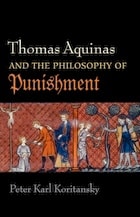
cover of Thomas Aquinas and the Philosophy of Punishment

Thomas Aquinas and the Philosophy of Punishment

Peter Karl Koritansky

Catholic University of America Press, 2012

Thomas Aquinas and the Philosophy of Punishment explores how Aquinas's understandings of natural law and the common good apply to the contemporary philosophical discussion of punitive justice.
[more]
cover of Thomas Aquinas as Spiritual Teacher

Thomas Aquinas as Spiritual Teacher

Michael A. Dauphinais

Sapientia Press of Ave Maria University, 2023
St. Thomas Aquinas preaches in his sermon Puer Jesus "Just as your father begot you bodily, your teacher begets you spiritually." St. Thomas himself has been blessed with prodigious fecundity through the centuries for his teaching in the Holy Spirit. Always, he leads us to think of the Blessed Trinity and all things from God's own view. With new insights into St. Thomas's spiritual teaching in its sources, context, breadth, wisdom, and influences, Thomas Aquinas as Spiritual Teacher presents chapters inspired by an international conference co-sponsored by the Aquinas Center for Theological Renewal at Ave Maria University and the Thomistic Institute of the Dominican House of Studies. The volume, like its conference, honors Archbishop J. Augustine Di Noia, OP, adjunct secretary of the Dicastery for the Doctrine of the Faith, for his dedication to the spiritual teaching of St. Thomas in several decades of service to the Church and the academy. Luis F. Cardinal Ladaria, SJ, prefect of the Dicastery for the Doctrine of the Faith, contributed the volume's foreword.
[more]
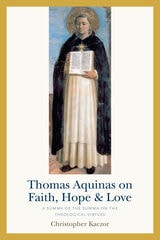
cover of Thomas Aquinas on Faith, Hope, and Love: A Summa of the Summa on the Theological Virtues

Thomas Aquinas on Faith, Hope, and Love

A Summa of the Summa on the Theological Virtues

Christopher Kaczor

Catholic University of America Press, 2020
Thomas Aquinas on Faith, Hope, and Love is designed to make as easy as possible a first reading of key passages from the Summa theologiae. This book contains selections from the Summa that are most influential, most important, or likely to be most interesting to the contemporary reader. The text of the Summa itself is edited and arranged for beginners. Each article begins with Thomas’s answers to the question at hand and then goes to the first objection, followed by the reply to the first objection, the second objection and its reply, and so on. This arrangement provides a greater accessibility and ease in following the argument. Below the text, copious footnotes illuminate the text as a professor in the classroom might. Some notes provide historical background to figures that Thomas presupposes his reader will know such as Gratian, Dionysius, and Lombard. Other notes offer doctrinal summaries of other parts of the Summa that illuminate what Thomas says about faith, hope, or love. Thomas had an enormous influence on theologians, Church councils, and popes after his time, so some footnotes examine this influence. Thomas drew heavily on sources of wisdom before him, so other footnotes summarize the teachings of earlier authors, such as Aristotle and Augustine. This book also contains introductory essays on the Summa, on faith, on hope, and on love, which provide an overview to situate the reader and place treatment of the theological virtues in its larger context of the Summa. For those who have never read Thomas Aquinas on faith, hope, and love (and for those who teach them), this book provides ready access to the wisdom of the Angelic doctor.
[more]
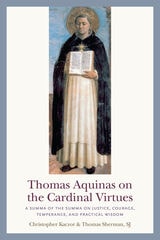
cover of Thomas Aquinas on the Cardinal Virtues: A Summa of the Summa on Prudence, Justice, Temperance, and Courage

Thomas Aquinas on the Cardinal Virtues

A Summa of the Summa on Prudence, Justice, Temperance, and Courage

Christopher Kaczor

Catholic University of America Press, 2020
Thomas Aquinas on the Cardinal Virtues provides essential passages from Thomas's treatment of the cardinal virtues in the Summa theologiae, edited and explained for classroom use or the independent reader. Arranged for beginners, this book contains passages from the Summa theologiae of great historical import, contemporary relevance, or intrinsic interest combined with abundant footnotes aiding the modern reader. Each individual article is arranged so that the question, e.g. “Is capital punishment moral?” is followed directed by Thomas’s answer. Then the first objection is raised, followed immediately by Thomas’s response, the second objection is raised and then Thomas answers it, and so forth. The abundant footnotes help first time readers navigate key theological and philosophical terms which may be unfamiliar. In addition, the notes provide biographical information about key authors cited by Thomas, such as Tully, Vegetius, and Gregory the Great. The footnotes sometimes look back at the sources and philosophical roots of what Thomas teaches. Other notes note how authors after Aquinas including theologians, church councils, and popes developed, synthesized, and sometimes rejected what Thomas teaches. In sum, this book seeks to illuminate Thomas’s teaching on the cardinal virtues such as a teacher might do in the classroom.
[more]
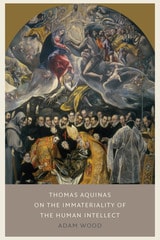
cover of Thomas Aquinas on the Immateriality of the Human Intellect

Thomas Aquinas on the Immateriality of the Human Intellect

Adam Wood

Catholic University of America Press, 2020

The chief aims of Thomas Aquinas on the Immateriality of the Human Intellect are to provide a comprehensive interpretation of Aquinas's oft-repeated claim that the human intellect is immaterial, and to assess his arguments on behalf of this claim. Adam Wood argues that Aquinas's claim refers primarily to the mode in which the human intellect has its act of being. That the human intellect has an immaterial mode of being, however, crucially underwrites Aquinas's additional views that the human soul is subsistent and incorruptible. To show how it does so, Wood argues that the human intellect's immateriality can also be put in terms of the impossibility of explaining its operations in terms of coordination between bodily parts, states and processes. Aquinas's arguments for the human intellect's immateriality, therefore, can be understood as attempts to show why intellectual operations cannot be explained in bodily terms. The book argues that not all of them succeed in this aim and also proposes, however, a novel interpretation of Aquinas's argument based on human intellect's universal mode of cognition that may indeed be sound. Wood concludes by considering the ramifications of Aquinas's position on matters pertaining to the afterlife. Thomas Aquinas on the Immateriality of the Human Intellect represents the first book-length examination of Aquinas's claim that the human intellect is immaterial, and so — given the centrality of this claim to his thought — should interest any scholars interested in understanding Thomas. While it focuses throughout on careful attention to Aquinas's texts along with the relevant secondary literature, it also positions Thomas's thought alongside recent developments in metaphysics and philosophy of mind. Hence it should also interest historically-minded metaphysicians interested in understanding how Thomas's hylomorphism intersects with recent work in hylomorphic metaphysics, philosophers of mind interested in understanding how Thomas's philosophical psychology relates to contemporary forms of dualism, physicalism and emergentism, and philosophers of religion interested in the possibility of the resurrection.
[more]