Results by title
7 books match the query 'Thoughts'
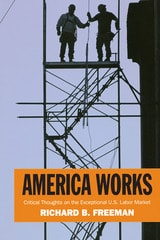
America Works
Thoughts on an Exceptional U.S. Labor MarketRichard B. Freeman
Russell Sage Foundation, 2007
The U.S. labor market is the most laissez faire of any developed nation, with a weak social safety net and little government regulation compared to Europe or Japan. Some economists point to this hands-off approach as the source of America's low unemployment and high per-capita income. But the stagnant living standards and rising economic insecurity many Americans now face take some of the luster off the U.S. model. In America Works, noted economist Richard Freeman reveals how U.S. policies have created a labor market remarkable both for its dynamism and its disparities. America Works takes readers on a grand tour of America's exceptional labor market, comparing the economic institutions and performance of the United States to the economies of Europe and other wealthy countries. The U.S. economy has an impressive track record when it comes to job creation and productivity growth, but it isn't so good at reducing poverty or raising the wages of the average worker. Despite huge gains in productivity, most Americans are hardly better off than they were a generation ago. The median wage is actually lower now than in the early 1970s, and the poverty rate in 2005 was higher than in 1969. So why have the benefits of productivity growth been distributed so unevenly? One reason is that unions have been steadily declining in membership. In Europe, labor laws extend collective bargaining settlements to non-unionized firms. Because wage agreements in America only apply to firms where workers are unionized, American managers have discouraged unionization drives more aggressively. In addition, globalization and immigration have placed growing competitive pressure on American workers. And boards of directors appointed by CEOs have raised executive pay to astronomical levels. Freeman addresses these problems with a variety of proposals designed to maintain the vigor of the U.S. economy while spreading more of its benefits to working Americans. To maintain America's global competitive edge, Freeman calls for increased R&D spending and financial incentives for students pursuing graduate studies in science and engineering. To improve corporate governance, he advocates licensing individuals who serve on corporate boards. Freeman also makes the case for fostering worker associations outside of the confines of traditional unions and for establishing a federal agency to promote profit-sharing and employee ownership. Assessing the performance of the U.S. job market in light of other developed countries' recent history highlights the strengths and weaknesses of the free market model. Written with authoritative knowledge and incisive wit, America Works provides a compelling plan for how we can make markets work better for all Americans. A Volume in the Russell Sage Foundation's Centennial Series
[more]
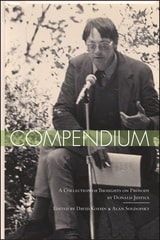
Compendium
A Collection of Thoughts on ProsodyDonald Justice
Omnidawn, 2017
Justice’s insights serve as a sort of de facto taxonomy, an organically designed system that he uses to present his lecture on each respective aspect of the evolution of poetic form. There is no formal thesis here, but rather a kind of scrapbook that has a broader motive. The material possesses no hidden secrets; the treasures lie in plain sight and simply need be discerned to open the artist’s mind to their possibilities.
[more]
The Kingdom to Come
Thoughts on the Union before and after the Scottish Independence ReferendumPeter Hennessy
Haus Publishing, 2015
Despite the “No” vote in the Scottish Independence Referendum of September 2014, the issue of potential Scottish secession from the United Kingdom has likely only just begun. The Kingdom to Come is the first book-length look at the consequences and implications of this momentous event.
Peter Hennessy discusses the run-up to the Scottish Independence Referendum and its immediate aftermath, as well as the constitutional issues the referendum opened for the entire United Kingdom. This book includes Hennessy’s personal impressions of recent questioning of the Acts of Union that created Great Britain and describes when he, as the top expert on Britain’s unwritten constitution, became an important voice in what might happen next. The Kingdom to Come also offers a valuable examination of the possible agenda for remaking the constitution in both the medium and long term.
Peter Hennessy discusses the run-up to the Scottish Independence Referendum and its immediate aftermath, as well as the constitutional issues the referendum opened for the entire United Kingdom. This book includes Hennessy’s personal impressions of recent questioning of the Acts of Union that created Great Britain and describes when he, as the top expert on Britain’s unwritten constitution, became an important voice in what might happen next. The Kingdom to Come also offers a valuable examination of the possible agenda for remaking the constitution in both the medium and long term.
[more]
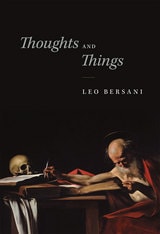
Thoughts and Things
Leo Bersani
University of Chicago Press, 2014
Leo Bersani’s career spans more than fifty years and extends across a wide spectrum of fields—including French studies, modernism, realist fiction, psychoanalytic criticism, film studies, and queer theory. Throughout this new collection of essays that ranges, interestingly and brilliantly, from movies by Claire Denis and Jean-Luc Godard to fiction by Proust and Pierre Bergounioux, Bersani considers various kinds of connectedness.
Thoughts and Things posits what would appear to be an irreducible gap between our thoughts (the human subject) and things (the world). Bersani departs from his psychoanalytic convictions to speculate on the oneness of being—of our intrinsic connectedness to the other that is at once external and internal to us. He addresses the problem of formulating ways to consider the undivided mind, drawing on various sources, from Descartes to cosmology, Freud, and Genet and succeeds brilliantly in diagramming new forms as well as radical failures of connectedness. Ambitious, original, and eloquent, Thoughts and Things will be of interest to scholars in philosophy, film, literature, and beyond.
Thoughts and Things posits what would appear to be an irreducible gap between our thoughts (the human subject) and things (the world). Bersani departs from his psychoanalytic convictions to speculate on the oneness of being—of our intrinsic connectedness to the other that is at once external and internal to us. He addresses the problem of formulating ways to consider the undivided mind, drawing on various sources, from Descartes to cosmology, Freud, and Genet and succeeds brilliantly in diagramming new forms as well as radical failures of connectedness. Ambitious, original, and eloquent, Thoughts and Things will be of interest to scholars in philosophy, film, literature, and beyond.
[more]
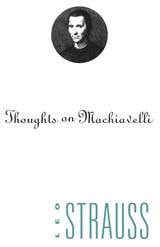
Thoughts on Machiavelli
Leo Strauss
University of Chicago Press, 1958
Leo Strauss argued that the most visible fact about Machiavelli's doctrine is also the most useful one: Machiavelli seems to be a teacher of wickedness. Strauss sought to incorporate this idea in his interpretation without permitting it to overwhelm or exhaust his exegesis of The Prince and the Discourses on the First Ten Books of Livy. "We are in sympathy," he writes, "with the simple opinion about Machiavelli [namely, the wickedness of his teaching], not only because it is wholesome, but above all because a failure to take that opinion seriously prevents one from doing justice to what is truly admirable in Machiavelli: the intrepidity of his thought, the grandeur of his vision, and the graceful subtlety of his speech." This critique of the founder of modern political philosophy by this prominent twentieth-century scholar is an essential text for students of both authors.
[more]
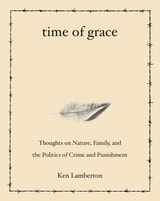
Time of Grace
Thoughts on Nature, Family, and the Politics of Crime and PunishmentKen Lamberton
University of Arizona Press, 2007
“I hole up in my own cozy cubicle and write, considering ways to make the approaching Thanksgiving holiday not just another day in this place. In prison, hope faces east; time is measured in wake-ups.”
Time of Grace is a remarkable book, written with great eloquence by a former science teacher who was incarcerated for twelve years for his sexual liaison with a teenage student. Far more than a “prison memoir,” it is an intimate and revealing look at relationships—with fellow humans and with the surprising wildlife of the Sonoran Desert, both inside and beyond prison walls. Throughout, Ken Lamberton reflects on human relations as they mimic and defy those of the natural world, whose rhythms calibrate Lamberton’s days and years behind bars. He writes with candor about his life, while observing desert flora and fauna with the insight and enthusiasm of a professional naturalist.
While he studies a tarantula digging her way out of the packed earth and observes Mexican freetail bats sailing into the evening sky, Lamberton ruminates on his crime and on the wrenching effects it has had on his wife and three daughters. He writes of his connections with his fellow inmates—some of whom he teaches in prison classes—and with the guards who control them, sometimes with inexplicable cruelty. And he unflinchingly describes a prison system that has gone horribly wrong—a system entrapped in a self-created web of secrecy, fear, and lies.
This is the final book of Lamberton’s trilogy about the twelve years he spent in prison. Readers of his earlier books will savor this last volume. Those who are only now discovering Lamberton’s distinctive voice—part poet, part scientist, part teacher, and always deeply, achingly human—will feel as if they are making a new friend.
Gripping, sobering, and beautifully written, Lamberton’s memoir is an unforgettable exploration of crime, punishment, and the power of the human spirit.
[more]
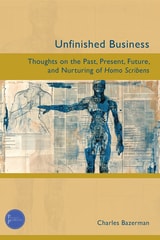
Unfinished Business
Thoughts on the Past, Present, Future, and Nurturing of Homo ScribensCharles Bazerman
University Press of Colorado, 2024
In Unfinished Business, Charles Bazerman considers long-standing puzzles in writing studies, from the most fundamental ideas about humans as writers and writing as constituting modern society to the most practical issues of curriculum and teaching. Together, the chapters provide a broad vision of the importance, role, consequences, and means of writing. The opening cluster of chapters places Homo sapiens’ capacity to write within the biological and cultural evolutionary arc. The second cluster of chapters focuses on how writing has extended and transformed our knowledge with major consequences for us as societies and individuals. The third cluster considers how we go about teaching this increasingly important skill that gives people voice in the literate world. The fourth reflects on the values and ethical concerns that pervade the practice and teaching of writing. In his final chapter, Bazerman speculates about where writing and writing instruction may go in the rapidly changing future.
[more]