Results by title
9 books match the query 'Tibet'

A Historical Atlas of Tibet
Karl E. Ryavec
University of Chicago Press, 2015
Cradled among the world’s highest mountains—and sheltering one of its most devout religious communities—Tibet is, for many of us, an ultimate destination, a place that touches the heavens, a place only barely in our world, at its very end. In recent decades Western fascination with Tibet has soared, from the rise of Tibetan studies in academia to the rock concerts aimed at supporting its independence to the simple fact that most of us—far from any base camp—know exactly what a sherpa is. And yet any sustained look into Tibet as a place, any attempt to find one’s way around its high plateaus and through its deep history, will yield this surprising fact: we have barely mapped it. With this atlas, Karl E. Ryavec rights that wrong, sweeping aside the image of Tibet as Shangri-La and putting in its place a comprehensive vision of the region as it really is, a civilization in its own right. And the results are absolutely stunning.
The product of twelve years of research and eight more of mapmaking, A Historical Atlas of Tibet documents cultural and religious sites across the Tibetan Plateau and its bordering regions from the Paleolithic and Neolithic times all the way up to today. It ranges through the five main periods in Tibetan history, offering introductory maps of each followed by details of western, central, and eastern regions. It beautifully visualizes the history of Tibetan Buddhism, tracing its spread throughout Asia, with thousands of temples mapped, both within Tibet and across North China and Mongolia, all the way to Beijing. There are maps of major polities and their territorial administrations, as well as of the kingdoms of Guge and Purang in western Tibet, and of Derge and Nangchen in Kham. There are town plans of Lhasa and maps that focus on history and language, on population, natural resources, and contemporary politics.
Extraordinarily comprehensive and absolutely gorgeous, this overdue volume will be a cornerstone in cartography, Asian studies, Buddhist studies, and in the libraries or on the coffee tables of anyone who has ever felt the draw of the landscapes, people, and cultures of the highest place on Earth.
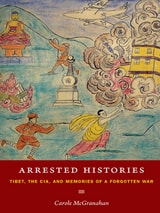
Arrested Histories
Tibet, the CIA, and Memories of a Forgotten WarCarole McGranahan
Duke University Press, 2010
Drawing on rich ethnographic and historical research, McGranahan tells the story of the Tibetan resistance and the social processes through which this history is made and unmade, and lived and forgotten in the present. Fulfillment of veterans’ desire for recognition hinges on the Dalai Lama and “historical arrest,” a practice in which the telling of certain pasts is suspended until an undetermined time in the future. In this analysis, struggles over history emerge as a profound pain of belonging. Tibetan cultural politics, regional identities, and religious commitments cannot be disentangled from imperial histories, contemporary geopolitics, and romanticized representations of Tibet. Moving deftly from armed struggle to nonviolent hunger strikes, and from diplomatic offices to refugee camps, Arrested Histories provides powerful insights into the stakes of political engagement and the cultural contradictions of everyday life.
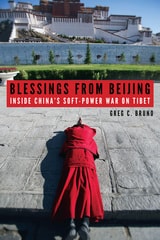
Blessings from Beijing
Inside China's Soft-Power War on TibetGreg C. Bruno
University Press of New England, 2018
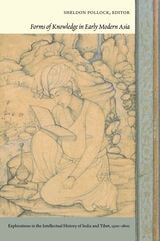
Forms of Knowledge in Early Modern Asia
Explorations in the Intellectual History of India and Tibet, 1500-1800Sheldon Pollock, ed.
Duke University Press, 2011
Contributors. Muzaffar Alam, Imre Bangha, Aditya Behl, Allison Busch, Sumit Guha, Janet Gyatso, Matthew T. Kapstein, Françoise Mallison, Sheldon Pollock, Velcheru Narayana Rao, Kurtis R. Schaeffer, Sunil Sharma, David Shulman, Sanjay Subrahmanyam, Mohamad Tavakoli-Targhi

Geopolitical Exotica
Tibet in Western ImaginationDibyesh Anand
University of Minnesota Press, 2008
Geopolitical Exotica examines exoticized Western representations of Tibet and Tibetans and the debate over that land’s status with regard to China. Concentrating on specific cultural images of the twentieth century—promulgated by novels, popular films, travelogues, and memoirs—Dibyesh Anand lays bare the strategies by which “Exotica Tibet” and “Tibetanness” have been constructed, and he investigates the impact these constructions have had on those who are being represented.
Although images of Tibet have excited the popular imagination in the West for many years, Geopolitical Exotica is the first book to explore representational practices within the study of international relations. Anand challenges the parochial practices of current mainstream international relations theory and practice, claiming that the discipline remains mostly Western in its orientation. His analysis of Tibet’s status with regard to China scrutinizes the vocabulary afforded by conventional international relations theory and considers issues that until now have been undertheorized in relation to Tibet, including imperialism, history, diaspora, representation, and identity.
In this masterfully synthetic work, Anand establishes that postcoloniality provides new insights into themes of representation and identity and demonstrates how IR as a discipline can meaningfully expand its focus beyond the West.
Dibyesh Anand is a reader in international relations at the University of Westminster, London.
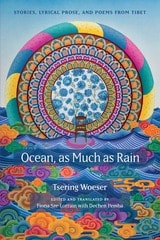
Ocean, as Much as Rain
Stories, Lyrical Prose, and Poems from TibetTsering Woeser. Edited and Translated by Fiona Sze-Lorrain with Dechen Pemba.
Duke University Press, 2026

Prisoners of Shangri-La
Tibetan Buddhism and the WestDonald S. Lopez Jr.
University of Chicago Press, 1998
"Lopez lifts the veil on America's romantic vision of Tibet to reveal a country and a spiritual history more complex and less ideal than popular perceptions allow. . . . Lively and engaging, Lopez's book raises important questions about how Eastern religions are often co-opted, assimilated and misunderstood by Western culture."—Publishers Weekly
"Proceeding with care and precision, Lopez reveals the extent to which scholars have behaved like intellectual colonialists. . . . Someone had to burst the bubble of pop Tibetology, and few could have done it as resoundingly as Lopez."—Booklist
"Fascinating. . . [A] provocative exploration. Lopez conveys the full dizziness of the Western encounter with Tibet and Tibetan Buddhism."—Fred Pheil, Tricycle: The Buddhist Review
"A timely and courageous exploration. . . . [Lopez's] book will sharpen the terms of the debate over what the Tibetans and their observers can or should be doing about the place and the idea of Tibet. And that alone is what will give us all back our Shambhala."—Jonathan Spence, Lingua Franca Book Review
"Lopez's most important theme is that we should be wary of the idea . . . that Tibet has what the West lacks, that if we were only to look there we would find the answers to our problems. Lopez's book shows that, on the contrary, when the West has looked at Tibet, all that it has seen is a distorted reflection of itself."—Ben Jackson, Times Higher Education Supplement
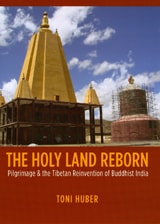
The Holy Land Reborn
Pilgrimage and the Tibetan Reinvention of Buddhist IndiaToni Huber
University of Chicago Press, 2008
Focusing on the Tibetan creation and recreation of India as a destination, a landscape, and a kind of other, in both real and idealized terms, Huber explores how Tibetans have used the idea of India as a religious territory and a sacred geography in the development of their own religion and society. In a timely closing chapter, Huber also takes up the meaning of India for the Tibetans who live in exile in their Buddhist holy land.
A major contribution to the study of Buddhism, The Holy Land Reborn describes changes in Tibetan constructs of India over the centuries, ultimately challenging largely static views of the sacred geography of Buddhism in India.
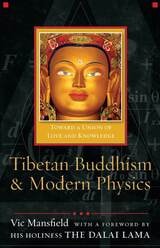
Tibetan Buddhism and Modern Physics
Toward a Union of Love and KnowledgeVic Mansfield
Templeton Press, 2008
Tibetan Buddhism and Modern Physics: Toward a Union of Love and Knowledge addresses the complex issues of dialogue and collaboration between Buddhism and science, revealing connections and differences between the two. While assuming no technical background in Buddhism or physics, this book strongly responds to the Dalai Lama’s “heartfelt plea” for genuine collaboration between science and Buddhism. The Dalai Lama has written a foreword to the book and the Office of His Holiness will translate it into both Chinese and Tibetan.