Results by title
3 books match the query 'Time perspective'

Ex Ante
Power and Prediction in the Real-Time FutureJohn Cheney-Lippold
University of Chicago Press, 2027
An incisive framework for understanding how predictive AI has reshaped our relationship with time.
Ex Ante argues that AI systems draw us into a new experience of time, a continuous stream of machine-generated futures that reshapes our relationship to ourselves, to capitalism, and to infrastructure. Unlike other predictive tools that help us prepare for what might come, these projections—produced by algorithms and sourced by massive flows of data—calibrate our actions moment by moment, second by second.
In this book, John Cheney-Lippold offers a framework he calls the ex ante, Latin for “before the event,” as a way to consider how the future has become capitalism’s latest resource for exploitation. Through case studies spanning TikTok beauty filters that have fueled a surge in plastic surgery consultations, chess engines that redefine how the game is played, online sports betting platforms that commodify probability itself, hospital sepsis algorithms that transform the labor of nursing, and coordinated vehicle networks that collectively anticipate their surroundings to function, Ex Ante offers an exploration and powerful critique of our algorithmic present and the powers behind it.

The Textures of Time
Agency and Temporal ExperienceAuthored by Michael G. Flaherty
Temple University Press, 2010
What do we mean when we say, "I made the time pass more quickly," or, "I’m creating some ‘me’ time"? InThe Textures of Time, Michael Flaherty examines how we alter or customize our experience of time. His detailed analysis reveals different strategies we use to try to manipulate time, further describing and defining those strategies within six discrete time categories: Duration, Frequency, Sequence, Timing, Allocation, and Taking Time.
Using in-depth interviews and analyzing responses through a sociological lens, Flaherty unearths folk theories and practices, which he calls "time work," that construct circumstances in order to provoke desired forms of temporal experience. As such, time is not justinflicted on us; rather, its various textures result from our intervention, and/or from our efforts to create different forms of temporal experience. These first-person accounts also highlight ongoing tensions between agency and determinism in social groups. Ultimately, in keeping with his central thesis, Flaherty's lucid prose make this book a quick read, and the strategies he describes reveal the profound and inventive ways we "manage the clock."
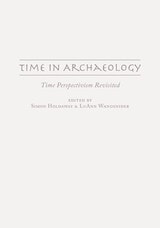
Time in Archaeology
Time Perspectivism RevisitedSimon Holdaway
University of Utah Press, 2011
The point of departure for this volume lies in the post-tumultuous times of processual archaeology, in the 1970s and 1980s, when Geoff Bailey, Lewis Binford, David Clarke, Robert Dunnell, Robert Foley, and Michael Schiffer, among others, initiated a deconstruction of time as used in archaeology. Here, the authors further this deconstruction.
Time in Archaeology was originally convened as an electronic symposium held at the Society of American Archaeology meetings in 2003. The result is a tightly focused group of papers that provide both a historical background to the development of the ideas of time perspectivism as well as a range of case studies that illustrate where scholars have taken the ideas. This book demonstrates the importance of concepts of time with excellent discussions and perspectives from twelve scholars working in vastly different arenas. It is a rigorous examination of the assumptions we make and the impacts of those assumptions. After reading this you may never think about time in quite the same way.