Results by title
7 books match the query 'Ting, David S-K.'
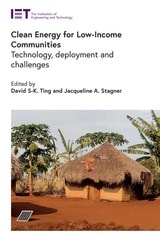
Clean Energy for Low-Income Communities
Technology, deployment and challengesDavid S-K. Ting
The Institution of Engineering and Technology, 2024
Energy provision for low income or remote communities is a difficult challenge, with many still depending on polluting and costly fossil fuels. Transporting energy is a further problem since some communities are only accessible during brief periods of the year. Local energy generation is a key solution, but technical challenges need to be overcome.
[more]
Compressed Air Energy Storage
Types, systems and applicationsDavid S-K. Ting
The Institution of Engineering and Technology, 2021
The intermittency of renewable energy sources is making increased deployment of storage technology necessary. Technologies are needed with high round-trip efficiency and at low cost to allow renewables to undercut fossil fuels. The cost of lithium batteries has fallen, but producing them comes with a substantial carbon footprint, as well as a cost to the local environment.
[more]
Energy Generation and Efficiency Technologies for Green Residential Buildings
David S-K. Ting
The Institution of Engineering and Technology, 2019
Residential buildings consume about a quarter of all energy (including electrical and thermal) in industrialized countries and emit around 20% of the carbon emissions there. Older and outdated heating and cooling technology causes high energy demand and, depending on building type, secondary causes can include ventilation and lighting. Technology is available to mitigate high energy consumption, and to enable the use of renewable or environmentally friendly energy, partly generated locally.
[more]
Flow Turbulence Engineering in Transport
David S-K. Ting
The Institution of Engineering and Technology, 2026
Turbulence in transportation occurs in the aerodynamics of vehicles, hydrodynamics of watercrafts, and combustion engines, amongst others. Turbulent flows can greatly affect the performance of vehicles, from air and water resistance, noise, and combustion quality - but it can also be exploited to improve the efficiency of the involved engineering operations. Understanding how turbulence effects occur within various transport modes can help engineers build better performing and safer vehicles, and overall improve transport networks.
[more]
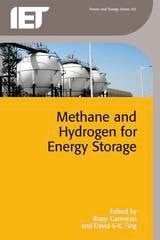
Methane and Hydrogen for Energy Storage
Rupp Carriveau
The Institution of Engineering and Technology, 2016
Commercial energy storage has moved from the margins to the mainstream as it fosters flexibility in our smarter, increasingly integrated energy systems. Natural gas has been identified by many as the fuel to take us to the no-carbon horizon; where a hydrogen economy waits on development. These two actors are already connected in precursor applications as transitional solutions for hydrogen handling and transportation are sought ahead of a fully established hydrogen infrastructure.
[more]
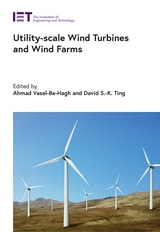
Utility-scale Wind Turbines and Wind Farms
Ahmad Vasel-Be-Hagh
The Institution of Engineering and Technology, 2021
Wind power is a pillar of low emission energy systems. Designing more efficient wind turbines and farms, and increasing reliability and flexibility, is an area of intense research and development. In order to overcome the intermittent character of wind power, both the individual turbines and the wind farm as a whole must be considered.
[more]
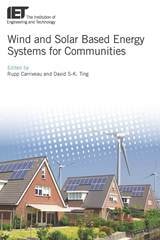
Wind and Solar Based Energy Systems for Communities
Rupp Carriveau
The Institution of Engineering and Technology, 2018
A sustainable community energy system is an approach to supplying a local community - ranging from a few homes or farms to entire cities - with its energy requirements from renewable energy or high-efficiency co-generation energy sources. Such systems are frequently based on wind power, solar power, biomass, either singly or in combination. Community energy projects have been growing in numbers in several key regions.
[more]