Results by title
3 books match the query 'Titles'

Outstanding Books for the College Bound
Titles and Programs for a New GenerationAngela Carstensen
American Library Association, 2011
[more]
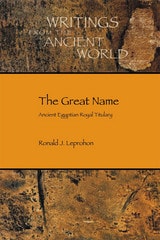
The Great Name
Ancient Egyptian Royal TitularyRonald J. Leprohon
SBL Press, 2013
The titulary of the ancient Egyptian king was one of the symbols of authority he assumed at his coronation. At first consisting only of the Horus name, the titulary grew to include other phrases chosen to represent the king’s special relationship with the divine world. By the Middle Kingdom (late twenty-first century B.C.E.), the full fivefold titulary was clearly established, and kings henceforth used all five names regularly. This volume includes all rulers’ names from the so-called Dynasty 0 (ca. 3200 B.C.E.) to the last Ptolemaic ruler in the late first century B.C.E., offered in transliteration and English translation with an introduction and notes.
[more]
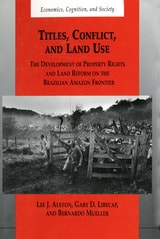
Titles, Conflict, and Land Use
The Development of Property Rights and Land Reform on the Brazilian Amazon FrontierLee J. Alston, Gary D. Libecap, and Bernardo Mueller
University of Michigan Press, 1999
The Amazon, the world's largest rain forest, is the last frontier in Brazil. The settlement of large and small farmers, squatters, miners, and loggers in this frontier during the past thirty years has given rise to violent conflicts over land as well as environmental duress. Titles, Conflict, and Land Use examines the institutional development involved in the process of land use and ownership in the Amazon and shows how this phenomenon affects the behavior of the economic actors. It explores the way in which the absence of well-defined property rights in the Amazon has led to both economic and social problems, including lost investment opportunities, high costs in protecting claims, and violence. The relationship between land reform and violence is given special attention.
The book offers an important application of the New Institutional Economics by examining a rare instance where institutional change can be empirically observed. This allows the authors to study property rights as they emerge and evolve and to analyze the effects of Amazon development on the economy. In doing so they illustrate well the point that often the evolution of economic institutions will not lead to efficient outcomes.
This book will be important not only to economists but also to Latin Americanists, political scientists, anthropologists, and scholars in disciplines concerned with the environment.
Lee Alston is Professor of Economics, University of Illinois, and Research Associate for the National Bureau of Economic Research. Gary Libecap is Professor of Economics and Law, University of Arizona, and Research Associate for the National Bureau of Economic Research. Bernardo Mueller is Assistant Professor, Universidade de Brasilia.
[more]