Results by title
2 books match the query 'To 1548'
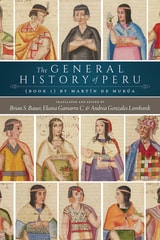
General History of Peru
Book 1Martín de Murúa
University Press of Colorado, 2024
Mercedarian friar Martín de Murúa’s General History of Peru (Historia General del Piru, 1616) is one of the most significant Spanish chronicles of Inca history and Peru’s early colonial period yet to be published in English. Written over several decades and approved by King Philip III for publication, Murúa’s magnificent manuscript disappeared from public view for nearly 350 years until its publication in 1964. Here, translators Brian S. Bauer, Eliana Gamarra C., and Andrea Gonzales Lombardi present the first English translation of Book 1 of Murúa’s comprehensive three-part work.
Book 1 covers both the history of the Inca Empire and the first forty years of the Spanish occupation, up to and including the fall of Vilcabamba in 1572. While the J. Paul Getty Museum produced a digital facsimile of Murúa’s full Historia in 2008, it remained underused and, until now, untranslated. This translation revitalizes the momentous early volume with an introduction offering a window into Murúa’s life and the writing of his Historia, and extensive footnotes that provide the scholarly context of Murúa’s work.
This edition of The General History of Peru: Book 1 provides long-awaited access to Murúa’s contribution to Indigenous Andean history and early colonial Peru. The book is valuable for English-speaking students and scholars of pre-Hispanic Andean history, especially those interested in the ancient Andean world and colonial Peru’s literary production.
[more]
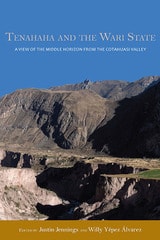
Tenahaha and the Wari State
A View of the Middle Horizon from the Cotahuasi ValleyEdited by Justin Jennings and Willy Yépez Álvarez
University of Alabama Press, 2015
The Middle Horizon period (A.D. 600–1000) was a time of sweeping cultural change in the Andes. Archaeologists have long associated this period with the expansion of the Wari (Huari) and Tiwanaku (Tiahuanaco) states in the south-central Andes and the Pacific coasts of contemporary Peru and Chile.
Tenahaha and the Wari State contains a series of essays that challenge current beliefs about the Wari state and suggest a reassessment of this pivotal era in Andean history. In this collection, a picture emerges of Wari power projected across the region’s rugged and formidable topography less as a conquering empire than as a source of ideas, styles, and material culture voluntarily adopted by neighboring peoples.
Much of the previous fieldwork on Wari history took place in the Wari heartland and in Wari strongholds, not areas where Wari power and influence were equivocal. In Tenahaha and the Wari State, editors Justin Jennings and Willy Yépez Álvarez set out to test whether current theories of the Wari state as a cohesive empire were accurate or simply reflective of the bias inherent in studying Wari culture in its most concentrated centers. The essays in this collection examine instead life in the Cotahuasi Valley, an area into which Wari influence expanded during the Middle Horizon period.
Drawing on ten years of exhaustive field work both at the ceremonial site of Tenahaha and in the surrounding valley, Jennings and Yépez Álvarez posit that Cotahuasinos at Tenahaha had little contact with the Wari state. Their excavations and survey in the area tell the story of a region in flux rather than of a people conquered by Wari. In a time of uncertainty, they adopted Wari ideas and culture as ways to cope with change.
[more]