Results by title
6 books match the query 'To 1819'
Alabama and the Borderlands
From Prehistory To StatehoodEdited by R. Reid Badger and Lawrence A. Clayton
University of Alabama Press, 1985
Brings together the nation's leading scholars on the prehistory and early history of Alabama and the southeastern US
This fascinating collection was born of a concern with Alabama's past and the need to explore and explain that legacy, so often hidden by the veils of time, ignorance, or misunderstanding. In 1981 The University of Alabama celebrated its 150th anniversary, and each College contributed to the celebration by sponsoring a special symposium. The College of Arts and Sciences brought together the nation's leading scholars on the prehistory and early history of Alabama and the Southeastern United States, and for two memorable days in September 1981 several hundred interested listeners heard those scholars present their interpretations of Alabama's remarkable past.
The organizers of the symposium deliberately chose to focus on Alabama's history before statehood. Alabama as a constituent state of the Old South is well known. Alabama as a home of Indian cultures and civilizations of a high order, as an object of desire, exploration, and conquest in the sixteenth century, and as a borderland disputed by rival European nationalities for almost 300 years is less well known. The resulting essays in this collection prove as interesting, enlightening, and provocative to the casual reader as to the professional scholar, for they are intended to bring to the general reader artifacts and documents that reveal the realities and romance of that older Alabama.
Topics in the collection range from the Mississippian Period in archaeology and the de Soto expedition (and other early European explorations and settlements of Alabama) to the 1780 Siege of Mobile.
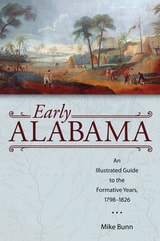
Early Alabama
An Illustrated Guide to the Formative Years, 1798–1826Mike Bunn
University of Alabama Press, 2019
An illustrated guidebook documenting the history and sites of the state’s origins
Alabama’s territorial and early statehood years represent a crucial formative period in its past, a time in which the state both literally and figuratively took shape. The story of the remarkable changes that occurred within Alabama as it transitioned from frontier territory to a vital part of the American union in less than a quarter century is one of the most compelling in the state’s past. This history is rich with stories of charismatic leaders, rugged frontiersmen, a dramatic and pivotal war that shaped the state’s trajectory, raging political intrigue, and pervasive sectional rivalry.
Many of Alabama’s modern cities, counties, and religious, educational, and governmental institutions first took shape within this time period. It also gave way to the creation of sophisticated trade and communication networks, the first large-scale cultivation of cotton, and the advent of the steamboat. Contained within this story of growth and innovation is a parallel story, the dispossession of Native groups of their lands and the forced labor of slaves, which fueled much of Alabama’s early development.
Early Alabama: An Illustrated Guide to the Formative Years, 1798–1826 serves as a traveler’s guidebook with a fast-paced narrative that traces Alabama’s developmental years. Despite the great significance of this era in the state’s overall growth, these years are perhaps the least understood in all of the state’s history and have received relatively scant attention from historians. Mike Bunn has created a detailed guide—appealing to historians and the general public—for touring historic sites and structures including selected homes, churches, businesses, government buildings, battlefields, cemeteries, and museums..
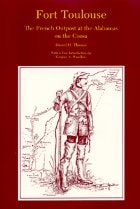
Fort Toulouse
The French Outpost at the Alabamas on the CoosaDaniel H Thomas, with an introduciton by Gregory A. Waselkov
University of Alabama Press, 1989
Situated at the head of the Alabama River system—at the juncture of the Coosa and Tallapoosa rivers—Fort Toulouse in 1717 was planned to keep the local Indians neutral, if not loyal, to the French and contain the British in their southernmost Atlantic colonies. Unlike the usual frontier settlements, Fort Toulouse was both a diplomatic post, since its officers acted as resident ministers, and a military post. Because it was located in a friendly territory adjoining an area under a rival (British) influence, the post participated in psychological warfare rather than in blood-letting. It used trade and aid, and was familiar with spies and double-agents—welcoming and debriefing British defectors; no cannon was discharged in anger at Toulouse.
The most eminent figure to have been connected directly with Fort Toulouse was General Andrew Jackson, who established a military post there during the War of 1812 after his victory over the Indians at Horseshoe Bend. The outpost was named Fort Jackson in his honor and played a key role in the treaty negotiations and eventual settlement of the Indian land by Americans.
In addition to discussing geopolitical and military affairs and diplomatic relations with Indian chiefs, Thomas describes daily life at the post and the variety of interactions between residents and visitors. Waselkov's introduction places the original 1960 book within the context of the existing scholarship of that time and adds an extensive and enlightening review of the most recent archaeological and historical research to Thomas' pioneering work.
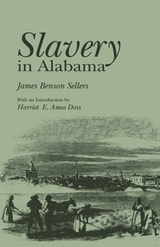
Slavery in Alabama
James Benson Sellers
University of Alabama Press, 1994
The only comprehensive statewide study of the institution of slavery in Alabama
Since its initial publication in 1950, Slavery in Alabama remains the only comprehensive statewide study of the institution of slavery in Alabama. Sellers concentrates on examining the social and economic aspects of how slavery operated in the state. After a brief discussion of slavery under imperial rulers of the colonial and territorial periods, Sellers focuses on the transplantation of the slavery system from the Atlantic seaboard states to Alabama.
Sellers used the primary sources available to him, including government documents, county and city records, personal papers, church records, and newspapers. His discussions of the church and the slave, and his treatment of the proslavery defense, deepen the comprehensiveness of his study. His two sections of photographs are special touches showing former slaves and churches with slave galleries.
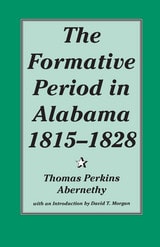
The Formative Period in Alabama, 1815-1828
Thomas Abernethy, with an introduction by David T. Morgan
University of Alabama Press, 1995
The Formative Period in Alabama, 1815-1828 is a beautifully crafted history of the evolution of the state written by Thomas Perkins Abernethy in 1922. The work shows how Alabama grew out of the Mississippi Territory and discusses the economic and political development during the years just before and just after Alabama became a state.
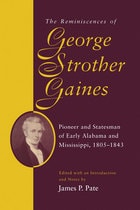
The Reminiscences of George Strother Gaines
Pioneer and Statesman of Early Alabama and Mississippi, 1805–1843George Strother Gaines
University of Alabama Press, 1998
One man’s remarkable account of nation‑building, Native diplomacy, and the making of the early American South.
The Reminiscences of George Strother Gaines: Pioneer and Statesman of Early Alabama and Mississippi, 1805–1843 offers one of the most vivid, irreplaceable firsthand accounts of the American Southeast during its most transformative decades. Edited and expertly contextualized by historian James P. Pate, this volume gathers Gaines’s dictated memoirs, rare letters, early newspaper publications, oral-history interviews, and extensive editorial notes to illuminate a world on the cusp of monumental change.
George Strother Gaines was no ordinary frontier figure. Trusted by U.S. officials and Choctaw leaders alike, he played central roles as federal factor at the Choctaw Trading House, a key intermediary during treaty negotiations, a primary organizer of the first Choctaw removal, a banker and state senator in newly formed Alabama, and later a driving force behind the Mobile & Ohio Railroad. His reminiscences reveal intimate knowledge of the region’s political development, frontier economy, Native diplomacy, and daily life. They are written in a strikingly elegant “Addisonian” style praised even in his own lifetime.
This edition’s special features—including detailed maps, illustrations, genealogical material, and a robust scholarly introduction—make it the most comprehensive and authoritative presentation of Gaines’s writings ever published. It not only preserves his voice but situates him within the broader historical forces reshaping the Gulf South and Native nations in the nineteenth century.
Ideal readers include:
• Historians of Alabama, Mississippi, and the early American South
• Scholars of Native American and Choctaw/Chickasaw history
• Readers of frontier, antebellum, or political history
• Genealogists and local-history enthusiasts
• Anyone seeking an engaging, elegantly written window into the early Southeast
This is a foundational text for understanding the region’s past—and a compelling story told by one of its most influential witnesses.