Results by title
14 books match the query 'To 1964'
After Freedom
A Cultural Study In The Deep SouthHortense Powdermaker
University of Wisconsin Press, 1993
Annotations
On the Early Thought of W. E. B. Du BoisNahum Dimitri Chandler
Duke University Press, 2022
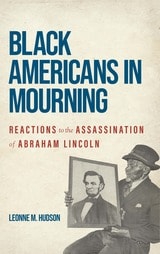
Black Americans in Mourning
Reactions to the Assassination of Abraham LincolnLeonne M. Hudson
Southern Illinois University Press, 2025
Centering Black grief in the aftermath of Lincoln’s assassination
On April 14, 1865, John Wilkes Booth carried out the first presidential assassination in United States history. The euphoria resulting from General Lee’s surrender evaporated at the news of Abraham Lincoln’s murder. The nation—excepting many white Southerners—found itself consumed with grief, and no group mourned Lincoln more deeply than people of color. African Americans did not speak with a monolithic voice on social or political issues, but even Lincoln’s Black contemporaries who may not have approved of him while he was alive mourned his death, understanding its implications for their future.
Beginning with the assassination itself and chronicling Lincoln’s three-week-long national funeral, historian Leonne M. Hudson captures the profound sadness of Black Americans as they mourned the crafter of the Emancipation Proclamation and the man they thought of as their earthly Moses, father, friend, and benefactor. Hudson continues the narrative by detailing the postwar efforts of African Americans to gain citizenship and voting rights.
Black Americans in Mourning includes the tributes of prominent figures such as Frederick Douglass, Martin R. Delany, and Elizabeth Keckley, who raised their voices to honor Lincoln, as well as formal expressions of grief by institutions and organizations such as the United States Colored Troops. In a triumph of research, Hudson also features the voices of lesser-known Black people who mourned Lincoln across the country, showing that the outpouring of individual and collective grief helped set the stage for his enduring glorification.
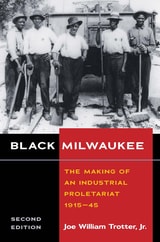
Black Milwaukee
The Making of an Industrial Proletariat, 1915-45Joe William Trotter, Jr.
University of Illinois Press, 2006
Praise for the first edition: “Trotter has written a valuable, provocative book that opens new areas for certain--and heated--debate.”--Journal of American Ethnic History
Other historians have tended to treat black urban life mainly in relation to the ghetto experience, but in Black Milwaukee, Joe William Trotter Jr. offers a new perspective that complements yet also goes well beyond that approach. The blacks in Black Milwaukee were not only ghetto dwellers; they were also industrial workers. The process by which they achieved this status is the subject of Trotter’s ground-breaking study.
This second edition features a new preface and acknowledgments, an essay on African American urban history since 1985, a prologue on the antebellum and Civil War roots of Milwaukee’s black community, and an epilogue on the post-World War II years and the impact of deindustrialization, all by the author. Brief essays by four of Trotter’s colleagues--William P. Jones, Earl Lewis, Alison Isenberg, and Kimberly L. Phillips--assess the impact of the original Black Milwaukee on the study of African American urban history over the past twenty years.

Crime and Punishment in the Jim Crow South
Edited by Amy Louise Wood and Natalie J. Ring
University of Illinois Press, 2019
In this collection, Amy Louise Wood and Natalie J. Ring present nine groundbreaking essays about the carceral system and its development over time. Topics range from activism against police brutality to the peculiar path of southern prison reform to the fraught introduction of the electric chair. The essays tell nuanced stories of rapidly changing state institutions, political leaders who sought to manage them, and African Americans who appealed to the regulatory state to protect their rights.
Contributors: Pippa Holloway, Tammy Ingram, Brandon T. Jett, Seth Kotch, Talitha L. LeFlouria, Vivien Miller, Silvan Niedermeier, K. Stephen Prince, and Amy Louise Wood
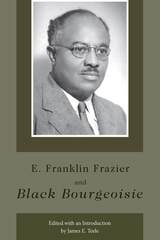
E. Franklin Frazier and Black Bourgeoisie
E. Franklin Frazier
University of Missouri Press, 2002
When E. Franklin Frazier was elected the first black president of the American Sociological Association in 1948, he was established as the leading American scholar on the black family and was also recognized as a leading theorist on the dynamics of social change and race relations. By 1948 his lengthy list of publications included over fifty articles and four major books, including the acclaimed Negro Family in the United States. Frazier was known for his thorough scholarship and his mastery of skills in both history and sociology.
With the publication of Bourgeoisie Noire in 1955 (translated in 1957 as Black Bourgeoisie), Frazier apparently set out on a different track, one in which he employed his skills in a critical analysis of the black middle class. The book met with mixed reviews and harsh criticism from the black middle and professional class. Yet Frazier stood solidly by his argument that the black middle class was marked by conspicuous consumption, wish fulfillment, and a world of make-believe. While Frazier published four additional books after 1948, Black Bourgeoisie remained by far his most controversial.
Given his status in American sociology, there has been surprisingly little study of Frazier's work. In E. Franklin Frazier and Black Bourgeoisie, a group of distinguished scholars remedies that lack, focusing on his often-scorned Black Bourgeoisie.
This in-depth look at Frazier's controversial publication is relevant to the growing concerns about racism, problems in our cities, the limitations of affirmative action, and the promise of self-help.
Ecology Control and Economic Development in East African History
The Case of Tanganyika, 1850–1950Helge Kjekshus
Ohio University Press, 1995
The book puts people at the centre of events. It thus serves as a modification to nationalist history with its emphasis on leaders. It presents environmental factors that had been underestimated; for instance, it points to the critical importance of the rinderpest outbreak.
Helge Kjekshus provides evidence to suggest that the nineteenth century was a period of relative prosperity with well-developed trade. He questions the view that warfare was pervasive and that the slave trade led to depopulation. He points to a balance between man and the environment.
This book is reissued at the same time as the first publication of Custodians of the Land: Ecology and Culture in the History of Tanzania edited by Gregory Maddox, James I. Giblin and Isaria N. Kimambo. The footnotes in that book point to the importance of the work of Helge Kjekshus.
Invisible Agents
Spirits in a Central African HistoryDavid M. Gordon
Ohio University Press, 2012
Invisible Agents shows how personal and deeply felt spiritual beliefs can inspire social movements and influence historical change. Conventional historiography concentrates on the secular, materialist, or moral sources of political agency. Instead, David M. Gordon argues, when people perceive spirits as exerting power in the visible world, these beliefs form the basis for individual and collective actions. Focusing on the history of the south-central African country of Zambia during the nineteenth and twentieth centuries, his analysis invites reflection on political and religious realms of action in other parts of the world, and complicates the post-Enlightenment divide of sacred and profane.
The book combines theoretical insights with attention to local detail and remarkable historical sweep, from oral narratives communicated across slave-trading routes during the nineteenth century, through the violent conflicts inspired by Christian and nationalist prophets during colonial times, and ending with the spirits of Pentecostal rebirth during the neoliberal order of the late twentieth century. To gain access to the details of historical change and personal spiritual beliefs across this long historical period, Gordon employs all the tools of the African historian. His own interviews and extensive fieldwork experience in Zambia provide texture and understanding to the narrative. He also critically interprets a diverse range of other sources, including oral traditions, fieldnotes of anthropologists, missionary writings and correspondence, unpublished state records, vernacular publications, and Zambian newspapers.
Invisible Agents will challenge scholars and students alike to think in new ways about the political imagination and the invisible sources of human action and historical change.

Penetration & Protest in Tanzania
Impact Of World Economy On The Pare, 1860-1960Isaria N. Kimambo
Ohio University Press, 1990
The originality of this study of rural transformation stems from the way in which Professor Kimambo has used the oral tradition to reveal the history of the impact of the world economy in northeastern Tanzania. First under the pressures of commodity trade, and later under German and British imperialism, the peasant producers of this region were forced into participation in capitalist production.
These partial changes destroyed the Pare’s balanced subsistence structure. But throughout the colonial period they were frustrated in their efforts to transform themselves fully into capitalist producers. These struggles finally led to open revolt in 1947 and it was three years before the protest ended. Between 1947 and 1960 the colonial government tried to reverse the effects of the revolt without providing the kind of transformation desired by the peasants.
This study illustrates vividly the difference between the intentions of capital and those of the colonized peasantry. The intentions of the two sides seemed to be incompatible. While imperialism would allow for the limited participation that would maximize profits for metropolitan capital, the peasants were struggling for freedom to transform themselves into capitalist producers.
Spectres of 1919
Class and Nation in the Making of the New NegroBarbara Foley
University of Illinois Press, 2002
A look at the violent “Red Summer of 1919” and its intersection with the highly politicized New Negro movement and the Harlem Renaissance
With the New Negro movement and the Harlem Renaissance, the 1920s was a landmark decade in African American political and cultural history, characterized by an upsurge in racial awareness and artistic creativity. In Spectres of 1919 Barbara Foley traces the origins of this revolutionary era to the turbulent year 1919, identifying the events and trends in American society that spurred the black community to action and examining the forms that action took as it evolved.
Unlike prior studies of the Harlem Renaissance, which see 1919 as significant mostly because of the geographic migrations of blacks to the North, Spectres of 1919 looks at that year as the political crucible from which the radicalism of the 1920s emerged. Foley draws from a wealth of primary sources, taking a bold new approach to the origins of African American radicalism and adding nuance and complexity to the understanding of a fascinating and vibrant era.
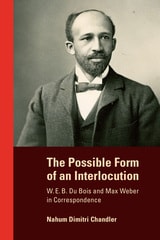
The Possible Form of an Interlocution
W. E. B. Du Bois and Max Weber in CorrespondenceNahum Dimitri Chandler
Duke University Press, 2025
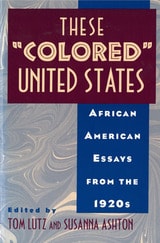
These Colored United States
African American Essays from the 1920sLutz, Tom
Rutgers University Press, 1996
"This series of essays from a crucial journal of the Harlem Renaissance epitomizes the diversity of middle-class African American intellectual culture of the 1920s, while the headnotes and introduction deftly articulate the complex social and institutional matrix from which the series emerged."––George Hutchinson, University of Tennessee, author of The Harlem Renaissance in Black and White
Originally published in The Messenger, “the most vibrant and controversial black journal in the nation” at the time, these essays represent an unexamined chapter in African American cultural history and provide a unique overview of social and cultural life during this crucial decade for race relations in the United States. While most scholarly attention on African American culture in the 1920s has focused on life in the major East Coast cities or the South, these essays are written by a highly diverse, eclectic group of African American writers from thirty different states, charged with assessing African American life in their home state. Socialists and pro-business writers, cultural nationalists and assimilationists, fiction writers, sociologists, theater critics, representatives of the New Negro group, the NAACP, and the union movement, and a series of idiosyncratic, nonaligned writers help give a full sense of the diversity of African American intellectual and cultural life in the 1920s.
Amont the essayists are Anita Scott Coleman, WIlliam H. Ferris, Alice Dunbar-Nelson, Charles S. Johnson, E. Franklin Frazier, Theophilus Lewis, Wallace Thurman, Roy Wilkins, George Schuyler, and Mamie Elaine Francis. The focus on the actual lived experience of African Americans across the nation provides copious materials for cultural study unavailable in any other collection.
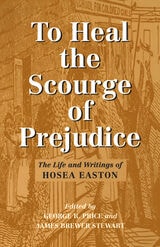
To Heal the Scourge of Prejudice
The Life and Writings of Hosea EastonHosea Easton
University of Massachusetts Press, 1999
How did racial prejudice originate and why has it been so deeply rooted in American culture? What have been the long-term effects of prejudice on the intellectual, communal, and psychological resources of African Americans? How might the nightmare of racial domination be truly brought to an end? Still pertinent today, these were among the key questions addressed more than a century and a half ago by Hosea Easton (1799–1837), an important yet long neglected activist and intellectual.
A black minister from New England, Easton rose to prominence during the 1820s and 1830s by joining in the struggle of free African Americans to resist southern slavery and secure racial equality. From this experience he developed a deep understanding of the problem of "race" in the United States and became a trenchant critic of white supremacy and its devastating consequences. This volume brings back into print the only extended writings of Easton that have survived into our time: his insightful, almost prescient A Treatise on the Intellectual Character, and the Civil and Political Condition of the Colored People of the U. States, first published in 1837; and his passionate 1828 Thanksgiving Day “Address.” The book also provides a biographical portrait of Easton and his family, drawn from primary documents as well as secondary sources in the areas of biography, genealogy, and social history.
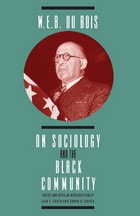
W. E. B. DuBois on Sociology and the Black Community
W. E. B. DuBois
University of Chicago Press, 1978
The editors provide an annotated bibliography, a lengthy overview of Du Bois's life and work, and detailed introductions to the selections.
"The most significant contribution of this book is its inclusive look at Du Bois as both academic and activist. . . . Individuals interested in the study of social issues and political sociology would benefit from reading and discussing this book."—Paul Kriese, Sociology: Reviews of New Books
"Green and Driver, informing this volume with a 48-page essay that summarizes Du Bois' career and places him in the context of the profession, have intelligently organized his writings. . . . A welcome contribution that should have wide use."—Elliott Rudwick, Contemporary Sociology