Results by title
4 books match the query 'Tohoku Earthquake and Tsunami, Japan, 2011'
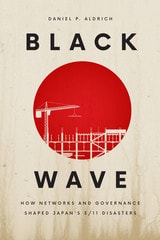
Black Wave
How Networks and Governance Shaped Japan’s 3/11 DisastersDaniel P. Aldrich
University of Chicago Press, 2019
Despite the devastation caused by the magnitude 9.0 earthquake and 60-foot tsunami that struck Japan in 2011, some 96% of those living and working in the most disaster-stricken region of Tōhoku made it through. Smaller earthquakes and tsunamis have killed far more people in nearby China and India. What accounts for the exceptionally high survival rate? And why is it that some towns and cities in the Tōhoku region have built back more quickly than others?
Black Wave illuminates two critical factors that had a direct influence on why survival rates varied so much across the Tōhoku region following the 3/11 disasters and why the rebuilding process has also not moved in lockstep across the region. Individuals and communities with stronger networks and better governance, Daniel P. Aldrich shows, had higher survival rates and accelerated recoveries. Less-connected communities with fewer such ties faced harder recovery processes and lower survival rates. Beyond the individual and neighborhood levels of survival and recovery, the rebuilding process has varied greatly, as some towns and cities have sought to work independently on rebuilding plans, ignoring recommendations from the national government and moving quickly to institute their own visions, while others have followed the guidelines offered by Tokyo-based bureaucrats for economic development and rebuilding.
Black Wave illuminates two critical factors that had a direct influence on why survival rates varied so much across the Tōhoku region following the 3/11 disasters and why the rebuilding process has also not moved in lockstep across the region. Individuals and communities with stronger networks and better governance, Daniel P. Aldrich shows, had higher survival rates and accelerated recoveries. Less-connected communities with fewer such ties faced harder recovery processes and lower survival rates. Beyond the individual and neighborhood levels of survival and recovery, the rebuilding process has varied greatly, as some towns and cities have sought to work independently on rebuilding plans, ignoring recommendations from the national government and moving quickly to institute their own visions, while others have followed the guidelines offered by Tokyo-based bureaucrats for economic development and rebuilding.
[more]
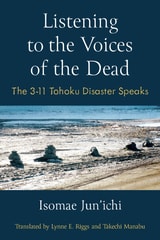
Listening to the Voices of the Dead
The 3-11 Tohoku Disaster SpeaksIsomae Jun'ichi
University of Michigan Press, 2024
Listening to the Voices of the Dead is an account of the author’s search for the disquieted voices of the dead in the wake of the March 11, 2011, Tōhoku Disaster and his attempt to translate those voices for the living. Isomae Jun’ichi considers the disaster a challenge for outside observers to overcome, especially for practitioners of religion and religious studies. He chronicles the care and devotion for the dead shown by ordinary people, people displaced from their homes and loved ones. Drawing upon religious studies, Japanese history, postcolonial studies, and his own experiences during the disaster, Isomae uncovers historical symptoms brought to the surface by the traumas of disaster. Only by listening to the disquieted voices of the dead, translating them, and responding to them can we regain our true selves as well as offer peace to the spirits of the victims. While Listening to the Voices of the Dead focuses on a specific event in Japanese history and memory, it captures a broadening critique at the heart of many movements responding to how increasing globalization impacts our sense of place and community.
[more]
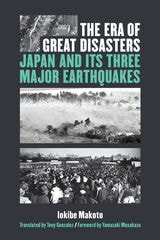
The Era of Great Disasters
Japan and Its Three Major EarthquakesMakoto Iokibe; Translated by Tony Gonzalez
University of Michigan Press, 2020
The Era of Great Disasters examines modern disaster response in Japan, from the changing earthquake preparations and regulations, to immediate emergency procedures from the national, prefectural, and city levels, and finally the evolving efforts of rebuilding and preparing for the next great disaster in the hopes of minimizing their tragic effects. This book focuses on three major earthquakes from Japan’s modern history. The first is the 1923 Great Kantō Earthquake, which struck the capital region. The second is the 1995 Great Hanshin-Awaji Earthquake, affecting the area between Kobe and Osaka. The third is the 2011 Great East Japan Earthquake, the magnitude 9.0 quake that struck off the Pacific coast of the Tōhoku region, causing a devastating tsunami and the nuclear accident. While the events of (and around) each of these earthquakes are unique, Professor Iokibe brings his deep expertise and personal experience to each disaster, unveiling not only the disasters themselves but the humanity underneath. In each case, he gives attention and gratitude to those who labored to save lives and restore the communities affected, from the individuals on the scene to government officials and military personnel and emergency responders, in hope that we might learn from the past and move forward with greater wisdom, knowledge, and common purpose.
[more]
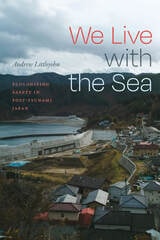
We Live with the Sea
Ecologizing Safety in Post-Tsunami JapanAndrew Littlejohn
Duke University Press, 2026
In We Live with the Sea, Andrew Littlejohn addresses the implementation and controversy surrounding safety infrastructures following the March 2011 tsunami in northeastern Japan. While the Japanese government proposed and enforced infrastructural transformations in the wake of the tsunami, these changes did not consider the impact on residents who built their communities and livelihoods around the coast. Focusing on the tsunami survivors who resisted government plans for increased coastal defenses, Littlejohn highlights alternative proposals offered by the local residents as well as the environmental, ecological, and more-than-human dependencies and imbrications those proposals reveal. In doing so, he argues that imposed modernist safety structures undermine the very things they claim to protect, showing how attempts to “ecologize” safety may offer more sustainable ways of thinking about security, preservation, and infrastructure.
[more]