Results by title
15 books match the query 'Traces'
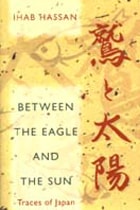
Between the Eagle and the Sun
Traces of JapanIhab Hassan
University of Alabama Press, 1996
A fascinating memoir by Egypt-born American literary theorist and writer Ihab Hassan about his life in Japan. Part recollection, part cultural perception, Between the Eagle and the Sun records his journey, living and seeing himself sometimes as another, assaying always to read the hieroglyphs of his past in the scripts of Japan. As lucid as it is intensely felt, at once lyrical and critical, the work offers a beguiling vision of Japan and, by tacit contrast, of America. For writing, the author says, is more than praise or blame, it is also knowledge, empathy, and delight. These attributes are evident in Hassan's treatment of Japanese culture, its people and scenes. Indeed, the people, rendered in vibrant portraits throughout the book, abide when all the shadows of romance and exasperation have fled.
True to its moment, the work also reinvests the forms of memoir, travel, and quest. Cultural essays, travel anecdotes, autobiographical meditations, portraits of Japanese friends, a section titled "Entries, A to Z," fit into a tight frame, with clear transitions from one section to another. The style, however, alters subtly to suit topic, occasion, and mood.
Japan may not hold the key to this planet's future; no single nation does. Yet the continuing interest in its history, society, and people and the incresed awareness of its recent trends and growing global impact engage an expanding audience. Avoiding cliches, sympathetic to its subject yet analytical, unflinching in judgment, and withal highly personal, Between the Eagle and the Sun offers a unique image of its subject by a distinguished and well-traveled critic, at home in several cultures.
Cosmic Impressions
Traces of God in the Laws of NatureWalter Thirring
Templeton Press, 2007
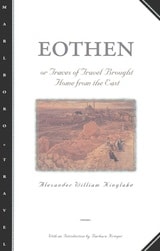
Eothen
Traces of Travel Brought Home from the EastAlexander William Kinglake
Northwestern University Press, 1997
Eothen has the freshness of the immediate and the new. Kinglake kept it free of the details of geography, history, science, politics, religion, and statistics; it is far less about the countries and the cities he passes through that it is about himself. This is what makes Eothen a modern travel book, possibly the first and certainly one of the greatest of its kind.

Illinois Trails & Traces
Portraits and Stories along the State’s Historic RoutesText by Gary Marx and photographs by Daniel Overturf, with a foreword by Dick Durbin
Southern Illinois University Press, 2022
FINALIST, 2023 Society of Midland Authors Award in Adult Nonfiction!
Exploring Illinois history through the paths we travel
Illinois Trails & Traces partners the deft writing of Gary Marx with vivid photography by Daniel Overturf to illuminate ever evolving patterns of travel and settlement. Taking the reader on a journey down early buffalo traces and Native American trails, this book shows how these paths evolved into wagon roads and paved highways. Marx and Overturf explore historic routes ranging from Route 66 to the Underground Railroad, all the way back to post-Ice Age animal migration trails followed by Paleo-Indian people. The authors also examine how rivers, canals, and railroads spurred the rapid rise of Illinois as a modern state.
Marx and Overturf bring history into the present by including over forty photographic portraits and written profiles of individuals who live along these routes today. Many of the people you will meet on these pages work to preserve and honor the history of these passages. Others profiled here embody the spirit of the old roads and provide a vivid link between past and present. Through this journey, we discover that we’ve all been traveling the same road all along.

Making Peace With Property
Traces of Post-Conflict ColombiaMeghan L. Morris
Duke University Press, 2027

Performing with the Dead
Trances and TracesChristopher "Kit" Danowski
Intellect Books, 2024
In this book, Kit Danowski constructs a methodology called kanga (from the Bantu for tying and untying), using three methods based on aspects of the Afrolatinx ritual and modified for performance contexts: spell, charm, and trance. This methodology enacts and complicates distinctions between performance and ritual, serving as a contribution to respectful and responsible intercultural performance practices. The methodology is bricoleur, drawing from ethnography, psychoanalytic theory, and phenomenology. Kanga in practice leads to a state of consciousness that Danowski calls hauntological. This borrows from Derrida but is redefined to refer to the study of haunted states of consciousness, where reality is coconstituted by the living and the dead and ancestral spirits are invoked to do the work once reserved for characters.
Salt Lantern
Traces of an American FamilyWilliam Towner Morgan
University of Iowa Press, 1997
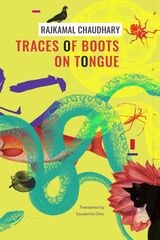
Traces of Boots on Tongue
and Other StoriesRajkamal Chaudhary
Seagull Books, 2023
Drawing influences from Indian folktales, French existentialism, and the Bengali Hungryalist movement, Rajkamal Chaudhary’s œuvre is like a secret back alley in an old city—not completely forgotten but existing only for the few. Even though Chaudhary also wrote in Maithili and Bengali, it was his writings in Hindi that established him as the bold new experimentalist of Indian literature. His India of the 1950 and 60s is populated with hopeless literature professors, scattered alcohol bottles, prostitutes, hysteria patients, and sell-out painters. His unconventional life and writing place him outside the mainstream, and so he remains as uncategorizable as the characters and lives he wrote about. Bringing together twelve of his most representative short stories, translated for the first time in English, Traces of Boots on Tongue and Other Stories allows a glimpse into the early decades of independent India and its weariness, which many readers will find in today’s India as well.
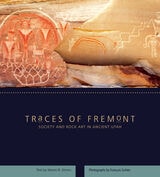
Traces of Fremont
Society and Rock Art in Ancient UtahSteven R. Simms, Photography by François Gohier
University of Utah Press, 2010
Fremont is a culture (ca. 300–1300 A.D.) first defined by archaeologist Noel Morss in 1928 based on characteristics unique to the area. Initially thought to be a simple socio-political system, recent reassessments of the Fremont assume a more complex society. This volume places Fremont rock art studies in this contemporary context. Author Steven Simms offers an innovative model of Fremont society, politics, and worldview using the principles of analogy and current archaeological evidence. Simms takes readers on a trip back in time by describing what a typical Fremont hamlet or residential area might have looked like a thousand years ago, including the inhabitants' daily activities. François Gohier's captivating photographs of Fremont art and artifacts offer an engaging complement to Simms's text, aiding us in our understanding of the lives of these ancient people.
Winner of the Utah Book Award in Nonfiction.
Winner of the Society for American Archaeology Book Award for Public Audience.
Traces of Gold
California's Natural Resources and the Claim to Realism in Western American LiteratureNicolas Witschi
University of Alabama Press, 2001
Artfully demonstrates the linkage of American literary realism to the texts, myths, and resources of the American West
From Gold Rush romances to cowboy Westerns, from hard-boiled detective thrillers to nature writing, the American West has long been known mainly through hackneyed representations in popular genres. But a close look at the literary history of the West reveals a number of writers who claim that their works represent the “real” West. As Nicolas Witschi shows, writers as varied as Bret Harte, John Muir, Frank Norris, Mary Austin, and Raymond Chandler have used claims of textual realism to engage, replicate, or challenge commonly held assumptions about the West, while historically acknowledged realists like William Dean Howells and Mark Twain have often relied on genre-derived impressions about the region.
The familiar association of the West with nature and the “great outdoors” implies that life in the West affords an unambiguous relationship with an unalloyed, non-human, real nature. But through a combination of textual scholarship, genre criticism, and materialist cultural studies, Witschi complicates this notion of wide-open spaces and unfettered opportunity. The West has been the primary source of raw materials for American industrial and economic expansion, especially between the California Gold Rush and World War II, and Witschi argues that the writers he examines exist within the intersections of cultural and material modes of production. Realistic depictions of Western nature, he concludes, must rely on the representation of the extraction of material resources like minerals, water, and oil.
With its forays into ecocriticism and cultural studies, Traces of Gold will appeal to students and scholars of American literature, American studies, and western history.
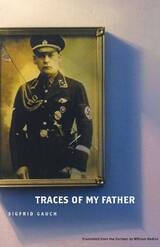
Traces of My Father
William Radice
Northwestern University Press, 2002
In 1979 Sigfrid Gauch published the groundbreaking Vaterspuren, (Traces of My Father), the first of the so-called father books about the relationships of postwar Germans with their parents. It inspired a new genre in German literature. Ever since, such writings have contributed greatly to Germany's ongoing struggle to overcome its own past.
This autobiographical novel is Gauch's attempt to come to terms with his father, Hermann Gauch, a physician who had joined the National Socialists in the 1920s, wrote six books of "race research" as a member of the SS, and to his dying day remained an unrepentant Nazi. The story alternates between the images of the elder Gauch's death and burial and the author's memories of childhood and adolescence.
Unlike many of the father books, however, Traces of My Father is less a political attack than a personal journey. Gauch, though honest about his father's monstrous actions and ideas, does not shirk their shared emotional bond. The result is a poignant attempt by a son to relive his father's notorious life and in doing so free himself from the man's influence.
Traces of the Old, Uses of the New
The Emergence of Digital Literary StudiesAmy E. Earhart
University of Michigan Press, 2015
Traces of the Past
Classics between History and ArchaeologyKaren Bassi
University of Michigan Press, 2016
Aimed at classicists, literary scholars, ancient historians, cultural historians, and archaeological theorists, the book combines three areas of research: time as a feature of narrative structure in literary theory; the concept of “the past itself” in the philosophy of history; and the ontological status of material objects in archaeological theory. Each of five central chapters explores how specific protoarchaeological narratives—from the fate of Zeus’ stone in Hesiod’s Theogony to the contest between words and objects in Aristophanes’ Frogs—both expose and attempt to bridge this gap. Throughout, the book serves as a response to Herodotus’ task in writing the Histories, namely, to ensure that “the past deeds of men do not fade with time.”
Traces of the Unseen
Photography, Violence, and Modernization in Early Twentieth-Century Latin AmericaCarolina Sá Carvalho
Northwestern University Press, 2023
Winner of the 2024 Roberto Reis Book Award
Winner of the LASA Environment Section Best Book of 2023
Winner of the LASA Amazonian Studies Section Best Book of 2024
Co-Winner of the LASA Book Award for the Visual Culture Studies 2024
A richly illustrated examination of photography as a technology for documenting, creating, and understanding the processes of modernization in turn-of-the-century Brazil and the Amazon
Photography at the turn of the twentieth century was not only a product of modernity but also an increasingly available medium to chronicle the processes of modernization. Traces of the Unseen: Photography, Violence, and Modernization in Early Twentieth-Century Latin America situates photography’s role in documenting the destruction wrought by infrastructure development and extractive capitalist expansion in the Amazon and outside the Brazilian metropole. Combining formal analysis of individual photographs with their inclusion in larger multimedia assemblages, Carolina Sá Carvalho explores how this visual evidence of violence was framed, captioned, cropped, and circulated. As she explains, this photographic creation and circulation generated a pedagogy of the gaze with which increasingly connected urban audiences were taught what and how to see: viewers learned to interpret the traces of violence captured in these images within the larger context of modernization.
Traces of the Unseen draws on works by Flavio de Barros, Euclides da Cunha, Roger Casement, Claude Lévi-Strauss, and Mario de Andrade to situate an unruly photographic body at the center of modernity, in all its disputed meanings. Moreover, Sá Carvalho locates historically specific practices of seeing within the geopolitical peripheries of capitalism. What emerges is a consideration of photography as a technology through which modern aspirations, moral inclinations, imagined futures, and lost pasts were represented, critiqued, and mourned.
Traces, Codes, and Clues
Reading Race in Crime FictionReddy, Maureen T
Rutgers University Press, 2002
Detective fiction featuring white women and people of color such as Barbara Neelys Blanche White and Walter Mosleys Easy Rawlinshas become tremendously popular. Although they are considered "light reading," mysteries also hold important cultural and social "clues." Much recent scholarly work has demonstrated that race is both a cultural fiction not a biological reality and a central organizing principle of experience. Popular writers are likely to reflect the conventions of their own historical situations.
In Traces, Codes, and Clues: Reading Race in Crime Fiction, Maureen T. Reddy explores the ways in which crime fiction manipulates cultural constructions such as race and gender to inscribe dominant cultural discourses. She notes that even those writers who appear to set out to revise outdated conventions repeatedly reproduce the genres most conservative elements. The greatest obstacle to transforming crime fiction, Reddy states, is the fact that the genre itself is deeply embedded in the discourse of white (and male) superiority. There is, therefore, an absolute necessity to break away from that discourse through reversal or other strategies in order to produce work that defies, and thus helps readers to defy, the dominant ideology of race.