Results by title
3 books match the query 'Transatlantic Perspective'

Managing Ethnic Diversity after 9/11
Integration, Security, and Civil Liberties in Transatlantic PerspectiveChebel d'Appollonia, Ariane
Rutgers University Press, 2010
America's approach to terrorism has focused on traditional national security methods, under the assumption that terrorism's roots are foreign and the solution to greater security lies in conventional practices. Europe offers a different model, with its response to internal terrorism relying on police procedures.
Managing Ethnic Diversity after 9/11 compares these two strategies and considers that both may have engendered greater radicalization--and a greater chance of home-grown terrorism. Essays address how transatlantic countries, including the United Kingdom, the United States, France, Germany, Spain, Italy, and the Netherlands have integrated ethnic minorities, especially Arabs and Muslims, since 9/11. Discussing the "securitization of integration," contributors argue that the neglect of civil integration has challenged the rights of these minorities and has made greater security more remote.
Managing Ethnic Diversity after 9/11 compares these two strategies and considers that both may have engendered greater radicalization--and a greater chance of home-grown terrorism. Essays address how transatlantic countries, including the United Kingdom, the United States, France, Germany, Spain, Italy, and the Netherlands have integrated ethnic minorities, especially Arabs and Muslims, since 9/11. Discussing the "securitization of integration," contributors argue that the neglect of civil integration has challenged the rights of these minorities and has made greater security more remote.
[more]

Science and Emotions after 1945
A Transatlantic PerspectiveEdited by Frank Biess and Daniel M. Gross
University of Chicago Press, 2014
Through the first half of the twentieth century, emotions were a legitimate object of scientific study across a variety of disciplines. After 1945, however, in the wake of Nazi irrationalism, emotions became increasingly marginalized and postwar rationalism took central stage. Emotion remained on the scene of scientific and popular study but largely at the fringes as a behavioral reflex, or as a concern of the private sphere. So why, by the 1960s, had the study of emotions returned to the forefront of academic investigation?
In Science and Emotions after 1945, Frank Biess and Daniel M. Gross chronicle the curious resurgence of emotion studies and show that it was fueled by two very different sources: social movements of the 1960s and brain science. A central claim of the book is that the relatively recent neuroscientific study of emotion did not initiate – but instead consolidated – the emotional turn by clearing the ground for multidisciplinary work on the emotions. Science and Emotions after 1945 tells the story of this shift by looking closely at scientific disciplines in which the study of emotions has featured prominently, including medicine, psychiatry, neuroscience, and the social sciences, viewed in each case from a humanities perspective.
In Science and Emotions after 1945, Frank Biess and Daniel M. Gross chronicle the curious resurgence of emotion studies and show that it was fueled by two very different sources: social movements of the 1960s and brain science. A central claim of the book is that the relatively recent neuroscientific study of emotion did not initiate – but instead consolidated – the emotional turn by clearing the ground for multidisciplinary work on the emotions. Science and Emotions after 1945 tells the story of this shift by looking closely at scientific disciplines in which the study of emotions has featured prominently, including medicine, psychiatry, neuroscience, and the social sciences, viewed in each case from a humanities perspective.
[more]
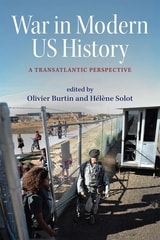
War in Modern US History
A Transatlantic PerspectiveOlivier Burtin and Hélène Solot
Ohio University Press, 2027
War in Modern US History: A Transatlantic Perspective brings together scholars based primarily in Europe to reconsider the place of war in the modern history of the United States. Although war has been central to the making of US power and global influence, the study of war and the military has often remained fragmented across subfields: military history, diplomatic history, cultural history, social history, American studies, sociology, and political science. This volume argues that a transatlantic and interdisciplinary perspective offers a particularly productive vantage point from which to rethink these divisions. The book approaches war not as a narrowly defined set of military actions but as a “total social act” whose effects extend across political institutions, social hierarchies, cultural representations, technologies, memory, gender, welfare, and everyday life. Its chapters range from the Civil War to the post-9/11 era and examine subjects including military occupation in Tennessee during the Civil War, nuclear communication during the Cold War, World War II intelligence, Cold War role-playing games, military spouses, disabled veterans, US military reform, and the afterlives of American bases in France. Together, they show how the boundaries between war and peace, military and civilian life, domestic and foreign policy, and national and transnational history have been constructed, blurred, and contested over time. By foregrounding the work of scholars trained in differing European academic contexts, the collection also highlights the value of looking at US history from the outside. This perspective challenges assumptions of American exceptionalism, brings US military history into dialogue with European and global historiographies of war, and encourages a broader understanding of the field. With an afterword by Beth Bailey, the volume speaks to scholars interested in the fields of US history, military history, war and society, and American studies and in the global and transnational dimensions of US power. Contributors Beth Bailey Olivier Burtin Malcolm Craig Anne-Lise Dall’Agnola François Doppler-Speranza Lucie Genay Katharina Gerund Andrew Houck Johannes Nagel Hélène Solot Simona Tobia
[more]