Results by title
3 books match the query 'Transnational Turn'
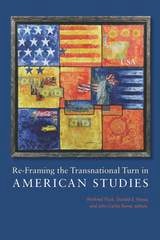
Re-Framing the Transnational Turn in American Studies
Edited by Winfried Fluck, Donald E. Pease, and John Carlos Rowe
Dartmouth College Press, 2011
This volume is the outcome of a transatlantic conversation on the topic “Transnational America,” in which more than sixty scholars from universities in the United States and Germany gathered to assess the historical significance of and examine the academic prospects for the “transnational turn” in American studies. This development has brought about the most significant re-imagining of the field since its inception. The “transnational” has subsumed competing spatial and temporal orientations to the subject and has dismantled the foundational tenets and premises informing the methodology, periodization, pedagogy, and geographical locations of U.S. American studies, but transnational American studies scholars have not yet provided a coherent portrait of their field. This volume constitutes an effort to produce this needed portrait. The editors have gathered work from a host of senior and up-and-coming Americanists to compile a field-defining project that will influence both scholars and students of American studies for many years to come.
[more]
The Imaginary and Its Worlds
American Studies after the Transnational TurnEdited by Laura Bieger, Ramón Saldívar, and Johannes Voelz
Dartmouth College Press, 2013
The Imaginary and Its Worlds collects essays that boldly rethink the imaginary as a key concept for cultural criticism. Addressing both the emergence and the reproduction of the social, the imaginary is ideally suited to chart the consequences of the transnational turn in American studies. Leading scholars in the field from the United States and Europe address the literary, social, and political dimensions of the imaginary, providing a methodological and theoretical groundwork for American studies scholarship in the transnational era and opening new arenas for conceptualizing formations of imaginary belonging and subjectivity. This important state-of-the-field collection will appeal to a broad constituency of humanists working to overcome methodological nationalism. The Imaginary and Its Worlds: An Introduction • LITERARY IMAGINARIES • Imagining Cultures: The Transnational Imaginary in Postrace America - Ramón Saldívar • The Necessary Fragmentation of the (U.S.) Literary-Cultural Imaginary - Lawrence Buell • Imaginaries of American Modernism - Heinz Ickstadt • SOCIAL IMAGINARIES • William James versus Charles Taylor: Philosophy of Religion and the Confines of the Social and Cultural Imaginaries - Herwig Friedl • The Shaping of We-Group Identities in the African American Community: A Perspective of Figurational Sociology on the Cultural Imaginary - Christa Buschendorf • Russia’s Californio Romance: The Other Shores of Whitman’s Pacific - Lene Johannessen • Form Games: Staging Life in the Systems Epoch - Mark Seltzer • POLITICAL IMAGINARIES • Real Toads - Walter Benn Michaels • Obama Unwound: The Romanticism of Victory and the Defeat of Compromise - Christopher Newfield • Barack Obama’s Orphic Mysteries - Donald E. Pease • Coda. The Imaginary and the Second Narrative: Reading as Transfer - Winfried Fluck • Contributors • Index
[more]
The Other Presences
Reading Literature Other-Wise after the Transnational Turn in American StudiesFlorian Tatschner
Dartmouth College Press, 2019
Florian Tatschner examines an alternative mode of reading fictional texts in the context of North American literature through “reading other-wise”: a mode of reading that regards the other in narratives not merely as a discursive construct of alterity, but as a presencing of otherness that resists discursive fixity. Waldenfels’s phenomenology constitutes the foundational approach of this work, and Lyotard’s poststructuralist philosophy of language, with its distinction between discursivity and figurality, offers a suitable framework for negotiating the relation between otherness and alterity. Drawing on the increasingly significant term “presence” in connection with phenomenon of otherness, Tatschner attempts to close a scholarly gap in the discourse on aesthetics regarding cultural difference as well as the relation between presence and aesthetics in American studies.
[more]