Results by title
8 books match the query 'Treatise'
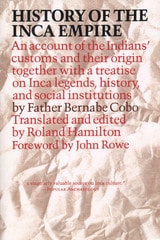
History of the Inca Empire
An Account of the Indians' Customs and Their Origin, Together with a Treatise on Inca Legends, History, and Social InstitutionsBy Bernabe Cobo
University of Texas Press, 1979
The Historia del Nuevo Mundo, set down by Father Bernabe Cobo during the first half of the seventeenth century, represents a singulary valuable source on Inca culture. Working directly frorn the original document, Roland Hamilton has translated that part of Cobo's massive manuscripts that focuses on the history of the kingdom of Peru. The volume includes a general account of the aspect, character, and dress of the Indians as well as a superb treatise on the Incas—their legends, history, and social institutions.

Portals
A Treatise on Internet-Distributed TelevisionAmanda D. Lotz
Michigan Publishing Services, 2017
Portals: A Treatise on Internet-Distributed Television pushes understandings of the business of television to keep pace with the considerable technological change of the last decade. It explains why shows such as Orange is the New Black or Transparent are indeed television despite coming to screens over internet connection and in exchange for a monthly fee. It explores how internet-distributed television is able to do new things – particularly, allow different people to watch different shows chosen from a library of possibilities. This technological ability allows new audience behaviors and new norms in making television.
Portals are the “channels” of internet-distributed television, and Portals identifies how the task of curating a library of shows differs from channels’ task of building a schedule. It explores the business model—subscriber funding—that supports many portals, and identifies the key differences from advertiser or direct purchase. Portals considers what we know about the future of television, even though we remain early in a process of transformative change.
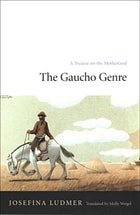
The Gaucho Genre
A Treatise on the MotherlandJosefina Ludmer
Duke University Press, 2002
By examining the formation of a genre whose origins predated the consolidation of Argentina as a nation-state but that gained significance only after the country's independence, Ludmer elucidates the relationship of literature to the state, as well as the complex positionings of gender within the struggle for independence. She develops a sociological investigation of “outsider” culture through close textual analyses of works by Hidalgo, Ascasubi, Del Campo, Hernandez, Sarmiento, and Borges. This inquiry culminates in the assertion that language, marked as it is by the collisions of high and low culture, constitutes the central issue of Latin American modernization and modernism. Extensive annotation renders this edition of Ludmer's seminal study easily accessible for a North American audience.
The Gaucho Genre’s far-reaching implications will make it valuable reading for a varied audience. While teachers and students of Latin American literature and criticism will find it an important resource, it will also interest those concerned with the processes of nation-building or in the complex intersections of dominant and marginal voices.
The Treatise on Laws (Decretum DD. 1-20) with the Ordinary Gloss (Studies in Medieval and Early Modern Canon Law, Volume 2)
Catholic University of America Press, 1993
Treatise On Laughter
Laurent Joubert, Translated by Gregory David de Rocher
University of Alabama Press, 1980
Laurent Joubert (b. 1529) was an important figure in the medical world of the French Renaissance. His monumental Treatise on Laughter provides categories and examples of the laughable. The work describes laughter, its causes and effects, its types and differences. His subdivisions and categories, along with their examples, furnish today's critic and reader with a Renaissance vision of comic commonplaces. It is this vision that may prove to be of great value in analyzing comic literature of the Renaissance.
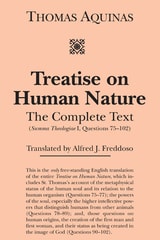
Treatise on Human Nature
The Complete Text (Summa Theologiae I, Questions 75-102)Thomas Aquinas
St. Augustine's Press, 2010
St. Thomas Aquinas’s Treatise on Human Nature occupies questions 75-102 of Part 1 of the Summa Theologiae. It contains St. Thomas’s most mature statement of his philosophical and theological anthropology, i.e., his account of what human beings are and of their origin as distinctive creatures made in the image of God. This translation, moreover, is the only complete edition of all the material St. Thomas envisaged as being part of the Treatise.
The treatise begins with two long and complex questions on the metaphysical status of the human soul and its relation to the human organism. Here St. Thomas tries to show how the human being is both an animal and an animal who transcend the other animals. In doing so he marks out a distinctive Christian/Aristotelian conceptual space between “materialist” accounts of human nature that reduce human beings to mere collections of physical or chemical or biological components and “dualistic” accounts of human nature, such as those propounded by Plato and, later on, Descartes, that identify human beings with their immaterial souls.
The next thirteen questions deal with the powers of the soul, especially those higher intellective powers of understanding and willing that distinguish human beings from the other animals. Here we are given a philosophical framework for the findings of the human sciences.
Finally, the last thirteen questions have to do with human origins, the creation of the first man and first woman, the state of our first parents, and their status as beings created in the image of God. In essence, this is St. Thomas’s philosophically attuned commentary on the parts of Genesis 1–2 that deal specifically with the creation of the human species. These thirteen questions, though an integral part of the Treatise, are not included in other translations of the Treatise on Human Nature.
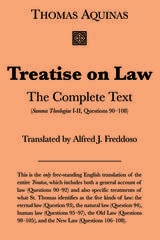
Treatise on Law
The Complete TextThomas Aquinas
St. Augustine's Press, 2009
St. Thomas’s account of law is firmly embedded within a general moral theory that begins with a rich conception of human flourishing, i.e., the good for human beings (Questions 1–5). This good consists, first and foremost, in our ultimate and intimate union with the Persons of the Blessed Trinity – a union that in our present state we can grasp intellectively and pursue affectively only with God’s supernatural assistance. It is within this framework that we order our loves and pursue the more proximate goals they open up to us as human beings in this life. Given the appropriate goals, the next question is how we can get from where we are, in the grips of the consequences of Original Sin, to where we want to be. The answer is: by means of (a) human actions that are good, i.e., rightly ordered toward our ultimate end and (b) the habits that these actions either engender or flow from. In analyzing human actions (Questions 6–21) and their relation to the passions (Questions 22–48), St. Thomas gives a general account of what he calls the ‘intrinsic principles’ of human actions and their associated habits – both virtues (Questions 49–70) and vices (Questions 71–89). It is only then that he turns to what he calls the ‘extrinsic principles’ of good human actions, viz., law (Questions 90–108) and grace (Questions 109–114).
According to St. Thomas, law, far from supplanting virtue as a basic principle of action, serves as an independent principle of action that complements virtue and is itself capable of being factored into practical deliberation. The reason is that all of God’s
precepts, prohibitions, and punishments are aimed at promoting the good of the whole universe and, more particularly, the good for human beings, both individually and within the various forms of social life. Because of this, law serves as both a restraint on bad actions and a spur to good action, i.e., a restraint on actions that take us away from virtue and genuine human flourishing and a spur to actions that promote virtue and flourishing.
There are many benefits of having the whole treatise rather than just the first few questions, as has been the standard practice in previous editions of the Treatise on Law. To mention just a few of these benefits, the question on the moral precepts of the Old Law (question 100) helps to illuminate in many different ways the earlier questions on natural law and human law (questions 94–97). Again, the questions on the ceremonial and judicial precepts of the Old Law (questions 101–105) demon-strate in depth the symbiotic relationship that St. Thomas takes to obtain between the Old Testament and the New Testament. The questions on the New Law provide an introduction to the Christian way of life that will be described in incomparable detail in the Second Part of the Second Part, the bulk of which is structured around the treatment of the three theological virtues and the four cardinal virtues.
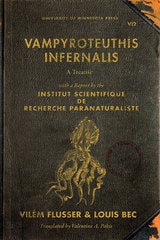
Vampyroteuthis Infernalis
A Treatise, with a Report by the Institut Scientifique de Recherche ParanaturalisteVilém Flusser
University of Minnesota Press, 2012
How far apart are humans from animals—even the “vampire squid from hell”? Playing the scientist/philosopher/provocateur, Vilém Flusser uses this question as a springboard to dive into a literal and a philosophical ocean. “The abyss that separates us” from the vampire squid (or vampire octopus, perhaps, since Vampyroteuthis infernalis inhabits its own phylogenetic order somewhere between the two) “is incomparably smaller than that which separates us from extraterrestrial life, as imagined in science fiction and sought by astrobiologists,” Flusser notes at the outset of the expedition.
Part scientific treatise, part spoof, part philosophical discourse, part fable, Vampyroteuthis Infernalis gives its author ample room to ruminate on human—and nonhuman—life. Considering the human condition along with the vampire squid/octopus condition seems appropriate because “we are both products of an absurd coincidence . . . we are poorly programmed beings full of defects,” Flusser writes. Among other things, “we are both banished from much of life’s domain: it into the abyss, we onto the surfaces of the continents. We have both lost our original home, the beach, and we both live in constrained conditions.”
Thinking afresh about the life of an “other”—as different from ourselves as the vampire squid/octopus—complicates the linkages between animality and embodiment. Odd, and strangely compelling, Vampyroteuthis Infernalis offers up a unique posthumanist philosophical understanding of phenomenology and opens the way for a non-philosophy of life.