Results by title
20 books match the query 'Trends'

Affirmative Action in Medicine
Improving Health Care for EveryoneJames L. Curtis, M.D.
University of Michigan Press, 2003
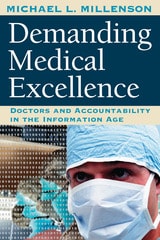
Demanding Medical Excellence
Doctors and Accountability in the Information AgeMichael L. Millenson
University of Chicago Press, 2000
"If you read only one book this year, read Demanding Medical Excellence. It's that good, and the revolution it describes is that important."—Health Affairs
"Millenson has done yeoman's work in amassing and understanding that avalanche of data that lies beneath most of the managed-care headlines. . . . What he finds is both important and well-explained: inconsistency, overlap, and inattention to quality measures in medical treatment cost more and are more dangerous than most cost-cutting measures. . . . [This book] elevates the healthcare debate to a new level and deserves a wide readership."—Library Journal
"An involving, human narrative explaining how we got to where we are today and what lies ahead."—Mark Taylor, Philadelphia Inquirer
"Read this book. It will entertain you, challenge, and strengthen you in your quest for better accountability in health care."—Alex R. Rodriguez, M.D., American Journal of Medical Quality
"Finally, a health-care book that doesn't wring its hands over the decline of medicine at the hands of money-grubbing corporations. . . . This is a readable account of what Millenson calls a 'quiet revolution' in health care, and his optimism makes for a refreshing change."—Publishers Weekly
"With meticulous detail, historical accuracy, and an uncommon understanding of the clinical field, Millenson documents our struggle to reach accountability."—Saty Satya-Murti, M.D., Journal of the American Medical Association
Emerging Issues and Trends in Education
Theodore S. Ransaw
Michigan State University Press, 2017
From Origin to Destination
Trends and Mechanisms in Social Stratification ResearchEdited by Stefani Scherer, Reinhard Pollak, Gunnar Otte, and Markus Gangl
Campus Verlag, 2007
Future Medicine
Ethical Dilemmas, Regulatory Challenges, and Therapeutic Pathways to Health Care and Healing in Human TransformationMichael H. Cohen
University of Michigan Press, 2002

Housing Needs and Policy Approaches
Trends in Thirteen CountriesWillem Van Vliet , Elizabeth Huttman, and Sylvia Fava, eds.
Duke University Press, 1985

Indicators of Trends in American Education
Abbott Lamoyne Ferriss
Russell Sage Foundation, 1969
Indicators of Trends in the Status of American Women
Abbott Lamoyne Ferriss
Russell Sage Foundation, 1971

Intelligent Multimedia Technologies for Financial Risk Management
Trends, tools and applicationsSimon Grima
The Institution of Engineering and Technology, 2023
Measuring the Gains from Medical Research
An Economic ApproachEdited by Kevin M. Murphy and Robert H. Topel
University of Chicago Press, 2003
From an economic perspective, they find, the answer is a resounding "yes": in fact, considering the extraordinary value of improvements to health, we may even be spending too little on medical research. The evidence these papers present and the conclusions they reach are both surprising and convincing: that growth in longevity since 1950 has been as valuable as growth in all other forms of consumption combined; that medical advances producing 10% reductions in mortality from cancer and heart disease alone would add roughly $10 trillion-a year's GDP-to the national wealth; or that the average new drug approved by the FDA yields benefits worth many times its cost of development.
The papers in this book are packed with these and many other surprising revelations, their sophisticated analysis persuasively demonstrating the massive economic benefits we can gain from investments in medical research. For anyone concerned about the cost and the value of such research-from policy makers to health care professionals and economists-this will be a landmark book.

Partners in Education
Issues and Trends from the 21st International Congress on the Education of the DeafDonald F. Moores
Gallaudet University Press, 2011
The 21st International Congress on the Education of the Deaf (ICED) witnessed revolutionary exchanges on the vital themes in education. Presenters addressed topics encompassing seven major strands: Educational Environments, Language and Literacy, Early Intervention, Unique Challenges in Developing Countries, Educating Learners with Diverse Needs, Technology in Education, and Sign Language and Deaf Culture. These presentations and ensuing dialogues raised many complex questions. Partners in Education: Issues and Trends from the 21st International Congress on the Education of the Deaf features all of the keynote addresses by renowned luminaries in deaf education: Breda Carty, Karen Ewing, Nassozi Kiyaga, John Luckner, Connie Mayer and Beverly Trezek, volume editor Donald F. Moores, Peter V. Paul, Antti Raike, Claudine Storbeck, James Tucker, and Alys Young.
Most critically, the contributors to this collection explore the many multifaceted challenges facing the world’s deaf students. Deaf children are being diagnosed with overlays of disabilities; more deaf children are growing up in poverty; and many deaf children represent minority racial/ethnic groups or are immigrants to their country of residence. The situation for deaf individuals in the most impoverished countries of the world is desperate and of crisis proportions. This volume brings these themes to light through its exceptional synthesis of the outstanding discourse that took place at ICED 2010, including abstracts from 30 celebrated conference presentations.

Taking Stock of Homicide
Trends, Emerging Themes, and Research ChallengesEdited by Karen F. Parker, Richard Stansfield, and Ashley M. Mancik
Temple University Press, 2024
Featuring leading scholars, this volume is organized around key themes and areas that reflect major contemporary trends and patterns in criminological literature. Chapters consider fundamentals such as data collection, sources, and histories; structural dynamics, including methodologies and fieldwork plus factors involving race and public health; the circumstances, types, and variations in homicide, from intimate partner violence to gangs, drugs, and firearms; as well as the prevention of and responses to homicide.
An essential state-of-the-discipline examination, Taking Stock of Homicide expands our knowledge while offering a toolkit for how to conduct future research on this serious, violent crime.
Contributors: Mark Berg, Laura Boisten, Anthony Braga, Fiona Brookman, Shytierra Gaston, Veronica Valencia Gonzalez, Elizabeth Griffiths, Chris Guerra, John Hipp, John Jarvis, Helen Jones, Sharon Jones-Eversley, Jungmyung Kim, Kenneth Land, Marieke Liem, Michael Light, Xiaoshuang Iris Luo, Amy Magnus, Patricia McCall, Erin Orrick, Alex Piquero, William Pridemore, David Pyrooz, Arnaldo Rabolini, Kasey Ragan, Wendy Regoeczi, Johnny Rice II, Jacqueline Rhoden-Trader, Ethan Rogers, Meghan Rodgers, Randolph Roth, Jose Antonio Sanchez, Daniel Semenza, James Tuttle, Jolien van Breen, Kirk Williams, and the editors

Technological Change in Health Care
A Global Analysis of Heart AttackMark B. McClellan and Daniel P. Kessler, Editors
University of Michigan Press, 2002
The comparisons presented here confirm that the use of medical technology in treatment for heart attack is strongly related to incentives, and that technological change is an important cause of medical expenditure growth in all developed countries. Each participating research team reviewed the economic and regulatory incentives provided by their country's health system, and major changes in those incentives over the 1980s and 1990s, according to a commonly used framework. Such incentives include: the magnitude of out-of-pocket costs to patients, the generosity of reimbursement to physicians and hospitals, regulation of the use of new technologies or the supply of physicians, regulation of competition, and the structure of hospital ownership. Each team also reviewed how care for heart attacks has changed in their country over the past decade.
The book will be of enormous importance to health economists, medical researchers and epidemiologists, and policymakers.
Mark McClellan is Associate Professor of Economics and of Medicine and, by courtesy, of Health Research and Policy, Stanford University. He is a National Fellow, the Hoover Institution. Daniel P. Kessler is Associate Professor of Economics, Law, and Policy in the Graduate School of Business, Stanford University, and a Research Fellow, the Hoover Institution.

The Changing Past
Trends in South African Historical WritingKen Smith
Ohio University Press, 1989
E.H. Carr said: “Before you study the history, study the historian.” Written history often tells us more about the historian’s own times than it does of the times about which he is writing. The historians and the way in which each generation has rewritten history in the light of its own preoccupations is the subject of The Changing Past. This is the first book-length survey in English that covers all the main trends in South African historiography. Starting with the first documents and histories, it goes on to trace the 19th century. British and settler “schools,” Afrikaans historiography from its pre-academic 19th century phase to the present, and the liberal historians who struck out in a new direction from the 1920s. The book highlights the break with the past that historians of the “new radical school” have made in the last 15 years, and surveys the position of historical writing to the present.
The canvas is delineated in bold strokes that sketch in the main outlines rather than seek an exhaustive treatment of all existing literature. This, together with a conscious effort to minimize theoretical discussion, makes it a highly readable text.

The Medical Malpractice Myth
Tom Baker
University of Chicago Press, 2005
This, according to Tom Baker, is the myth of medical malpractice, and as a reality check he offers The Medical Malpractice Myth, a stunning dismantling of this familiar, but inaccurate, picture of the health care industry. Are there too many medical malpractice suits? No, according to Baker; there is actually a great deal more medical malpractice, with only a fraction of the cases ever seeing the inside of a courtroom. Is too much litigation to blame for the malpractice insurance crisis? No, for that we can look to financial trends and competitive behavior in the insurance industry. Are these lawsuits frivolous? Very rarely. Point by point, Baker—a leading authority on insurance and law—pulls together the research that demolishes the myths that have taken hold about medical malpractice and suggests a series of legal reforms that would help doctors manage malpractice insurance while also improving patient safety and medical accountability.
President Bush has made medical malpractice reform a priority in his last term in office, but if history is any indication, legislative reform would only worsen the situation and perpetuate the gross misunderstanding of it. The debate surely will be transformed by The Medical Malpractice Myth, a book aimed squarely at general readers but with radical conclusions that speak to the highest level of domestic policymaking.

The Political Economy of Health in Africa
Mis Af#60Toyin Falola
Ohio University Press, 1992
The Rational Public
Fifty Years of Trends in Americans' Policy PreferencesBenjamin I. Page and Robert Y. Shapiro
University of Chicago Press, 1992
The authors unequivocally demonstrate that, notwithstanding fluctuations in the opinions of individuals, collective public opinion is remarkably coherent: it reflects a stable system of values shared by the majority of Americans and it responds sensitively to new events, arguments, and information reported in the mass media. While documenting some alarming case of manipulation, Page and Shapiro solidly establish the soundness and value of collective political opinion. The Rational Public provides a wealth of information about what we as a nation have wanted from government, how we have changed our minds over the years, and why.
For anyone interested in the short- and long-term trends in Americans' policy preferences, or eager to learn what Americans have thought about issues ranging from racial equality to the MX missile, welfare to abortion, this book offers by far the most sophisticated and detailed treatment available.

Trends in American Higher Education
Joseph Ben-David
University of Chicago Press, 1981

Trends in Communication Policy Research
New Theories, Methods and SubjectsEdited by Natascha Just and Manuel Puppis
Intellect Books, 2012