Results by title
17 books match the query 'Trump, Donald'

"Destined to Fail"
Carl Seashore’s World of Eugenics, Psychology, Education, and MusicJulia Eklund Koza
University of Michigan Press, 2021
A little-known fact about the prominent US psychologist and educator Carl E. Seashore (1866–1949) is that he was deeply involved in the American eugenics movement. He was among the US academics to support eugenics long before German Nazis embraced it. A titan in a host of disciplines and a proponent of radical education reform, Seashore used his positional power to promote a constellation of education reforms consistent with central precepts of eugenics. Many of these reforms, including tracking, gifted and talented programs, and high-stakes standardized testing, were adopted and remain standard practice in the United States today. He promulgated the idea that musical talent is biologically inheritable, and he developed the first standardized tests of musical talent; these tests were used by early-twentieth-century researchers in their attempts to determine whether there are race differences in musical talent. Seashore’s ideas and work profoundly shaped music education’s research trajectory, as well as enduring “commonsense” beliefs about musical ability. An intersectional analysis, “Destined to Fail” focuses on the relationship between eugenics and Seashore’s views on ability, race, and gender. Koza concludes that Seashore promoted eugenics and its companion, euthenics, because he was a true believer. She also discusses the longstanding silences surrounding Seashore’s participation in eugenics. As a diagnosis and critique of the present, “Destined to Fail” identifies resemblances and connections between past and present that illustrate the continuing influence of eugenics—and the systems of reasoning that made early-twentieth-century eugenics imaginable and seem reasonable—on education discourse and practice today. It maps out discursive, citational, and funding connections between eugenicists of the early twentieth-century and contemporary White supremacists; this mapping leads to some of Donald Trump’s supporters and appointees.

American Values, Religious Voices
100 Days. 100 LettersAndrea L. Weiss and Lisa M. Weinberger
University of Minnesota Press, 2018
American Values, Religious Voices: 100 Days, 100 Letters is a collection of letters written by some of America’s most accomplished and thoughtful scholars of religion during the first 100 days of the Trump presidency. While the letters are addressed to the president, vice president, and members of the 115th Congress and Trump administration, they speak to a broad audience of Americans looking for wisdom and encouragement at this tumultuous time in our nation’s history.
This unique volume assembles the 100 letters, plus four new supplemental essays and many of the graphic illustrations that enhanced the campaign.
Published near the midway point of the Trump presidency, this book showcases a wide range of ancient sacred texts that pertain to our most pressing contemporary issues. At a time of great division in our country, this post-election project models how people of different backgrounds can listen to and learn from one another. The letters offer insight and inspiration, reminding us of the enduring values that make our nation great.
Changing Their Minds?
Donald Trump and Presidential LeadershipGeorge C. Edwards III
University of Chicago Press, 2021
Donald Trump has been a distinctive president, and his arrival in the Oval Office brought new questions. Could someone with his decades of experience as a self-promoter connect with the public and win its support? Could a president who is an experienced negotiator obtain the support in Congress needed to pass his legislative programs? Would we need to adjust the theory of presidential leadership to accommodate a president with unique persuasive skills?
Building on decades of research and employing extensive new data, George C. Edwards III addresses these questions. He finds that President Trump has been no different than other presidents in being constrained by his environment. He moved neither the public nor Congress. Even for an experienced salesman and dealmaker, presidential power is still not the power to persuade. Equally important was the fact that, as Edwards shows, Trump was not able to exploit the opportunities he had. In fact, we learn here that the patterns of the president’s rhetoric and communications and his approach to dealing with Congress ultimately lessened his chances of success. President Trump, it turns out, was often his own agenda’s undoing.
Decoding the Digital Church
Evangelical Storytelling and the Election of Donald J. TrumpStephanie A. Martin
University of Alabama Press, 2021
"This investigation tries to understand why many Evangelical pastors were blamed for endorsing Trump when, in fact, most did not. This book joins other attempts by scholars and journalists to analyze the relationship between Trump and Evangelicals. Recommended.” —CHOICE
Tracing the digital narratives that shaped evangelical identity in a pivotal political moment.
As a political constituency, white conservative evangelicals are generally portrayed as easy to dupe, disposed to vote against their own interests, and prone to intolerance and knee-jerk reactions. In Decoding the Digital Church: Evangelical Storytelling and the Election of Donald J. Trump, Stephanie A. Martin challenges this assumption and moves beyond these overused stereotypes to develop a refined explanation for this constituency’s voting behavior.
This volume offers a fresh perspective on the study of religion and politics and stems from the author’s personal interest in the ways her experiences with believers differ from how scholars often frame this group’s rationale and behaviors. To address this disparity, Martin examines sermons, drawing on her expertise in rhetoric and communication studies with the benefits of ethnographic research in an innovative hybrid approach she terms a “digital rhetorical ethnography.” Martin’s thorough research surveys more than 150 online sermons from America’s largest evangelical megachurches in 37 different states. Through listening closely to the words of the pastors who lead these conservative congregations, Martin describes a gentler discourse less obsessed with issues like abortion or marriage equality than stereotypes of evangelicals might suggest. Instead, the politicaleconomic sermons and stories from pastors encourage true believers
to remember the exceptional nature of the nation’s founding while also deemphasizing how much American citizenship really means.
Martin grapples with and pays serious, scholarly attention to a seeming contradiction: while the large majority of white conservative evangelicals voted in 2016 for Donald J. Trump, Martin shows that many of their pastors were deeply concerned about the candidate, the divisive nature of the campaign, and the potential effect of the race on their congregants’ devotion to democratic process itself. In-depth chapters provide a fuller analysis of our current political climate, recapping previous scholarship on the history of this growing divide and establishing the groundwork to set up the dissonance between the political commitments of evangelicals and their faith that the rhetorical ethnography addresses.
Digital Demagogue
Authoritarian Capitalism in the Age of Trump and TwitterChristian Fuchs
Pluto Press, 2018
This book delves into new political-economic structures as expressed through political communication to explain the rise of authoritarian capitalism, nationalism and right-wing ideology throughout the world. Christian Fuchs does this through updating Marxist theory and the Frankfurt School's critical theory. He re-invigorates the works on authoritarianism of Franz L. Neumann, Theodor W. Adorno, Erich Fromm, Herbert Marcuse, Max Horkheimer, Wilhelm Reich, Leo Lowenthal and Klaus Theweleit in the age of Trump and Twitter.
In the age of big data and social media, Digital Demagogue studies the expressions of ideology, nationalism and authoritarianism today and discusses prospects for overcoming capitalism and renewing the Left.
Imagining Politics
Interpretations in Political Science and Political TelevisionStephen Benedict Dyson
University of Michigan Press, 2019
Imagining Politics critically examines two interpretations of government. The first comes from pop culture fictions about politics, the second from academic political science. Stephen Benedict Dyson argues that televised political fictions and political science theories are attempts at meaning-making, reflecting and shaping how a society thinks about its politics.
By taking fiction seriously, and by arguing that political science theory is homologous to fiction, the book offers a fresh perspective on both, using fictions such as The West Wing, House of Cards, Borgen, Black Mirror, and Scandal to challenge the assumptions that construct the discipline of political science itself.
Imagining Politics is also about a political moment in the West. Two great political shocks—Brexit and the election of Donald Trump—are set in a new context here. Dyson traces how Brexit and Trump campaigned against our image of politics as usual, and won.
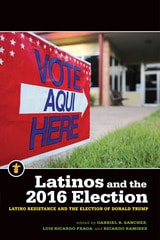
Latinos and the 2016 Election
Latino Resistance and the Election of Donald TrumpGabriel R. Sanchez
Michigan State University Press, 2020
Presidents, Populism, and the Crisis of Democracy
William G. Howell and Terry M. Moe
University of Chicago Press, 2020
The most visible cause is Donald Trump, who has used his presidency to attack the nation’s institutions and violate its democratic norms. Yet Trump is but a symptom of causes that run much deeper: social forces like globalization, automation, and immigration that for decades have generated economic harms and cultural anxieties that our government has been wholly ineffective at addressing. Millions of Americans have grown angry and disaffected, and populist appeals have found a receptive audience. These are the drivers of Trump’s dangerous presidency. And after he leaves office, they will still be there for other populists to weaponize.
What can be done to safeguard American democracy? The disruptive forces of modernity cannot be stopped. The solution lies, instead, in having a government that can deal with them—which calls for aggressive new policies, but also for institutional reforms that enhance its capacity for effective action.
The path to progress is filled with political obstacles, including an increasingly populist, anti-government Republican Party. It is hard to be optimistic. But if the challenge is to be met, we need reforms of the presidency itself—reforms that harness the promise of presidential power for effective government, but firmly protect against the fear that it may be put to anti-democratic ends.
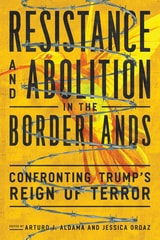
Resistance and Abolition in the Borderlands
Confronting Trump's Reign of TerrorEdited by Arturo J. Aldama and Jessica Ordaz; Foreword by Leo R. Chavez; Afterword by Karma R. Chávez
University of Arizona Press, 2024
This volume provides a well-argued look at the Trump era. Insightful contributions delve into the impact of Donald Trump’s rhetoric and policies on migrants detained and returned, immigrant children separated from their parents and placed in detention centers, and migrant women subjected to sexual and reproductive abuses, among other timely topics. The chapter authors document a long list in what the book calls “Trump’s Reign of Terror.”
Organized thematically, the book has four sections: The first gathers histories about the Trump years’ roots in a longer history of anti-migration; the second includes essays on artistic and activist responses on the border during the Trump years; the third critiques the normalization of Trump’s rhetoric and actions in popular media and culture; and the fourth envisions the future.
Resistance and Abolition in the Borderlands is an essential reader for those wishing to understand the extent of the damage caused by the Trump era and its impact on Latinx people.
Contributors
Arturo J. Aldama
Rebecca Avalos
Cynthia Bejarano
Tria Blu Wakpa
Renata Carvalho Barreto
Karma R. Chávez
Leo R. Chavez
Jennifer Cullison
Jasmin Lilian Diab
Allison Glover
Jamila Hammami
Alexandria Herrera
Diana J. Lopez
Sergio A. Macías
Cinthya Martinez
Alexis N. Meza
Roberto A. Mónico
José Enrique Navarro
Jessica Ordaz
Eliseo Ortiz
Kiara Padilla
Leslie Quintanilla
J-M Rivera
Heidy Sarabia
Tina Shull
Nishant Upadhyay
Maria Vargas
Antonio Vásquez
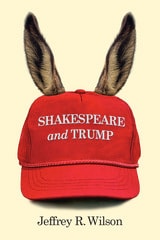
Shakespeare and Trump
Jeffrey R. Wilson
Temple University Press, 2020
Should we draw an analogy between Shakespeare’s tyrants—Richard III, Julius Caesar, Macbeth, and King Lear—and Donald Trump? In Shakespeare and Trump, Jeffrey Wilson applies literary criticism to real life, examining plot, character, villainy, soliloquy, tragedy, myth, and metaphor to identify the formal features of the Trump phenomenon, and its hidden causes, structure, and meanings.
Wilsonapproaches his comparison prismatically. He first considers two high-concept (read: far-fetched) Shakespeare adaptations penned by Trump’s former chief political strategist Steve Bannon. He looks at University of Pennsylvania students protesting Trump by taking down a monument to Shakespeare. He reads Trump’s first 100 days in office against Netflix’s House of Cards. Wilson also addresses the summer 2017 Shakespeare in the Park production of Julius Caesar wherein an assassination of a Trump-ian leader caused corporations to withdraw sponsorship.
These stories reveal a surprising—and bizarre—relationship between the provincial English playwright and the billionaire President of the United States, ostensibly a medieval king living in a modern world. The comparison reveals a politics that blends villainy and comedy en route to tragedy.
Sovereignty, Inc.
Three Inquiries in Politics and EnjoymentWilliam Mazzarella, Eric L. Santner, and Aaron Schuster
University of Chicago Press, 2020
Drawing on anthropology, political theory, philosophy, psychoanalysis, and theater, William Mazzarella, Eric L. Santner, and Aaron Schuster show how politics in the age of Trump functions by mobilizing a contradictory and convoluted enjoyment, an explosive mixture of drives and fantasies that eludes existing portraits of our era. The current political moment turns out to be not so much exceptional as exceptionally revealing of the constitutive tension between enjoyment and economy that has always been a key component of the social order. Santner analyzes the collective dream-work that sustains a new sort of authoritarian charisma or mana, a mana-facturing process that keeps us riveted to an excessively carnal incorporation of sovereignty. Mazzarella examines the contemporary merger of consumer brand and political brand and the cross-contamination of politics and economics, warning against all too easy laments about the corruption of politics by marketing. Schuster, focusing on the extreme theatricality and self-satirical comedy of the present, shows how authority reasserts itself at the very moment of distrust and disillusionment in the system, profiting off its supposed decline. A dazzling diagnostic of our present, Sovereignty, Inc., forces us to come to terms with our complicity in Trump’s political presence and will immediately take its place in discussions of contemporary politics.
The Myth of the Imperial Presidency
How Public Opinion Checks the Unilateral ExecutiveDino P. Christenson and Douglas L. Kriner
University of Chicago Press, 2020
With robust empirical data and compelling case studies, the authors reveal the extent to which domestic public opinion limits executive might. Presidents are emboldened to pursue their own agendas when they enjoy strong public support, and constrained when they don’t, since unilateral action risks inciting political pushback, jeopardizing future initiatives, and further eroding their political capital. Although few Americans instinctively recoil against unilateralism, Congress and the courts can sway the public’s view via their criticism of unilateral policies. Thus, other branches can still check the executive branch through political means. As long as presidents are concerned with public opinion, Christenson and Kriner contend that fears of an imperial presidency are overblown.
The Personality of Power
A Theory of Fascism for Anti-fascist LifeBrian Massumi
Duke University Press, 2025
The Rise of Trump
America's Authoritarian SpringMatthew C. MacWilliams
Amherst College Press, 2016
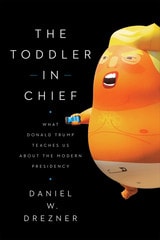
The Toddler in Chief
What Donald Trump Teaches Us about the Modern PresidencyDaniel W. Drezner
University of Chicago Press, 2020
Every president faces criticism and caricature. Donald Trump, however, is unique in that he is routinely characterized in ways more suitable for a toddler. What’s more, it is not just Democrats, pundits, or protestors who compare the president to a child; Trump’s staffers, subordinates, and allies on Capitol Hill also describe Trump like a small, badly behaved preschooler.
In April 2017, Daniel W. Drezner began curating every example he could find of a Trump ally describing the president like a toddler. So far, he’s collected more than one thousand tweets—a rate of more than one a day. In The Toddler-in-Chief, Drezner draws on these examples to take readers through the different dimensions of Trump’s infantile behavior, from temper tantrums to poor impulse control to the possibility that the President has had too much screen time. How much damage can really be done by a giant man-baby? Quite a lot, Drezner argues, due to the winnowing away of presidential checks and balances over the past fifty years. In these pages, Drezner follows his theme—the specific ways in which sharing some of the traits of a toddler makes a person ill-suited to the presidency—to show the lasting, deleterious impact the Trump administration will have on American foreign policy and democracy.
The “adults in the room” may not be able to rein in Trump’s toddler-like behavior, but, with the 2020 election fast approaching, the American people can think about whether they want the most powerful office turned into a poorly run political day care facility. Drezner exhorts us to elect a commander-in-chief, not a toddler-in-chief. And along the way, he shows how we must rethink the terrifying powers we have given the presidency.

Twilight of the American State
Pierre Schlag
University of Michigan Press, 2023
Finalist: 2024 Order of the Coif Book Award | March 3, 2025
The sudden emergence of the Trump nation surprised nearly everyone, including journalists, pundits, political consultants, and academics. When Trump won in 2016, his ascendancy was widely viewed as a fluke. Yet time showed it was instead the rise of a movement—angry, militant, revanchist, and unabashedly authoritarian.
How did this happen? Twilight of the American State offers a sweeping exploration of how law and legal institutions helped prepare the grounds for this rebellious movement. The controversial argument is that, viewed as a legal matter, the American state is not just a liberal democracy, as most Americans believe. Rather, the American state is composed of an uneasy and unstable combination of different versions of the state—liberal democratic, administered, neoliberal, and dissociative. Each of these versions arose through its own law and legal institutions. Each emerged at different times historically. Each was prompted by deficits in the prior versions. Each has survived displacement by succeeding versions. All remain active in the contemporary moment—creating the political-legal dysfunction America confronts today.
Pierre Schlag maps out a big picture view of the tribulations of the American state. The book abjures conventional academic frameworks, sets aside prescriptions for quick fixes, dispenses with lamentations about polarization, and bypasses historical celebrations of the American Spirit.
Under the Cover of Chaos
Trump and the Battle for the American RightLawrence Grossberg
Pluto Press, 2018
Lawrence Grossberg shows that the truth is bigger and more frightening. Locating Trumpism in the long struggle among traditional conservatism, the new right and the reactionary right, he suggests that the chaos is far more significant and strategic ... and dangerous. Taking the arguments of the reactionary right seriously, he projects a possible, nightmarish future: a cultural nationalism governed by a popular corporatocracy.
He lays bare how contemporary political struggles are being shaped by a changing national landscape of moods and feelings, marked by a growing absolutism of judgement and belief, and new forms of anxiety, alienation and narcissism.s—and lays out a possible nightmare future: a vision of a political system controlled by corporate interests, built on a deliberate dismantling of modern politics.