Results by title
96 books match the query 'Truth' and 9 start with a
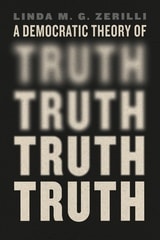
A Democratic Theory of Truth
Linda M. G. Zerilli
University of Chicago Press, 2025
We say that we live in a “post-truth” era because disinformation threatens our confidence in the existence of a shared public world. Affirming objective truth may, therefore, seem necessary to save democracy. According to political theorist Linda M. G. Zerilli, such affirmation can stifle political debate and silence dissent. In fact, Zerilli argues that the unqualified insistence on objective truth is as dangerous for democracy as denying it.
Drawing on Arendt, Foucault, and Wittgenstein, A Democratic Theory of Truth challenges the concept of truth presupposed by the post-truth debate. It argues that we, the people, have an essential role in discovering and evaluating any truth relevant to the political realm. The result is a striking defense of plurality, dissent, and opinion in contemporary democratic societies.
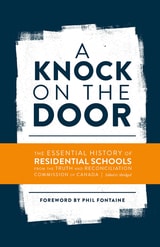
A Knock on the Door
The Essential History of Residential Schools from the Truth and Reconciliation Commission of CanadaUniversity of Manitoba Press, 2015
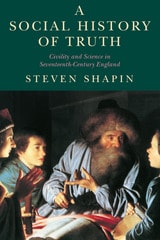
A Social History of Truth
Civility and Science in Seventeenth-Century EnglandSteven Shapin
University of Chicago Press, 1994
In A Social History of Truth, Shapin engages these universal questions through an elegant recreation of a crucial period in the history of early modern science: the social world of gentlemen-philosophers in seventeenth-century England. Steven Shapin paints a vivid picture of the relations between gentlemanly culture and scientific practice. He argues that problems of credibility in science were practically solved through the codes and conventions of genteel conduct: trust, civility, honor, and integrity. These codes formed, and arguably still form, an important basis for securing reliable knowledge about the natural world.
Shapin uses detailed historical narrative to argue about the establishment of factual knowledge both in science and in everyday practice. Accounts of the mores and manners of gentlemen-philosophers are used to illustrate Shapin's broad claim that trust is imperative for constituting every kind of knowledge. Knowledge-making is always a collective enterprise: people have to know whom to trust in order to know something about the natural world.
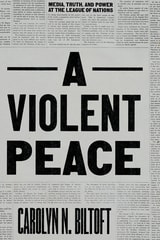
A Violent Peace
Media, Truth, and Power at the League of NationsCarolyn N. Biltoft
University of Chicago Press, 2021
An exploration of instability in information systems, the allure of fascism, and the contradictions at the heart of a global modernity, A Violent Peace paints a rich portrait of the emergence of the age of information—and all its attendant problems.
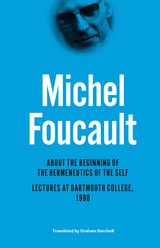
About the Beginning of the Hermeneutics of the Self
Lectures at Dartmouth College, 1980Michel Foucault
University of Chicago Press, 2015
Foucault analyzes the practices of self-examination and confession in Greco-Roman antiquity and in the first centuries of Christianity in order to highlight a radical transformation from the ancient Delphic principle of “know thyself” to the monastic precept of “confess all of your thoughts to your spiritual guide.” His aim in doing so is to retrace the genealogy of the modern subject, which is inextricably tied to the emergence of the “hermeneutics of the self”—the necessity to explore one’s own thoughts and feelings and to confess them to a spiritual director—in early Christianity. According to Foucault, since some features of this Christian hermeneutics of the subject still determine our contemporary “gnoseologic” self, then the genealogy of the modern subject is both an ethical and a political enterprise, aiming to show that the “self” is nothing but the historical correlate of a series of technologies built into our history. Thus, from Foucault’s perspective, our main problem today is not to discover what “the self” is, but to try to analyze and change these technologies in order to change its form.
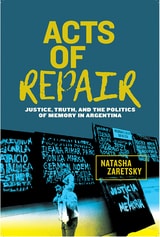
Acts of Repair
Justice, Truth, and the Politics of Memory in ArgentinaNatasha Zaretsky
Rutgers University Press, 2021
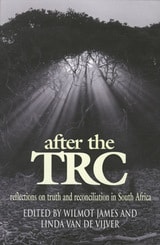
After the TRC
Reflections on Truth and ReconciliationWilmot James
Ohio University Press, 2001
Has South Africa dealt effectively with the past, and is the country ready to face the future? What are the challenges facing both government and civil society in the years ahead? These and other questions are explored in this collection of essays by international and local commentators on the Truth and Reconciliation Commission.
A range of perspectives on whether the TRC met its objectives of truth and reconciliation is presented. The areas of particular contention-the payment of reparation, the granting of amnesty, and memorialization-are also examined.
Finally, the major challenges facing South Africa are identified, and ways of meeting these challenges and developing the assets of the nation are explored.
Contributors: Haribert Adam, Kanya Adam, Alex Boraine, Colin Bundy, Mary Burton, John de Gruchy, Richard Goldstone, Willem Heath, Wilmot James, Jeffrey Lever, Mahmood Mamdani, Gary Minkley, Njabulo Ndebele, Dumisa Ntsebeza, Kaizer Nyatsumba, Grace Naledi Pandor, Mamphela Ramphele, Ciraj Rassool, Albie Sachs, Patricia Valdez, Linda van de Vijver, Jan van Eck, Frederik Van Zyl Slabbert, Charles Villa-Vicencio, Francis Wilson, and Leslie Witz

Aleksandr Tvardovskii
Memory and Truth in the Soviet UnionGeoffrey Hosking
Central European University Press, 2025
By giving a balanced account of his strengths and weaknesses, his achievements and failures, the author succeeds in giving the fullest picture available anywhere of a controversial man who turns out to be more complex than he has been portrayed so far. To understand him better is to understand why the Soviet intelligentsia changed so fundamentally in the USSR’s final decades, a change that helps to explain the rise of Gorbachev twenty years later. The study—which includes an in-depth analysis of Tvardovskii’s major works—also helps to better understand the fate of culture under an authoritarian regime and the intricacies of the struggle against censorship.

Apocalypse of Truth
Heideggerian MeditationsJean Vioulac
University of Chicago Press, 2021
In his first book to be translated into English, Vioulac radicalizes Heidegger’s understanding of truth as disclosure through the notion of truth as apocalypse. This “apocalypse of truth” works as an unveiling that reveals both the finitude and mystery of truth, allowing a full confrontation with truth-as-absence. Engaging with Heidegger, Marx, and St. Paul, as well as contemporary figures including Giorgio Agamben, Alain Badiou, and Slavoj Žižek, Vioulac’s book presents a subtle, masterful exposition of his analysis before culminating in a powerful vision of “the abyss of the deity.” Here, Vioulac articulates a portrait of Christianity as a religion of mourning, waiting for a god who has already passed by, a form of ever-present eschatology whose end has always already taken place. With a preface by Jean-Luc Marion, Apocalypse of Truth presents a major contemporary French thinker to English-speaking audiences for the first time.