Results by title
2 books match the query 'Truth - Telling'
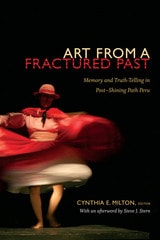
Art from a Fractured Past
Memory and Truth-Telling in Post-Shining Path PeruCynthia E. Milton, ed.
Duke University Press, 2014
Peru's Truth and Reconciliation Commission not only documented the political violence of the 1980s and 1990s but also gave Peruvians a unique opportunity to examine the causes and nature of that violence. In Art from a Fractured Past, scholars and artists expand on the commission's work, arguing for broadening the definition of the testimonial to include various forms of artistic production as documentary evidence. Their innovative focus on representation offers new and compelling perspectives on how Peruvians experienced those years and how they have attempted to come to terms with the memories and legacies of violence. Their findings about Peru offer insight into questions of art, memory, and truth that resonate throughout Latin America in the wake of "dirty wars" of the last half century. Exploring diverse works of art, including memorials, drawings, theater, film, songs, painted wooden retablos (three-dimensional boxes), and fiction, including an acclaimed graphic novel, the contributors show that art, not constrained by literal truth, can generate new opportunities for empathetic understanding and solidarity.
Contributors. Ricardo Caro Cárdenas, Jesús Cossio, Ponciano del Pino, Cynthia M. Garza, Edilberto Jímenez Quispe, Cynthia E. Milton, Jonathan Ritter, Luis Rossell, Steve J. Stern, María Eugenia Ulfe, Víctor Vich, Alfredo Villar
Contributors. Ricardo Caro Cárdenas, Jesús Cossio, Ponciano del Pino, Cynthia M. Garza, Edilberto Jímenez Quispe, Cynthia E. Milton, Jonathan Ritter, Luis Rossell, Steve J. Stern, María Eugenia Ulfe, Víctor Vich, Alfredo Villar
[more]
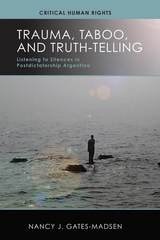
Trauma, Taboo, and Truth-Telling
Listening to Silences in Postdictatorship ArgentinaNancy J. Gates-Madsen
University of Wisconsin Press, 2018
Argentina’s repressive 1976–83 dictatorship, during which an estimated thirty thousand people were “disappeared,” prompted the postauthoritarian administrations and human rights groups to encourage public exposure of past crimes and traumas. Truth commissions, trials, and other efforts have aimed to break the silence and give voice to the voiceless. Yet despite these many reckonings, there are still silences, taboos, and unanswerable questions.
Nancy J. Gates-Madsen reads between the lines of Argentine cultural texts (fiction, drama, testimonial narrative, telenovela, documentary film) to explore the fundamental role of silence—the unsaid—in the expression of trauma. Her careful examination of the interplay between textual and contextual silences illuminates public debate about the meaning of memory in Argentina—which stories are being told and, more important, which are being silenced. The imposition of silence is not limited to the military domain or its apologists, she shows; the human rights community also perpetuates and creates taboos.
Nancy J. Gates-Madsen reads between the lines of Argentine cultural texts (fiction, drama, testimonial narrative, telenovela, documentary film) to explore the fundamental role of silence—the unsaid—in the expression of trauma. Her careful examination of the interplay between textual and contextual silences illuminates public debate about the meaning of memory in Argentina—which stories are being told and, more important, which are being silenced. The imposition of silence is not limited to the military domain or its apologists, she shows; the human rights community also perpetuates and creates taboos.
[more]