Results by title
19 books match the query 'Turn'
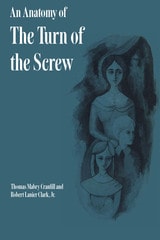
An Anatomy of The Turn of the Screw
By Thomas Mabry Cranfill and Robert Lanier Clark, Jr.
University of Texas Press, 1965
The ambiguous intent of Henry James’s horror story The Turn of the Screw has fascinated and divided its readers since its publication in 1898. The division arises between the apparitionists and the nonapparitionists in interpretation of the plot and the characters. Thomas Mabry Cranfill and Robert Lanier Clark, Jr., have here taken up the argument and made an interpretation of their own.
The authors carefully considered the mountainous critical comment, studied James’s statements regarding his intent, and minutely scrutinized the story itself. After all this probing of opinions and following of clues and observing of human beings in action, they have come out strongly on the side of the nonapparitionists.
The authors base their conclusion on analyses of character, centrally that of the governess, whom they consider the protagonist of the fearsome drama, but peripherally those of Mrs. Grose, the children, the uncle in Harley Street, and even the deceased Miss Jessel and Peter Quint. Relentlessly they relate every episode, action, and speech to the character of the governess and her relationships with those around her at Bly, picturing her as a psychological “case” whose abnormal mental state brings to those around her the inescapable misery they all suffer.
The authors’ analysis unfolds as interestingly in terms of character and motive as if the reader did not already know what happens in James’s much-read story. It moves, moreover, with something of the same suspense as James’s horror tale, although the tension is intellectual rather than emotional. Each additional disclosure of evidence, the resolution of each situation, and the clarification of every puzzling ambiguity builds the analysis step-by-inevitable-step to its inescapable conclusion.
The style of the analysis is graceful, urbane, and witty. The introduction gives an excellent appraisal of literary comment on James’s story and an illuminating summary of the literary “war” over the meaning of it; the bibliography provides an impressive list of books and articles on this subject, annotated to indicate in what particular ways each makes a contribution to the controversy.
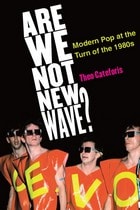
Are We Not New Wave?
Modern Pop at the Turn of the 1980sTheo Cateforis
University of Michigan Press, 2011
“Are We Not New Wave? is destined to become the definitive study of new wave music.”
—Mark Spicer, coeditor of Sounding Out Pop
New wave emerged at the turn of the 1980s as a pop music movement cast in the image of punk rock’s sneering demeanor, yet rendered more accessible and sophisticated. Artists such as the Cars, Devo, the Talking Heads, and the Human League leapt into the Top 40 with a novel sound that broke with the staid rock clichés of the 1970s and pointed the way to a more modern pop style.
In Are We Not New Wave? Theo Cateforis provides the first musical and cultural history of the new wave movement, charting its rise out of mid-1970s punk to its ubiquitous early 1980s MTV presence and downfall in the mid-1980s. The book also explores the meanings behind the music’s distinctive traits—its characteristic whiteness and nervousness; its playful irony, electronic melodies, and crossover experimentations. Cateforis traces new wave’s modern sensibilities back to the space-age consumer culture of the late 1950s/early 1960s.
Three decades after its rise and fall, new wave’s influence looms large over the contemporary pop scene, recycled and celebrated not only in reunion tours, VH1 nostalgia specials, and “80s night” dance clubs but in the music of artists as diverse as Rihanna, Lady Gaga, Miley Cyrus, and the Killers.
Art, Theory, Revolution
The Turn to Generality in Contemporary LiteratureMitchum Huehls
The Ohio State University Press, 2022

Blood Ties
Sex, Scandal, and Serial Murder at the Turn of the Twentieth CenturyHarold Schechter
University of Iowa Press, 2027
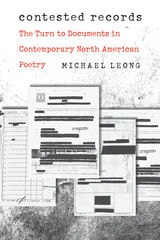
Contested Records
The Turn to Documents in Contemporary North American PoetryMichael Leong
University of Iowa Press, 2020
Why have so many contemporary poets turned to source material, from newspapers to governmental records, as inspiration for their poetry? How can citational poems offer a means of social engagement? Contested Records analyzes how some of the most well-known twenty-first century North American poets work with fraught documents. Whether it’s the legal paperwork detailing the murder of 132 African captives, state transcriptions of the last words of death row inmates, or testimony from miners and rescue workers about a fatal mine disaster, author Michael Leong reveals that much of the power of contemporary poetry rests in its potential to select, adapt, evaluate, and extend public documentation.
Examining the use of documents in the works of Kenneth Goldsmith, Vanessa Place, Amiri Baraka, Claudia Rankine, M. NourbeSe Philip, and others, Leong reveals how official records can evoke a wide range of emotions—from hatred to veneration, from indifference to empathy, from desire to disgust. He looks at techniques such as collage, plagiarism, re-reporting, and textual outsourcing, and evaluates some of the most loved—and reviled—contemporary North American poems. Ultimately, Leong finds that if bureaucracy and documentation have the power to police and traumatize through the exercise of state power, then so, too, can document-based poetry function as an unofficial, counterhegemonic, and popular practice that authenticates marginalized experiences at the fringes of our cultural memory.
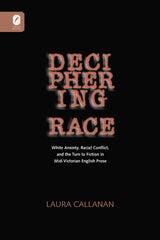
DECIPHERING RACE
WHITE ANXIETY, RACIAL CONFLICT, & THE TURN TO FICTION IN MID-VICTORIAN ENGLISH PROSELaura Callanan
The Ohio State University Press, 2005
In this manner these narratives confront the complexity, indeterminacy, and irrationality of both racial difference and the systems put in place to understand that difference. Deciphering Race unpacks this narrative turn to the aesthetic in writings by white English individuals and thus reveals the instability at the heart of cultural understanding of race and racial tropes at mid-century. This series of readings will help to see how figurative structures, while providing a bridge between different cultures and epistemologies, also reinforce a distance that keeps groups separate. Only by disentangling these structures, by addressing and unpacking our assumptions and narratives about those different from ourselves, and by understanding our deep cultural anxiety and investment in these ways of talking about one another, can we begin to create the conditions for productive, local understanding between different cultures, races, and communities.
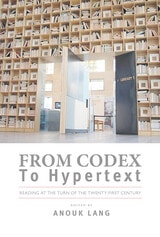
From Codex to Hypertext
Reading at the Turn of the Twenty-first CenturyAnouk Lang
University of Massachusetts Press, 2012
In From Codex to Hypertext, scholars from multiple disciplines engage with both of these strands. This volume includes essays that consider how changes such as the mounting ubiquity of digital technology and the globalization of structures of publication and book distribution are shaping the way readers participate in the encoding and decoding of textual meaning. Contributors also examine how and why reading communities cohere in a range of contexts, including prisons, book clubs, networks of zinesters, state-funded programs designed to promote active citizenship, and online spaces devoted to sharing one's tastes in books.
As concerns circulate in the media about the ways that reading—for so long anchored in print culture and the codex—is at risk of being irrevocably altered by technological shifts, this book insists on the importance of tracing the historical continuities that emerge between these reading practices and those of previous eras.
In addition to the volume editor, contributors include Daniel Allington, Bethan Benwell, Jin Feng, Ed Finn, Danielle Fuller, David S. Miall, Julian Pinder, Janice Radway, Julie Rak, DeNel Rehberg Sedo, Megan Sweeney, Joan Bessman Taylor, Molly Abel Travis, and David Wright.

Mexican Foreign Policy at the Turn of the Twenty-first Century
How Domestic a Foreign Policy?Ana Covarrubias
University of London Press, 2005
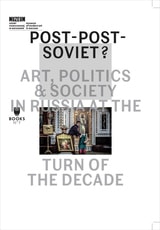
Post-Post-Soviet?
Art, Politics and Society in Russia at the Turn of the DecadeEdited by Marta Dziewanska, Ekaterina Degot, and Ilya Budratskis
Museum of Modern Art in Warsaw, 2013
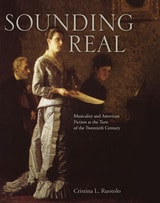
Sounding Real
Musicality and American Fiction at the Turn of the Twentieth CenturyCristina L. Ruotolo
University of Alabama Press, 2013
The Ruse of Repair
US Neoliberal Empire and the Turn from CritiquePatricia Stuelke
Duke University Press, 2021
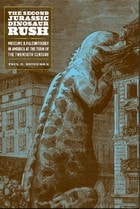
The Second Jurassic Dinosaur Rush
Museums and Paleontology in America at the Turn of the Twentieth CenturyPaul D. Brinkman
University of Chicago Press, 2010
The so-called “Bone Wars” of the 1880s, which pitted Edward Drinker Cope against Othniel Charles Marsh in a frenzy of fossil collection and discovery, may have marked the introduction of dinosaurs to the American public, but the second Jurassic dinosaur rush, which took place around the turn of the twentieth century, brought the prehistoric beasts back to life. These later expeditions—which involved new competitors hailing from leading natural history museums in New York, Chicago, and Pittsburgh—yielded specimens that would be reconstructed into the colossal skeletons that thrill visitors today in museum halls across the country.
Reconsidering the fossil speculation, the museum displays, and the media frenzy that ushered dinosaurs into the American public consciousness, Paul Brinkman takes us back to the birth of dinomania, the modern obsession with all things Jurassic. Featuring engaging and colorful personalities and motivations both altruistic and ignoble, The Second Jurassic Dinosaur Rush shows that these later expeditions were just as foundational—if not more so—to the establishment of paleontology and the budding collections of museums than the more famous Cope and Marsh treks. With adventure, intrigue, and rivalry, this is science at its most swashbuckling.
The Turn to Transcendence
The Role of Religion in the Twenty-First CenturyGlenn Olsen
Catholic University of America Press, 2010

The Turn
A NovellaRachel Feder
Northwestern University Press, 2026
A contemporary gothic delving into the power of unmoored lust and familial bonds
When Baxter, a young writer and recent college graduate, accepts a live-in nanny position for an affluent professor’s family in the foothills of the Rocky Mountains, she rapidly becomes aware of strange happenings orbiting the family and their children, Quinn and Thebes. After the father becomes estranged and the mother disappears into the night with only one child, Baxter is left utterly lost and in charge of the baby, Thebes, as she struggles to make sense of the bizarre occurrences within the family, the house, and even her own body. But the unnatural occurrences are far from over, and as Baxter stumbles in the dark to protect the child, something sinister stalks the night, looking to sink in its teeth.
For fans of gothic classics such as The Turn of the Screw and Carmilla, The Turn is an eerie and magnificent modern gothic tale about the monstrous bond of love between caregiver and child.
The Urban Generation
Chinese Cinema and Society at the Turn of the Twenty-First CenturyZhen Zhang, ed.
Duke University Press, 2007
The contributors analyze the historical and social conditions that gave rise to the Urban Generation, its aesthetic innovation, and its ambivalent relationship to China’s mainstream film industry and the international film market. Focusing attention on the Urban Generation’s sense of social urgency, its documentary impulses, and its representations of gender and sexuality, the contributors highlight the characters who populate this new urban cinema—ordinary and marginalized city dwellers including aimless bohemians, petty thieves, prostitutes, postal workers, taxi drivers, migrant workers—and the fact that these “floating urban subjects” are often portrayed by non-professional actors. Some essays concentrate on specific films (such as Shower and Suzhou River) or filmmakers (including Jia Zhangke and Zhang Yuan), while others survey broader concerns. Together the thirteen essays in this collection give a multifaceted account of a significant, ongoing cinematic and cultural phenomenon.
Contributors. Chris Berry, Yomi Braester, Shuqin Cui, Linda Chiu-han Lai, Charles Leary, Sheldon H. Lu, Jason McGrath, Augusta Palmer, Bérénice Reynaud, Yaohua Shi, Yingjin Zhang, Zhang Zhen, Xueping Zhong
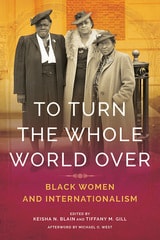
To Turn the Whole World Over
Black Women and InternationalismEdited by Keisha N. Blain and Tiffany M. Gill
University of Illinois Press, 2019
To Turn the World Around
Democracy and the Politics of RepairAli Aslam
University of Minnesota Press, 2027
A stirring exploration of abolitionist thought and Black feminism to articulate a transformative theory of repair
Amid the relentless news of ICE raids, Supreme Court rulings that dismantle our civil rights, and egregious violations of democratic norms, people in the United States are struggling to visualize an actionable path forward. In To Turn the World Around, Ali Aslam proposes a transformative approach that pairs inner healing work with collective external engagement challenging oppressive forces. To actualize W. E. B. DuBois’s concept of abolition democracy, drawing from Black sociality grounded in the refusal of white institutions, Aslam advocates for not working within a broken system nor fleeing it, or merely enduring injustice, and instead offers combined personal healing and embodied action.
Aslam’s vision of transformative selfhood centers healing justice, self and mutual aid, and a somatic approach informed by Black women’s history of navigating bodily dispossession and violations of autonomy and personhood. Simultaneously a tool of personal survival, political refusal, and collective care, inner work incubates new forms of resistance and prepares participants to engage with the outer work of abolition. The movements that rise from the foundation of this inner work are collaborative and experimental, a collective “figuring out” that creates holistic approaches to abolition that transcend conventional politics.
Reimagining inner work as resistance that is ongoing, expansive, and relational, To Turn the World Around offers a stirring framework for the creation of transformational movements. Aslam’s unique theory of repair carefully bridges constituencies, acknowledging the politics of refusal while embracing the hopefulness of sociality.
Retail e-book files for this title are screen-reader friendly.
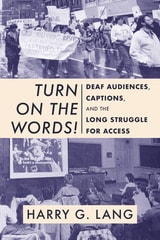
Turn on the Words!
Deaf Audiences, Captions, and the Long Struggle for AccessHarry G. Lang
Gallaudet University Press, 2021
Lang describes the legislation, programs, and people who contributed great ingenuity and passion over decades to realize widespread access to captions, one breakthrough at a time. He also chronicles the resistance to captioned films from Hollywood studios and others, and the Deaf and hearing activists who championed the right to access. Deaf, hard of hearing, disabled, and English-as-a-second-language audiences now experience improved access to the educational, occupational, and cultural benefits of film and television programming. The struggle continues as deaf audiences advocate for equal access in a variety of settings such as movie theaters and online video-sharing platforms. This is a history of technological innovation, as well as a testament to the contributions of the Deaf community to the benefit of society as a whole.
This book has been made possible in part by the National Endowment for the Humanities: Exploring the human endeavor. Any views, findings, conclusions, or recommendations expressed in this book do not necessarily represent those of the National Endowment for the Humanities.
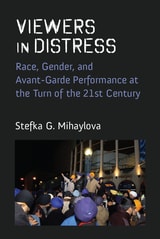
Viewers in Distress
Race, Gender, Religion, and Avant-Garde Performance at the Turn of the Twenty-First CenturyStefka G. Mihaylova
University of Michigan Press, 2023
Honorable Mention: American Society for Theatre Research Barnard Hewitt Award | November 8, 2024
Conventional notions of avant-garde art suggest innovative artists rebelling against artistic convention and social propriety, shocking unwilling audiences into new ways of seeing and living. Viewers in Distress tells a different story. Beginning in the tumultuous 1990s, after the fall of the Berlin Wall and in the wake of the Los Angeles riots, rebellious spectators in American and British theaters broke with theater decorum and voiced their radical interpretations of shows that were not meant to be radical. In doing so, audiences tried to understand the complex racial, gender, and religious politics of their times, while insisting that liberal societies fulfill their promise of dignity for all. Stefka Mihaylova argues that such non-conforming viewing amounts to an avant-garde of its own: a bold reimagining of how we live together and tell stories of our lives together, aimed to achieve liberalism’s promise. In telling this story, she analyzes the production and reception politics of works by Susan-Lori Parks, Sarah Kane, Forced Entertainment, Gurpreet Kaur Bhatti, and Young Jean Lee, as well as non-theatrical controversies such as the conflict over Halloween costumes at Yale in 2015. At the core of spectators’ discontent, this book suggests, is an effort to figure out how to get along with people different from ourselves in the diverse U.S. and British societies in which we live.