Results by title
6 books match the query 'Tuscaloosa'
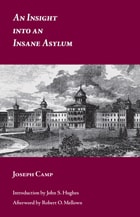
An Insight into an Insane Asylum
Joseph Camp
University of Alabama Press, 2011
A rare 19th‑century voice revealing what asylum life felt like from the inside.
In 1881, Joseph Camp, an elderly and self-trained Methodist minister from Talladega County in eastern Alabama, was brought by his family to Bryce Hospital, an insane asylum in Tuscaloosa, where he remained for over five months. Camp, misled by relatives concerning the purpose of the trip, was shocked and angered at his loss of freedom and his treatment in the hospital. After his release, he composed an account of his stay and published it at his own expense, providing a rare glimpse of 19th century mental health care from a patient’s viewpoint. Camp’s account reveals his naive trust in others, but also a sharp and retentive memory. Camp is remarkably accurate in his account of the details of his treatment and the operation and staff of the hospital, although his emotional assessments reflect his unhappiness with his situation. Adding to the importance of Camp’s account is the fact that in the 19th century Bryce was considered a remarkably humane institution focused on recovery. Camp provides a glimpse into how treatment for the insane felt to the recipient.

Earline's Pink Party
The Social Rituals and Domestic Relics of a Southern WomanElizabeth Findley Shores
University of Alabama Press, 2017
A compelling, genre-bending page-turner, Earline’s Pink Party: The Social Rituals and Domestic Relics of a Southern Woman analyzes the life of a small-city matron in the Deep South. A combination of biography, material culture analysis, social history, and memoir, this volume offers a new way of thinking about white racism through Shores’s conclusion that Earline’s earliest childhood experiences determined her worldview.
Set against a fully drawn background of geography and culture and studded with detailed investigations of social rituals (such as women’s parties) and objects (such as books, handwritten recipes, and fabric scraps), Earline’s Pink Party tells the story of an ordinary woman, the grandmother Shores never knew. Looking for more than the details and drama of bourgeois Southern life, however, the author digs into generations of family history to understand how Earline viewed the racial terror that surrounded her during the Jim Crow years in this fairly typical southern town.
Shores seeks to narrow a gap in the scholarship of the American South, which has tended to marginalize and stereotype well-to-do white women who lived after Emancipation. Exploring her grandmother’s home and its contents within the context of Tuscaloosa society and historical events, Shores evaluates the belief that women like Earline consciously engaged in performative rituals in order to sustain the “fantastical” view of the white nobility and the contented black underclass. With its engaging narrative, illustrations, and structure, this fascinating book should interest scholars of memory, class identity, and regional history, as well as sophisticated lay readers who enjoy Southern history, foodways, genealogy, and material culture.
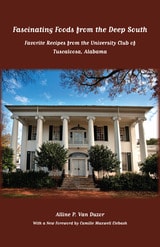
Fascinating Foods from the Deep South
Favorite Recipes from the University Club of Tuscaloosa, AlabamaAlline P. Van Duzor
University of Alabama Press, 2010
250 Recipes from the University of Alabama’s famed University Club in Tuscaloosa
The historic mansion at the corner of University Boulevard and Queen City Avenue in Tuscaloosa, Alabama has been home to the University of Alabama University Club since 1944. In its early years, the Club took shape around the vision and culinary expertise of the formidable Atlantan Alline P. Van Duzor, still remembered in Tuscaloosa for her impeccable and exacting standards. This book reveals her most beloved recipes.
Commissioned in the early 1960s by a New York publisher, this collection of her gastronomic creations sold through more than eight printings, further spreading her reputation.
The more than 250 favorite Southern recipes in this now-classic cookbook are written in Van Duzor’s straight-forward style, using common fresh and store-bought ingredients. This new edition has been augmented by a guide to portions and food brand names, an index to the recipes, and an appendix of past presidents of the University Club Board.
Cookbook collectors, local history buffs, the university community, and happy cooks everywhere will welcome this reissue of a popular cookbook that has won decades of fans.
Opening the Doors
The Desegregation of the University of Alabama and the Fight for Civil Rights in TuscaloosaB. J. Hollars
University of Alabama Press, 2013
The story of how a university, a city, and a movement opened the door to change in the American South.
Opening the Doors is a wide-ranging account of the University of Alabama’s 1956 and 1963 desegregation attempts, as well as the little-known story of Tuscaloosa, Alabama’s, own civil rights movement. While E. Culpepper Clark’s The Schoolhouse Door remains the standard history of the University of Alabama’s desegregation, in Opening the Doors B. J. Hollars focuses on Tuscaloosa’s purposeful divide between “town” and “gown,” providing a new contextual framework for this landmark period in civil rights history.
The image of George Wallace’s stand in the schoolhouse door has long burned in American consciousness; however, just as interesting are the circumstances that led him there in the first place, a process that proved successful due to the concerted efforts of dedicated student leaders, a progressive university president, a steadfast administration, and secret negotiations between the U.S. Justice Department, the White House, and Alabama’s stubborn governor.
In the months directly following Governor Wallace’s infamous stand, Tuscaloosa became home to a leader of a very different kind: twenty-eight-year-old African American reverend T. Y. Rogers, an up-and-comer in the civil rights movement, as well as the protégé of Martin Luther King Jr. After taking a post at Tuscaloosa’s First African Baptist Church, Rogers began laying the groundwork for the city’s own civil rights movement. In the summer of 1964, the struggle for equality in Tuscaloosa resulted in the integration of the city’s public facilities, a march on the county courthouse, a bloody battle between police and protesters, confrontations with the Grand Wizard of the Ku Klux Klan, a bus boycott, and the near-accidental-lynching of movie star Jack Palance.
Relying heavily on new firsthand accounts and personal interviews, newspapers, previously classified documents, and archival research, Hollars’s in-depth reporting reveals the courage and conviction of a town, its university, and the people who call it home.
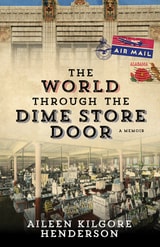
The World through the Dime Store Door
A MemoirAileen Kilgore Henderson
University of Alabama Press, 2020
A coming-of-age memoir evoking farm, mining, and small-town life in Alabama’s Tuscaloosa County as the world transitions from the Great Depression to World War II.
In the 1930s, the rural South was in the throes of the Great Depression. Farm life was monotonous and hard, but a timid yet curious teenager thought it worth recording. Aileen Kilgore Henderson kept a chronicle of her family’s daily struggles in Tuscaloosa County alongside events in the wider world she gleaned from shortwave radio and the occasional newspaper. She wrote about Howard Hughes’s round-the-world flight and her horror at the rise to power in Germany of a bizarre politician named Adolf Hitler. Henderson longed to join the vast world beyond the farm, but feared leaving the refuge of her family and beloved animals.
Yet, with her father’s encouragement, she did leave, becoming a clerk in the Kress dime store in downtown Tuscaloosa. Despite long workdays and a lengthy bus commute, she continued to record her observations and experiences in her diary, for every day at the dime store was interesting and exciting for an observant young woman who found herself considering new ideas and different points of view.
Drawing on her diary entries from the 1930s and early 1940s, Henderson recollects a time of sweeping change for Tuscaloosa and the South. The World through the Dime Store Door is a personal and engaging account of a Southern town and its environs in transition told through the eyes of a poor young woman with only a high school education but gifted with a lively mind and an openness to life.
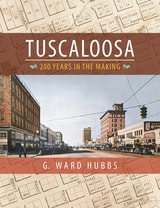
Tuscaloosa
200 Years in the MakingG. Ward Hubbs
University of Alabama Press, 2019
A lavishly illustrated history of this distinctive city’s origins as a settlement on the banks of the Black Warrior River to its development into a thriving nexus of higher education, sports, and culture
In both its subject and its approach, Tuscaloosa: 200 Years in the Making is an account unlike any other of a city unlike any other—storied, inimitable, and thriving. G. Ward Hubbs has written a lively and enlightening bicentennial history of Tuscaloosa that is by turns enthralling, dramatic, disturbing, and uplifting. Far from a traditional chronicle listing one event after another, the narrative focuses instead on six key turning points that dramatically altered the fabric of the city over the past two centuries.
The selection of this frontier village as the state capital gave rise to a building boom, some extraordinary architecture, and the founding of The University of Alabama. The state’s secession in 1861 brought on a devastating war and the burning of the university by Union cavalry; decades of social adjustments followed, ultimately leading to legalized racial segregation. Meanwhile, town boosters set out to lure various industries, but with varying success.
The decision to adopt new inventions, ranging from electricity to telephones to automobiles, revolutionized the daily lives of Tuscaloosans in only a few short decades. Beginning with radio, and followed by the Second World War and television, the formerly isolated townspeople discovered an entirely different world that would culminate in Mercedes-Benz building its first overseas production plant nearby. At the same time, the world would watch as Tuscaloosa became the center of some pivotal moments in the civil rights movement—and great moments in college football as well.
An impressive amount of research is collected in this accessibly written history of the city and its evolution. Tuscaloosa is a versatile history that will be of interest to a general readership, for scholars to use as a starting point for further research, and for city and county school students to better understand their home locale.