Results by title
9 books match the query 'Twenty-first century'
A Civil Economy
Transforming the Marketplace in the Twenty-First CenturySeveryn T. Bruyn
University of Michigan Press, 2000

A Short History of the Future
W. Warren Wagar
University of Chicago Press, 1992
A Short History of the Future
W. Warren Wagar
University of Chicago Press, 1999
"Thanks to Wagar's magisterial command of futurist information and theory, his extrapolated near-term future is an incisive, dynamic vision of where we may indeed be heading."—H. Bruce Franklin, Washington Post
"A comprehensive, massively detailed script of a possible near future. . . . Intriguing."—San Francisco Chronicle
"A Short History of the Future reads with ease, raises provocative possibilities and presents challenging occasions for thought and argument."—Chicago Tribune
"A breathtaking future history in the manner of Wells and Stapledon, unnerving in its mixture of fact, fiction, and personal perspectives."—George Zebrowski, New York Review of Science Fiction
A Short History of the Future
W. Warren Wagar
University of Chicago Press, 1989
Jensen's tale traces the flow of the future from the early twenty-first-century reign of a megacorporate global economy, to its sudden collapse in 2044, when nuclear catastrophe envelops the world. In the traumatic aftermath, a socialist world commonwealth comes into being in the year 2062, followed by a lengthy transition to a decentralized order of technologically mature autonomous societies, many located in outer space. The riveting literary interludes that follow each chapter take the form of letters and documents from the history of Jensen's family, evoking the everyday lives of people in the midst of these global-historical events. Here we meet a woman in Brazil whose son is dying from a new immuno-deficiency disease, two brothers comparing life on earth with life in a space colony, and many more.
Neither fiction nor nonfiction, Wagar's brilliantly creative work is not meant to forecast the future, but rather to draw attention to possibilities and alternatives for humankind and planet Earth. In doing so, it also serves as an unforgettable reminder that the future is being made now.
Composition in the Twenty-First Century
Crisis and ChangeEdited by Lynn Z. Bloom, Donald A. Daiker, and Edward M. White
Southern Illinois University Press, 1997
Despite its pervasiveness and its significance, composition has an unstable status within the curriculum. Writing programs and writing faculty are besieged by academic, political, and financial concerns that have not been well understood or addressed.
At many institutions, composition functions paradoxically as both the gateway to academic success and as the gatekeeper, reducing access to academic work and opportunity for those with limited facility in English. Although writing programs are expected to provide services that range from instruction in correct grammar to assisting—or resisting—political correctness, expanding programs and shrinking faculty get caught in the crossfire. The bottom line becomes the firing line as forces outside the classroom determine funding and seek to define what composition should do.
In search of that definition, the contributors ask and answer a series of specific and salient questions: What implications—intellectual, political, and institutional—will forces outside the classroom have on the quality and delivery of composition in the twenty-first century? How will faculty and administrators identify and address these issues? What policies and practices ought we propose for the century to come?
This book features sixteen position papers by distinguished scholars and researchers in composition and rhetoric; most of the papers are followed by invited responses by other notable compositionists. In all, twenty-five contributors approach composition from a wide variety of contemporary perspectives: rhetorical, historical, social, cultural, political, intellectual, economic, structural, administrative, and developmental. They propose solutions applicable to pedagogy, research, graduate training of composition teachers, academic administration, and public and social policy. In a very real sense, then, this is the only book to offer a map to the future of composition.

Imagining America in 2033
How the Country Put Itself Together after BushHerbert J. Gans
University of Michigan Press, 2008
At the heart of Herbert J. Gans's utopian narrative is the vision of progress with fairness on which the best of American idealism has been built. Part utopia, part realism, Imagining America in 2033 is also a liberal's dream of life after Bush and a set of progressive yet practical guidelines for restoring sanity and intelligence to nearly every aspect of public and political life post-Bush.
Herbert J. Gans, one of the most influential and prolific sociologists and social commentators of our time, achieves a realistic utopia set mostly in the second and third decades of the century. In Gans's imagined future, elected officials, policymakers, activists, and citizens have transformed America into a much more humane and effective democracy. The book features three Democratic presidents; the major new domestic, foreign, and social policies their administrations pursue; and the political battles they fight.
Gans provides chapters on an exhaustive list of social, political, and economic policy issues: jobs; war; tax reform; global warming; economic, racial, gender, and religious equality; family policies; the creation of affordable housing and energy saving communities; education reform; and more. While hopeful and idealistic, many of Gans's proposals---such as the concept of the nurse-doctor, in which nurses increasingly take on tasks previously handled only by medical doctors within a framework of national health care---are ideas innovative enough that they should be taken seriously by actual policymakers.
Imagining America in 2033 is lively and accessible, with an appeal for general readers, policy hounds, and the politically savvy alike.

Preview 2001+
Popular Culture Studies in the FutureRay B. Browne
University of Wisconsin Press, 1995
The essays in this collection, written by some of the leading scholars in Popular Culture Studies, turn the page on the new millennium to see what are the directions of approach and the opportunities to be gained in recognition of the compelling need for studies in everyday cultures.
The Fabulous Future?
America and the World in 2040Morton Schapiro and Gary Saul Morson
Northwestern University Press, 2015
Will the future be one of economic expansion, greater tolerance, liberating inventions, and longer, happier lives? Or do we face economic stagnation, declining quality of life, and a technologically enhanced totalitarianism worse than any yet seen? The Fabulous Future? America and the World in 2040 draws its inspiration from a more optimistic time, and tome, The Fabulous Future: America in 1980, in which Fortune magazine celebrated its twenty-fifth anniversary by publishing the predictions of thought leaders of its time.
In the present volume, the world’s leading specialists from diverse fields project developments in their areas of expertise, from religion and the media to the environment and nanotechnology. Will we be happier, and what exactly does happiness have to do with our economic future? Where is higher education heading and how should it develop? And what is the future of prediction itself? These exciting essays provoke sharper questions, reflect unexpectedly on one another, and testify to our present anxieties about the surprising world to come.
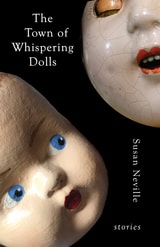
The Town of Whispering Dolls
StoriesSusan Neville, Foreword by Shelley Jackson
University of Alabama Press, 2020
WINNER OF FC2’S CATHERINE DOCTOROW INNOVATIVE FICTION PRIZE
Stories haunted by the remains of the industrial Midwest, the opioid epidemic, and the technology of war
Located somewhere in the rust belt in the early twenty-first century, residents of the town of Whispering Dolls dream of a fabled and illusory past, even as new technologies reshape their world into something different and deeply strange. Dolls walk down the streets, cradling their empty heads and letting the wind turn them into flutes. A politician heads to Washington, DC, and leaves a toxic underground plume in his wake. A woman eats car parts instead of confronting the children who have forgotten her. A young woman falls in love with the robot who took her job at the candy factory.
In The Town of Whispering Dolls, it is usually the grandmothers and the children who grieve. Feeling invisible, in the story “Here,” a woman who has buried her children looks up at the sky where commercial and military jets fly overhead and tries to express her rage to the rich and powerful: “Keep flying above us in your planes. From one coast to the other, keep right on flying over us! We test your bombs and your beloved warriors. Here. Right here. Look down.”