Results by title
3 books match the query 'Tymoczko, Maria'
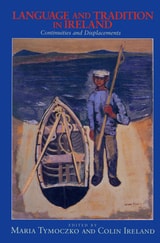
Language and Tradition in Ireland
Continuities and DisplacementsMaria Tymoczko
University of Massachusetts Press, 2003
If language and culture are intimately connected, then cultures involving people who speak more than one language must have special characteristics, as well as particular social issues to negotiate. What are the challenges faced by a people with two or more languages as their heritage? How does that multiple heritage affect cultural forms, including literature and the arts? How does linguistic difference influence the conceptualization and writing of history? And if the meeting of languages within a people has involved contestation and power, how are those conflicts negotiated?
This volume uses the tools of critical theory to explore such questions with respect to the complex, multilingual history of Ireland. Avoiding the simplistic polarized oppositions popular with cultural nationalists, the contributors examine the nexus of language, tradition, and authority in Ireland that has created such a rich, multivalent culture.
Although the linguistic interface of Irish and English has dominated cultural negotiations in Ireland over the last five hundred years, the island has an even longer history of linguistic and cultural exchange. Arguing that tradition is never static, the essays in this volume challenge the concept of a monolithic cultural origin, while insisting on the importance of inherited discourses in the continuity of culture through time and across linguistic difference. The chapters cover a broad range of topics from early Irish narratives and Latin hagiography to literary works by such writers as Yeats, Joyce, Friel, Montague, and McGahern, as well as other cultural forms, including traditional Irish music. Several chapters address issues of politics and power, from the role of interpreters in the relations between linguistic communities in Ireland to the politicization of language in Northern Ireland since the 1980s. Taken together, the essays illuminate scholarly domains as varied as postcolonial theory, the relationship between language and nation, the nature of tradition, and Irish literature of all periods.
In addition to the editors, contributors include Michael Cronin, Joanne Findon, Helen Fulton, Declan Kiberd, Jeremy Lowe, Gordon McCoy and Camille O'Reilly, Catherine McKenna, Cóilín Owens, Thomas Dillon Redshaw, and Sally K. Sommers Smith.
Translation and Power
Maria Tymoczko
University of Massachusetts Press, 2002
Although governments, churches, publishing firms, and other powerful institutions may influence the translation process, many translators have found ways to resist that influence and have used translation to introduce new ideas and modes of expression. Exploring the nexus of translation and power, the essays in this volume offer a wide variety of examples, across multiple languages and societies. They range from case studies of historical episodes in which translation has played a role in the assertion of political and military power, such as an 1840 treaty between the British and Maori that continues to be a source of conflict in present-day New Zealand, to analyses of the work of specific translators, such as Germaine de Staël and Gayatri Spivak. Along with examining how translation contributes to ideological negotiations and cultural struggles, the essays reveal the dimensions of power inherent in the translation process itself—in the relationship of translator to author, source text, and translated text.
In addition to the editors, contributors include Rosemary Arrojo, Michael Cronin, Sabine Fenton, Camino Gutiérrez Lanza, Christopher Larkosh, Alexandra Lianeri, Lin Kenan, Carol Maier, Paul Moon, Adriana S. Pagano, and Sherry Simon.
Translation, Resistance, Activism
Maria Tymoczko
University of Massachusetts Press, 2010
From silence to radical manipulation of texts, translation strategies are instrumental in significant historical interventions and cultural change. Translation plays a pivotal role in ideological dialogue and struggle, including resistance to oppression and cultural straitjackets of all types, from sexual puritanism to military dictatorships. Situated in their own space, time, history, and political contexts, translators promote ideological agendas by creating new cultural narratives, pragmatically adjusting tactics so as to maximize the social and political impact.
The essays in this volume explore ways to read translations as records of cultural contestation and ideological struggle; as means of fighting censorship, physical coercion, cultural repression, and political dominance; and as texts that foster a wide variety of goals from cultural nationalism to armed confrontation. Translations are set in relief as central cultural documents rather than derivative, peripheral, or marginalized productions. They are seen as forms of ethical, political, and ideological activity rather than as mere communicative transactions or creative literary exercises.
The contributors demonstrate that engaged and activist translations are performative acts within broader political and ideological contexts. The essays detail the initiative, resourcefulness, and courage of individual translators, whose willingness to put themselves on the line for social change can sometimes move the world.
In addition to Maria Tymoczko, contributors include Pua'ala'okalani D. Aiu, Brian James Baer, Mona Baker, Paul F. Bandia, Georges L. Bastin, Nitsa Ben-Ari, Ãngela Campo, Antonia Carcelen-Estrada, Ãlvaro Echeverri, Denise Merkle, John Milton, and Else R.P. Vieira.