Results by title
4 books match the query 'United States. Army. American Expeditionary Forces'
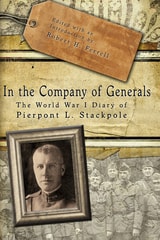
In the Company of Generals
The World War I Diary of Pierpont L. StackpoleEdited & Intro by Robert H. Ferrell
University of Missouri Press, 2009
Pierpont Stackpole was a Boston lawyer who in January 1918 became aide to Lieutenant General Hunter Liggett, soon to be commander of the first American corps in France. Stackpole’s diary, published here for the first time, is a major eyewitness account of the American Expeditionary Forces’ experience on the Western Front, offering an insider’s view into the workings of Liggett’s commands, his day-to-day business, and how he orchestrated his commands in trying and confusing situations.
Hunter Liggett did not fit John J. Pershing’s concept of the trim and energetic officer, but Pershing entrusted to him a corps and then an army command. Liggett assumed leadership of the U.S. First Army in mid-October of 1918, and after reorganizing, reinforcing, and resting, the battle-weary troops broke through the German lines in a fourth attack at the Meuse-Argonne—accomplishing what Pershing had failed to do in three previous attempts. The victory paved the way to armistice on November 11.
Liggett has long been a shadowy figure in the development of the American high command. He was “Old Army,” a veteran of Indian wars who nevertheless kept abreast of changes in warfare and more than other American officers was ready for the novelties of 1914–1918. Because few of his papers have survived, the diary of his aide—who rode in the general’s staff car as Liggett unburdened himself about fellow generals and their sometimes abysmal tactical notions—provides especially valuable insights into command within the AEF.
Stackpole’s diary also sheds light on other figures of the war, presenting a different view of the controversial Major General Clarence Edwards than has recently been recorded and relating the general staff’s attitudes about the flamboyant aviation figure Billy Mitchell. General Liggett built the American army in France, and the best measure of his achievement is this diary of his aide. That record stands here as a fascinating and authentic look at the Great War.

The AEF in Print
An Anthology of American Journalism in World War IChris Dubbs
University of North Texas Press, 2018
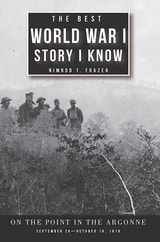
The Best World War I Story I Know
On the Point in the Argonne, September 26–October 16, 1918Nimrod T. Frazer
University of Alabama Press, 2018
The Best World War I Story I Know: On the Point in the Argonne is the breath-taking story of three US Army divisions tasked with capturing the Côte de Châtillon during the Meuse-Argonne offensive in autumn 1918. Readers will first follow in the footsteps of Missouri-Kansas Guard troops who were repulsed in the opening days of the battle; their courage in the face of heavy fire was not enough to overcome poor leadership.
They were replaced by the 1st Division, the “best of the Regular Army.” This fine unit became physically and mentally exhausted after suffering horrendous casualties. Unable to fight on, “The Big Red One” was exchanged at the base of Côte de Châtillon, with the 42nd, the Rainbow Division. It too struggled to gain ground on the heavily-contested hill until General Douglas MacArthur’s determined 84th Brigade of “Alabama cotton pickers and Iowa corn growers” forced their way past the Germans. The Côte was finally in American hands and the war all but over.
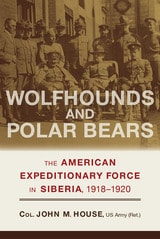
Wolfhounds and Polar Bears
The American Expeditionary Force in Siberia, 1918–1920Col. John M. House, US Army (Ret.)
University of Alabama Press, 2016
In the final months of World War I, President Woodrow Wilson and many US allies decided to intervene in Siberia in order to protect Allied wartime and business interests, among them the Trans-Siberian Railroad, from the turmoil surrounding the Russian Revolution. American troops would remain until April 1920 with some of our allies keeping troops in Siberia even longer.
Few American citizens have any idea that the United States ever deployed soldiers to Siberia and that those soldiers eventually played a role in the Russian revolution while protecting the Trans-Siberian Railroad. Wolfhounds and Polar Bears relies on the detailed reports of the American Expeditionary Force (AEF) as well as on personal stories to bring this rarely discussed expedition to life.
Initial chapters recount the period in World War I when conditions in Russia pointed to the need for intervention as well as the varied reasons for that decision. A description of the military forces and the geographic difficulties faced by those forces operating in Siberia provide the baseline necessary to understand the AEF’s actions in Siberia. A short discussion of the Russian Railway Service Corps explains their essential and sometimes overlooked role in this story, and subsequent chapters provide a description of actual operations by the AEF.
Wolfhounds and Polar Bears: The American Expeditionary Force in Siberia, 1918–1920 may well be the most detailed study of the military aspects of the American intervention in Siberia ever undertaken, offering a multitude of details not available in any other book-length history.