Results by title

13 books match the query 'United States. Federal Bureau of Investigation'
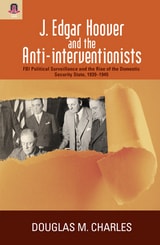
cover of J. Edgar Hoover and the Anti-interventionists: FBI Political Surveillance and the Rise of the Domestic Security State, 1939–1945

J. Edgar Hoover and the Anti-interventionists

FBI Political Surveillance and the Rise of the Domestic Security State, 1939–1945

Douglas M. Charles

The Ohio State University Press, 2007
In this very timely manuscript, Douglas M. Charles reveals how FBI Director J. Edgar Hoover catered to President Franklin D. Roosevelt’s political interests. Between 1939 and 1945, the Federal Bureau of Investigation monitored the political activities of President Roosevelt’s anti-interventionist foreign policy critics. Hoover, whose position as FBI director was tenuous within the left-of-center Roosevelt administration, catered to the president’s political and policy interests in order to preserve his position and to expand FBI authority. In his pragmatic effort to service administration political goals, Hoover employed illegal wiretaps and informers, collected derogatory information, conducted investigations that had the potential to discredit the anti-interventionists, forwarded political intelligence to administration officials, and coordinated some activity with British intelligence. This all occurred within a crisis atmosphere created with the onset of the Second World War, and it was this political dynamic that permitted Hoover to successfully cultivate his relationship with President Roosevelt. In the process, the administration's otherwise legitimate foreign policy opposition—regarded by some as subversive—had their civil liberties violated through intensive FBI scrutiny of their political dissent. Moreover, the FBI’s surveillance marks the origins of the FBI’s role in the later national security state. Among the targets examined in this book are Charles Lindbergh, the America First Committee, notable anti-interventionist senators and congressmen, the anti-interventionist press, and other prominent individuals who advocated American isolation from foreign war.
 
[more]
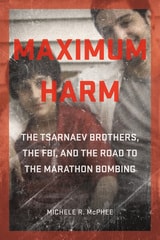
cover of Maximum Harm: The Tsarnaev Brothers, the FBI, and the Road to the Marathon Bombing

Maximum Harm

The Tsarnaev Brothers, the FBI, and the Road to the Marathon Bombing

Michele R. McPhee

University Press of New England, 2017
In Maximum Harm, veteran investigative journalist Michele R. McPhee unravels the complex story behind the public facts of the Boston Marathon bombing. She examines the bombers’ roots in Dagestan and Chechnya, their struggle to assimilate in America, and their growing hatred of the United States—a deepening antagonism that would prompt federal prosecutors to dub Dzhokhar Tsarnaev “America's worst nightmare.” The difficulties faced by the Tsarnaev family of Cambridge, Massachusetts, are part of the public record. Circumstances less widely known are the FBI’s recruitment of the older brother, Tamerlan Tsarnaev, as a “mosque crawler” to inform on radical separatists here and in Chechnya; the tracking down and killing of radical Islamic separatists during the six months he spent in Russia—travel that raised eyebrows, since he was on several terrorist watchlists; the FBI’s botched deals and broken promises with regard to his immigration; and the disenchantment, rage, and growing radicalization of Tamerlan and Dzhokhar, along with their mother, sisters, and Tamerlan’s wife, Katherine. Maximum Harm is also a compelling examination of the Tsarnaev brothers’ movements in the days leading up to the Boston Marathon bombing on April 15, 2013, the subsequent investigation, the Tsarnaevs’ murder of MIT police officer Sean Collier, the high-speed chase and shootout that killed Tamerlan, and the manhunt in which the authorities finally captured Dzhokhar, hiding in a Watertown backyard. McPhee untangles the many threads of circumstance, coincidence, collusion, motive, and opportunity that resulted in the deadliest attack on the city of Boston to date.
[more]
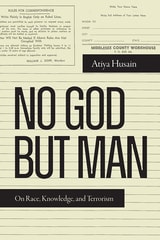
cover of No God but Man: On Race, Knowledge, and Terrorism

No God but Man

On Race, Knowledge, and Terrorism

Atiya Husain

Duke University Press, 2025
Reconceptualizing the relationship between race and Islam in the United States, No God but Man theorizes race as an epistemology using the FBI’s post-9/11 Most Wanted Terrorist list and its posters as its starting point. Atiya Husain traces the origins of the FBI wanted poster form to the work of nineteenth-century social scientist Adolphe Quetelet, specifically his overvalued type of human called “average man.” Husain argues that this notion of the human continues to structure wanted posters, as well as much contemporary social scientific thinking about race. Focusing on the curious representations on the Most Wanted Terrorist list that range from Muslims who lack a race category on their posters to the 2013 addition of Black revolutionary Assata Shakur, Husain demonstrates the ongoing influence of the average man and its relevance even today, proposing a counterweight to the category by engaging Shakur’s turn to Islam in the 1970s in the legal context. In doing so, Husain shows the limitations of race as an analytical category altogether.
[more]
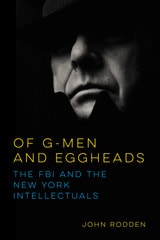
cover of Of G-Men and Eggheads: The FBI and the New York Intellectuals

Of G-Men and Eggheads

The FBI and the New York Intellectuals

John Rodden

University of Illinois Press, 2017

Spy romances of Cold War counterespionage evoke scenes of heroic FBI and CIA agents dedicated to smashing communism and its subversive coterie of intellectual fellow travelers bent on painting the world red.
 
John Rodden cuts this tall tale down to its authentic pint size, refusing to indulge the public relations myth promoted by J. Edgar Hoover's FBI. In Of G-Men and Eggheads, Rodden portrays federal agents’ hilarious obsession with monitoring that ever-present threat to national security, the American literary intellectual. Drawing on government dossiers and archives, Rodden focuses on the onetime members of a radical political sect of ex-Trotskyists (barely numbering a thousand at its height), the so-called New York intellectuals. He describes the nonsensical decades-long pursuit of this group of intellectuals, especially Lionel Trilling, Dwight Macdonald, and Irving Howe. The Keystone Cops style of numerous FBI agents is documented carefully in Rodden's meticulous case studies of how Hoover's men recruited informants to snoop on the "Commies," opened their personal mail, tracked their movements, and reported on their wives and friends.
 
[more]
cover of The American Surveillance State: How the U.S. Spies on Dissent

The American Surveillance State

How the U.S. Spies on Dissent

David H. Price

Pluto Press, 2022

New evidence has come to light proving how far the FBI monitored its citizens throughout the Cold War and beyond

When the possibility of wiretapping first became known to Americans they were outraged. Now, in our post-9/11 world, it’s accepted that corporations are vested with human rights, and government agencies and corporations use computers to monitor our private lives. David H. Price pulls back the curtain to reveal how the FBI and other government agencies have always functioned as the secret police of American capitalism up to today, where they luxuriate in a near-limitless NSA surveillance of all.

Price looks through a roster of campaigns by law enforcement, intelligence agencies, and corporations to understand how we got here. Starting with J. Edgar Hoover and the early FBI’s alignment with business, his access to 15,000 pages of never-before-seen FBI files shines a light on the surveillance of Edward Said, Andre Gunder Frank and Alexander Cockburn, Native American communists, and progressive factory owners.

Price uncovers patterns of FBI monitoring and harassing of activists and public figures, providing the vital means for us to understand how these new frightening surveillance operations are weaponized by powerful governmental agencies that remain largely shrouded in secrecy.
[more]
cover of The Eagle Has Eyes: The FBI Surveillance of César Estrada Chávez of the United Farm Workers Union of America, 1965–1975

The Eagle Has Eyes

The FBI Surveillance of César Estrada Chávez of the United Farm Workers Union of America, 1965–1975

José Angel Gutiérrez

Michigan State University Press, 2019
This book is the first of its kind to bring transparency to the FBI’s attempts to destroy the incipient Chicano Movement of the 1960s. While the activities of the deep state are current research topics, this has not always been the case. The role of the U.S. government in suppressing marginalized racial and ethnic minorities began to be documented with the advent of the Freedom of Information Act and most recently by disclosures of whistle blowers. This book utilizes declassified files from the FBI to investigate the agency’s role in thwarting Cesar E. Chavez’s efforts to build a labor union for farm workers and documents the roles of the FBI, California state police, and local police in assisting those who opposed Chavez. Ultimately, The Eagle Has Eyes is a must-read for academics and activists alike.
[more]
cover of The FBI and the Catholic Church, 1935-1962

The FBI and the Catholic Church, 1935-1962

Steve Rosswurm

University of Massachusetts Press, 2009

During his long tenure as director of the Federal Bureau of Investigation, J. Edgar Hoover made no secret of his high regard for the Catholic faith. Though himself a Protestant, he shared with Catholicism a set of values and a vision of the world, grounded in certain assumptions about the way things ought to be in a well-ordered society. The Church reciprocated Hoover's admiration, establishing the basis for a working alliance between two powerful and influential American institutions.

Steve Rosswurm explores the history of that relationship from the turbulent 1930s to the 1960s, when growing Catholic opposition to the Vietnam War led Hoover to distance himself from the Church. Drawing on a vast range of sources, including thousands of pages of previously classified FBI files, Rosswurm pursues his investigation along two parallel tracks. First, he looks at the joint war waged by Hoover and the Catholic hierarchy against forces considered threats to their organizations, values, and nation. Second, he examines how each pursued its own institutional interests with the help of the other.

While opposition to communism was a preoccupation of both institutions, it was not the only passion they shared, according to Rosswurm. Even more important, perhaps, was their fervent commitment to upholding traditional gender roles, particularly the prerogatives of patriarchal authority. When women and men carried out their assigned obligations, they believed, society ran smoothly; when they did not, chaos ensued.

Organized topically, The FBI and the Catholic Church, 1935–1962 looks not only at the shared values and interests of the two institutions, but also at the personal relationships between Hoover and his agents and some of the most influential Catholic prelates of the time. Rosswurm discusses the role played by Edward A. Tamm, the FBI's highest-ranking Catholic, in forging the alliance; the story behind Father John Cronin's 1945 report on the dangers of communism; the spying conducted by Father Edward Conway S.J. on behalf of the FBI while treasurer of the National Committee for Atomic Information; and Monsignor Charles Owen Rice's FBI-aided battle against communists within the CIO.
[more]
cover of The FBI in Latin America: The Ecuador Files

The FBI in Latin America

The Ecuador Files

Marc Becker

Duke University Press, 2017
During the Second World War, the FDR administration placed the FBI in charge of political surveillance in Latin America. Through a program called the Special Intelligence Service (SIS), 700 agents were assigned to combat Nazi influence in Mexico, Brazil, Chile, and Argentina. The SIS’s mission, however, extended beyond countries with significant German populations or Nazi spy rings. As evidence of the SIS’s overreach, forty-five agents were dispatched to Ecuador, a country without any German espionage networks. Furthermore, by 1943, FBI director J. Edgar Hoover shifted the SIS’s focus from Nazism to communism. Marc Becker interrogates a trove of FBI documents from its Ecuador mission to uncover the history and purpose of the SIS’s intervention in Latin America and for the light they shed on leftist organizing efforts in Latin America. Ultimately, the FBI’s activities reveal the sustained nature of US imperial ambitions in the Americas.
[more]
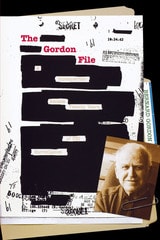
cover of The Gordon File: A Screenwriter Recalls Twenty Years of FBI Surveillance

The Gordon File

A Screenwriter Recalls Twenty Years of FBI Surveillance

By Bernard Gordon

University of Texas Press, 2004

For twenty-six years, the FBI devoted countless hours of staff time and thousands of U.S. taxpayer dollars to the surveillance of an American citizen named Bernard Gordon. Given the lavish use of resources, one might assume this man was a threat to national security or perhaps a kingpin of organized crime—not a Hollywood screenwriter whose most subversive act was joining the Communist Party during the 1940s when we were allied with the USSR in a war against Germany. For this honest act of political dissent, Gordon came to be investigated by the House Committee on Un-American Activities in 1952, blacklisted by the Hollywood film industry, and tailed by the FBI for over two decades.

In The Gordon File, Bernard Gordon tells the compelling, cautionary story of his life under Bureau surveillance. Drawing on his FBI file of over 300 pages, which he obtained under the Freedom of Information Act, he traces how the Bureau followed him from Hollywood to Mexico, Paris, London, Rome, and even aboard a Dutch freighter as he created an unusually successful, albeit uncredited, career as a screenwriter and producer during the blacklist years. Comparing his actual activities during that time to records in the file, he pointedly and often humorously underscores how often the FBI got it wrong, from the smallest details of his life to the main fact of his not being a threat to national security.

Most important, Gordon links his personal experience to the headlines of today, when the FBI is again assuming broad powers to monitor political dissidents it deems a threat to the nation. "Is it possible," he asks, "that books like this will help to move our investigative agencies from the job of blackmailing those who are critical of our imperfect democracy to arresting those who are truly out to destroy us?"
[more]
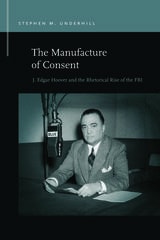
cover of The Manufacture of Consent: J. Edgar Hoover and the Rhetorical Rise of the FBI

The Manufacture of Consent

J. Edgar Hoover and the Rhetorical Rise of the FBI

Stephen M. Underhill

Michigan State University Press, 2020
The second Red Scare was a charade orchestrated by a tyrant with the express goal of undermining the New Deal—so argues Stephen M. Underhill in this hard-hitting analysis of J. Edgar Hoover’s rhetorical agency. Drawing on Classification 94, a vast trove of recently declassified records that documents the longtime FBI director’s domestic propaganda campaigns in the mid-twentieth century, Underhill shows that Hoover used the growing power of his office to subvert the presidencies of Franklin D. Roosevelt and Harry S. Truman and redirect the trajectory of U.S. culture away from social democracy toward a toxic brand of neoliberalism. He did so with help from Republicans who opposed organized labor and Southern Democrats who supported Jim Crow in what is arguably the most culturally significant documented political conspiracy in U.S. history, a wholesale domestic propaganda program that brainwashed Americans and remade their politics. Hoover also forged ties with the powerful fascist leaders of the period to promote his own political ambitions. All the while, as a love letter to Clyde Tolson still preserved in Hoover’s papers attests, he strove to pass for straight while promoting a culture that demonized same-sex love. The erosion of democratic traditions Hoover fostered continues to haunt Americans today.
[more]
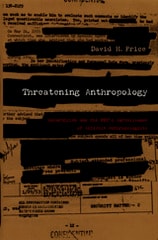
cover of Threatening Anthropology: McCarthyism and the FBI’s Surveillance of Activist Anthropologists

Threatening Anthropology

McCarthyism and the FBI’s Surveillance of Activist Anthropologists

David H. Price

Duke University Press, 2004

A vital reminder of the importance of academic freedom, Threatening Anthropology offers a meticulously detailed account of how U.S. Cold War surveillance damaged the field of anthropology. David H. Price reveals how dozens of activist anthropologists were publicly and privately persecuted during the Red Scares of the 1940s and 1950s. He shows that it was not Communist Party membership or Marxist beliefs that attracted the most intense scrutiny from the fbi and congressional committees but rather social activism, particularly for racial justice. Demonstrating that the fbi’s focus on anthropologists lessened as activist work and Marxist analysis in the field tapered off, Price argues that the impact of McCarthyism on anthropology extended far beyond the lives of those who lost their jobs. Its messages of fear and censorship had a pervasive chilling effect on anthropological investigation. As critiques that might attract government attention were abandoned, scholarship was curtailed.

Price draws on extensive archival research including correspondence, oral histories, published sources, court hearings, and more than 30,000 pages of fbi and government memorandums released to him under the Freedom of Information Act. He describes government monitoring of activism and leftist thought on college campuses, the surveillance of specific anthropologists, and the disturbing failure of the academic community—including the American Anthropological Association—to challenge the witch hunts. Today the “war on terror” is invoked to license the government’s renewed monitoring of academic work, and it is increasingly difficult for researchers to access government documents, as Price reveals in the appendix describing his wrangling with Freedom of Information Act requests. A disquieting chronicle of censorship and its consequences in the past, Threatening Anthropology is an impassioned cautionary tale for the present.
[more]
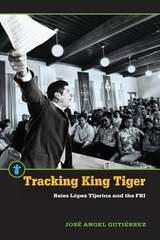
cover of Tracking King Tiger: Reies López Tijerina and the FBI

Tracking King Tiger

Reies López Tijerina and the FBI

José Angel Gutiérrez

Michigan State University Press, 2019
Reies López Tijerina, one of the Four Horsemen of the Chicano Movement, led the land grant struggle by Hispanos in the 1960s to recover the lands granted to their ancestors by Spain and Mexico and then guaranteed by the Treaty of Guadalupe Hidalgo. In his struggle, Tijerina became the target of local and state law enforcement officials in New Mexico and the FBI nationwide. José Angel Gutiérrez meticulously examines thousands of pages of FBI documents, interview transcripts, newspaper reports, and other written accounts on Tijerina and the Alianza Federal de Pueblos Libres, the organization of land grant claimants led by Tijerina in New Mexico. The primary source materials that document the U.S. government’s attempts to destroy Tijerina, his family, and his followers complement the secondary literature on Tijerina and his efforts as the premier leader of the land grant recovery movement. Threaded through the volume are glimpses into the special personal relationship between Tijerina and the author.
[more]
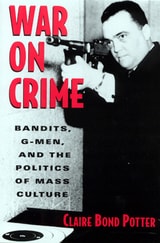
cover of War on Crime: Bandits, G-Men, and the Politics of Mass Culture

War on Crime

Bandits, G-Men, and the Politics of Mass Culture

Potter, Claire Bond

Rutgers University Press, 1998

War on Crime revises the history of the New Deal transformation and suggests a new model for political history-one which recognizes that cultural phenomena and the political realm produce, between them, an idea of "the state." The war on crime was fought with guns and pens, movies and legislation, radio and government hearings. All of these methods illuminate this period of state transformation, and perceptions of that emergent state, in the years of the first New Deal. The creation of G-men and gangsters as cultural heroes in this period not only explores the Depression-era obsession with crime and celebrity, but it also lends insight on how citizens understood a nation undergoing large political and social changes.

Anxieties about crime today have become a familiar route for the creation of new government agencies and the extension of state authority. It is important to remember the original "war on crime" in the 1930s-and the opportunities it afforded to New Dealers and established bureaucrats like J. Edgar Hoover-as scholars grapple with the ways states assert influence over populations, local authority, and party politics while they pursue goals such as reducing popular violence and protecting private property.

[more]