Results by title
6 books match the query 'University of Alabama'
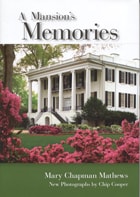
A Mansion's Memories
Mary Chapman Mathews
University of Alabama Press, 2006
An engaging history of The University of Alabama President’s Mansion
As part of The University of Alabama’s 175th anniversary celebration (2006), the new edition of A Mansion’s Memories includes details of the tenures of the four presidents who have served since the Mathews term. Profusely illustrated with 69 black-and-white and 17 color photographs, this classic is sure to be welcomed anew by alumni and friends of the University and all lovers of fine old buildings that still function in their original capacities.
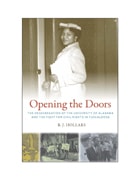
Opening the Doors
The Desegregation of the University of Alabama and the Fight for Civil Rights in TuscaloosaB. J. Hollars
University of Alabama Press, 2013
The story of how a university, a city, and a movement opened the door to change in the American South.
Opening the Doors is a wide-ranging account of the University of Alabama’s 1956 and 1963 desegregation attempts, as well as the little-known story of Tuscaloosa, Alabama’s, own civil rights movement. While E. Culpepper Clark’s The Schoolhouse Door remains the standard history of the University of Alabama’s desegregation, in Opening the Doors B. J. Hollars focuses on Tuscaloosa’s purposeful divide between “town” and “gown,” providing a new contextual framework for this landmark period in civil rights history.
The image of George Wallace’s stand in the schoolhouse door has long burned in American consciousness; however, just as interesting are the circumstances that led him there in the first place, a process that proved successful due to the concerted efforts of dedicated student leaders, a progressive university president, a steadfast administration, and secret negotiations between the U.S. Justice Department, the White House, and Alabama’s stubborn governor.
In the months directly following Governor Wallace’s infamous stand, Tuscaloosa became home to a leader of a very different kind: twenty-eight-year-old African American reverend T. Y. Rogers, an up-and-comer in the civil rights movement, as well as the protégé of Martin Luther King Jr. After taking a post at Tuscaloosa’s First African Baptist Church, Rogers began laying the groundwork for the city’s own civil rights movement. In the summer of 1964, the struggle for equality in Tuscaloosa resulted in the integration of the city’s public facilities, a march on the county courthouse, a bloody battle between police and protesters, confrontations with the Grand Wizard of the Ku Klux Klan, a bus boycott, and the near-accidental-lynching of movie star Jack Palance.
Relying heavily on new firsthand accounts and personal interviews, newspapers, previously classified documents, and archival research, Hollars’s in-depth reporting reveals the courage and conviction of a town, its university, and the people who call it home.
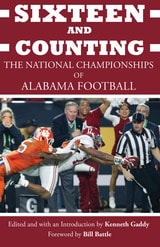
Sixteen and Counting
The National Championships of Alabama FootballEdited and with an Introduction by Kenneth Gaddy; Foreword by Bill Battle
University of Alabama Press, 2017
Dramatic accounts of every University of Alabama National Championship football season recounted by noted sports writers, players, and Alabamians.
Dating back to 1925, when Wallace Wade coached the Crimson Tide to an undefeated season and earned a spot in the Rose Bowl, the driving goal of every University of Alabama football season has been a national championship. A winning team surfaced that very next year, when Hoyt “Wu” Winslett’s squad sealed the national championship at the Rose Bowl for a second time. Winning seasons and bowl games culminating in the coveted crown followed again in 1930, 1934, 1941, 1961, 1964, 1965, 1973, 1978, 1979, 1992, 2009, 2011, 2012, and 2015—more championships than any other college team in the nation.
Sixteen and Counting features a chapter highlighting each of these championship seasons and collects the legendary stories of many of the outstanding coaches and players on the University of Alabama’s championship teams. College football legends such as Wallace Wade, Wu Winslett, Johnny Mack Brown, Pooley Herbert, Frank Thomas, Dixie Howell, Don Hutson, Jimmy Nelson, Holt Rast, Pat Trammel, Sam Bailey, Lee Roy Jordan, Harry Gilmer, Bill Lee, Ken Stabler, Joe Namath, Gary Rutledge, Randy Billingsley, Barry Krauss, Clem Gryska, Gene Stallings, Paul “Bear” Bryant, and, of course, Nick Saban all make prominent appearances.
A seventeenth chapter is included that looks at the uncrowned teams commonly referred to as “the other five,” who were considered national champions by at least one national ranking service at the end of the season. Every glorious milestone and high point in Alabama football history is included here: “Mama called,” the wishbone formation, “The Goal Line Stand,” the Million Dollar Band, the coaching tower, the Davis kicking dynasty, the Notre Dame box, Coach of the Year, Team of the Decade, and two Heisman trophy winners.
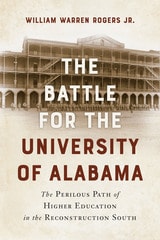
The Battle for the University of Alabama
The Perilous Path of Higher Education in the Reconstruction SouthWilliam Warren Rogers, Jr.
University of Alabama Press, 2025
Traces the little-known story of the bitter contest for the fate of the University of Alabama after the Civil War.
In The Battle for the University of Alabama, William Warren Rogers Jr. gives a fascinating account of the fierce struggle over the nature of the University of Alabama after the Civil War. Union forces reduced the campus to ruins as the war ended, and the university did not reopen until 1869. In the interregnum, powerful forces shifted the trajectory of the school. Alabama Republicans authored an egalitarian state constitution that delivered oversight of the university to the Republican Party. That set the stage for turmoil and confrontation. This book tells the story of that conflict.
In the next few years, Democrats charged Republicans with turning the university into a “radical” institution. They alleged that a handful of unqualified individuals had gained faculty positions because of their political allegiance, which resulted in the university’s academic desecration. Professors were bitterly denounced in the state newspaper press and quite personally in Tuscaloosa. Administration of the university became part of the fratricidal political debate in the state. Political violence and questions concerning race, specifically the possible integration of the university, illuminated the controversies of the Reconstruction years. Many of these questions resonate even today.
This authoritative account sets events at the University of Alabama against the backdrop of what occurred at other state universities in the Reconstruction South. The University of North Carolina experienced controversy similar to Alabama’s. At the University of Georgia, however, calm prevailed. This story of the incendiary events at Alabama’s flagship university charts new ground and provides a revelatory look into the extraordinary partisanship that characterized the South after the Civil War.
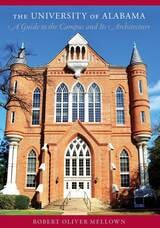
The University of Alabama
A Guide to the Campus and Its ArchitectureRobert Oliver Mellown
University of Alabama Press, 2013
In 1988 the University of Alabama Press published Robert Oliver Mellown’s The University of Alabama: A Guide to the Campus, a culmination of a decade’s worth of research into both the facts and the legends surrounding the architecture, history, and traditions of the Capstone.
Over twenty years later, this new guide brings to light the numerous additions, expansions, and renovations the university has undergone on its spacious grounds in Tuscaloosa. In addition to updated sections devoted to the university’s historic landmarks—such as Foster Auditorium, where “the stand in the schoolhouse door” occurred; Denny Chimes,where the handprints and footprints of famous Tide athletes are memorialized in concrete; and the Gorgas House, which with stood the destruction of Union troops at the end of the Civil War—new sections account for the acquisition of Bryce Hospital’s campus, the expansions at Bryant-Denny Stadium to accommodate the growing Crimson Tide fan base, and the burgeoning student recreation facilities, playing fields, and residential communities.
Chapters are arranged into various campus tours for walking or driving—Antebellum, Victorian, Early Twentieth-Century, East Quad, West Quad, Science and Engineering Corridor, Student Life, Bryce, Medical, Southeast, Athletics, and Off Campus. Alumni, prospective students and their parents, new faculty, out-of-state visitors, and foreign dignitaries will all welcome this useful, compact, and colorful guide to one of the most beautiful campuses in the country.
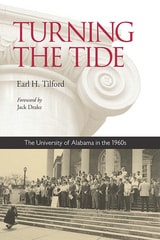
Turning the Tide
The University of Alabama in the 1960sEarl H. Tilford
University of Alabama Press, 2014
Earl H. Tilford details the origins of the student movement from within the Student Government Association, whose leaders included Ralph Knowles and future governor Don Siegelman, among others; the participation of key members of “The Machine,” the political faction made up of the powerful fraternities and sororities on campus; and the efforts of more radical non-Greek students like Jack Drake, Ed Still, and Sondra Nesmith. Tilford also details the political maneuverings that drove the cause of social change through multiple administrations at the university. Turning the Tide highlights the contributions of university presidents Frank A. Rose and David Mathews, as well as administrators like the dean of men John L. Blackburn, who supported the student leaders but also encouraged them to work within the system rather than against it.
Based on archival research, interviews with many of the principal participants, and the author’s personal experiences, Tilford’s Turning the Tide is a compelling portrait of a university in transition during the turbulence surrounding the civil rights and anti-war movements of the 1960s.