Results by title
8 books match the query 'Unraveling'
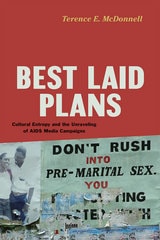
Best Laid Plans
Cultural Entropy and the Unraveling of AIDS Media CampaignsTerence E. McDonnell
University of Chicago Press, 2016
McDonnell argues that these well-designed campaigns are undergoing “cultural entropy”: the process through which the intended meanings and uses of cultural objects fracture into alternative meanings, new practices, failed interactions, and blatant disregard. Using AIDS media campaigns in Accra, Ghana, as its central case study, the book walks readers through best-practice, evidence-based media campaigns that fall totally flat. Female condoms are turned into bracelets, AIDS posters become home decorations, red ribbons fade into pink under the sun—to name a few failures. These damaging cultural misfires are not random. Rather, McDonnell makes the case that these disruptions are patterned, widespread, and inevitable—indicative of a broader process of cultural entropy.

Blueprint for Disaster
The Unraveling of Chicago Public HousingD. Bradford Hunt
University of Chicago Press, 2009
Now considered a dysfunctional mess, Chicago’s public housing projects once had long waiting lists of would-be residents hoping to leave the slums behind. So what went wrong? To answer this complicated question, D. Bradford Hunt traces public housing’s history in Chicago from its New Deal roots through current mayor Richard M. Daley’s Plan for Transformation. In the process, he chronicles the Chicago Housing Authority’s own transformation from the city’s most progressive government agency to its largest slumlord.
Challenging explanations that attribute the projects’ decline primarily to racial discrimination and real estate interests, Hunt argues that well-intentioned but misguided policy decisions—ranging from design choices to maintenance contracts—also paved the road to failure. Moreover, administrators who fully understood the potential drawbacks did not try to halt such deeply flawed projects as Cabrini-Green and the Robert Taylor Homes. These massive high-rise complexes housed unprecedented numbers of children but relatively few adults, engendering disorder that pushed out the working class and, consequently, the rents needed to maintain the buildings. The resulting combination of fiscal crisis, managerial incompetence, and social unrest plunged the CHA into a quagmire from which it is still struggling to emerge.
Blueprint for Disaster, then,is an urgent reminder of the havoc poorly conceived policy can wreak on our most vulnerable citizens.

Haywire
Discord in Maine's Logging Woods and the Unraveling of an IndustryAndrew Egan
University of Massachusetts Press, 2022
Logging in the northern forest has been romanticized, with images of log drives, plaid shirts, and bunkhouses in wide circulation. Increasingly dismissed as a quaint, rural pastime, logging remains one of the most dangerous jobs in the United States, with loggers occupying a precarious position amid unstable markets, expanding global competition, and growing labor discord. Examining a time of transition and decline in Maine’s forest economy, Andrew Egan traces pathways for understanding the challenges that have faced Maine’s logging community and, by extension, the state’s forestry sector, from the postwar period through today.
Seeking greater profits, logging companies turned their crews loose at midcentury, creating a workforce of independent contractors who were forced to purchase expensive equipment and compete for contracts with the mills. Drawing on his own experience with the region’s forest products industry, interviews with Maine loggers, media coverage, and court documents, Egan follows the troubled recent history of the industry and its battle for survival.
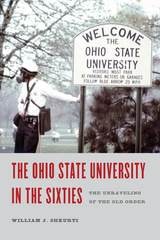
The Ohio State University in the Sixties
The Unraveling of the Old OrderWilliam J. Shkurti
The Ohio State University Press, 2016
Just a year earlier the campus seemed immune to such disruptions. President Nixon considered it safe enough to plan an address at commencement. Yet a year later the campus erupted into a spasm of violent protest exceeding even that of traditional hot spots like Berkeley and Wisconsin. How could conditions have changed so dramatically in just a few short months?
Using contemporary news stories, long overlooked archival materials, and first-person interviews, The Ohio State University in the Sixties explores how these tensions built up over years, why they converged when they did and how they forever changed the university.
Unraveling of Civil Society
Peacebuilding, Health Crises, and Aid in Twenty-First-Century Guinea and Sierra LeoneMichelle Reddy
Ohio University Press, 2026
In recent years, the capacity of civil society to respond to crises has been increasingly constrained by rising authoritarianism. Yet in West Africa, where civil society has historically played a pivotal role in democratization, this trend reveals deeper structural challenges. Unraveling of Civil Society examines how international aid strategies emphasizing technical capacity and professionalization have inadvertently contributed to the politicization and fragmentation of civil society in Guinea and Sierra Leone.
Drawing on extensive fieldwork—including interviews with representatives of more than a hundred locally led organizations, analysis of 260 strategic plans, and collection of cross-national survey data—this book offers a rare longitudinal and comparative study of civil society in the region. It traces how donor-driven models have led organizations to become sector specific, mimic donor institutions, or align with political interests—ultimately reducing organizational diversity and weakening the social infrastructure necessary for collective action and crisis resilience.
The book situates these findings within broader debates on democratic backsliding, noting that three of the nine countries that transitioned to autocracy between 2021 and 2023—Guinea, Chad, and Mali—are in West Africa. Despite significant international investment, “coup culture” and unconstitutional power shifts have resurged, raising urgent questions about the effectiveness of aid and the role of civil society in sustaining democratic norms.
Combining comparative historical analysis with a mixed-methods approach, Unraveling of Civil Society challenges prevailing assumptions about capacity building and offers practical recommendations for democratizing local organizations from within. It advocates for participatory governance and funding mechanisms and engages with ongoing conversations around the localization and decolonization of aid in a shifting geopolitical landscape.
This book is essential reading for scholars of African studies, political science, development studies, and global civil society as well as for practitioners in crisis management and political reform.
Unraveling the Garment Industry
Transnational Organizing and Women’s WorkEthel C. Brooks
University of Minnesota Press, 2007
Brooks analyzes a two-pronged problem in consumer boycott campaigns against labor abuse in the garment industry. First, how are we to understand the political necessities of local protest such as the right to unionize against the emphasis placed on consumer boycotts? Second, what and whose agency is privileged or obscured within the symbolic economies and the politics of information deployed by these campaigns? Tying both of these questions together is a commitment to seeing globalization as embedded in the everyday realities of the local.
Drawing attention to the race, class, and gender assumptions central to powerful consumer boycotts, Brooks reveals how these movements unintentionally reinforce the global economic forces they denounce.
Ethel C. Brooks is assistant professor of women’s and gender studies and sociology at Rutgers University.

Unraveling the Real
The Fantastic in Spanish-American FiccionesAuthored by Cynthia Duncan
Temple University Press, 2010
In literary and cinematic fictions, the fantastic blurs the lines between reality and fantasy. Lacking a consensus on definition, critics often describe the fantastic as supernatural, or similar to, but quite different from fantasy, science fiction, and magical realism.
In Unraveling the Real Cynthia Duncan provides a new theoretical framework for discussing how the fantastic explores both metaphysical and socially relevant themes in Spanish American fictions. Duncan deftly shows how authors and artists have used this literary genre to convey marginalized voices as well as critique colonialism, racism, sexism, and classism. Selecting examples from the works of such noted writers as Jorge Luis Borges, Julio Cortázar, and Carlos Fuentes, among others, she shows how capacious the concept is, and why it eludes standard definition.
Challenging the notion that the fantastic is escapist in nature, Unraveling the Real shows how the fantastic has been politically engaged throughout the twentieth century, often questioning what is real or unreal. Presenting a mirror image of reality, the fantastic does not promoting a utopian parallel universe but rather challenges the way we think about the world around us and the cultural legacy of colonialism.
Unraveling
Remaking Personhood in a Neurodiverse AgeMatthew J. Wolf-Meyer
University of Minnesota Press, 2020
Developing a cybernetic model of subjectivity and personhood that honors disability experiences to reconceptualize the category of the human
Twentieth-century neuroscience fixed the brain as the basis of consciousness, the self, identity, individuality, even life itself, obscuring the fundamental relationships between bodies and the worlds that they inhabit. In Unraveling, Matthew J. Wolf-Meyer draws on narratives of family and individual experiences with neurological disorders, paired with texts by neuroscientists and psychiatrists, to decenter the brain and expose the ableist biases in the dominant thinking about personhood.
Unraveling articulates a novel cybernetic theory of subjectivity in which the nervous system is connected to the world it inhabits rather than being walled off inside the body, moving beyond neuroscientific, symbolic, and materialist approaches to the self to focus instead on such concepts as animation, modularity, and facilitation. It does so through close readings of memoirs by individuals who lost their hearing or developed trauma-induced aphasia, as well as family members of people diagnosed as autistic—texts that rethink modes of subjectivity through experiences with communication, caregiving, and the demands of everyday life.
Arguing for a radical antinormative bioethics, Unraveling shifts the discourse on neurological disorders from such value-laden concepts as “quality of life” to develop an inclusive model of personhood that honors disability experiences and reconceptualizes the category of the human in all of its social, technological, and environmental contexts.