Results by title
923 books match the query 'Urban' and 58 start with a
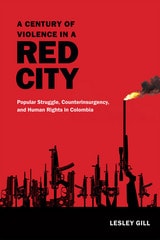
A Century of Violence in a Red City
Popular Struggle, Counterinsurgency, and Human Rights in ColombiaLesley Gill
Duke University Press, 2016
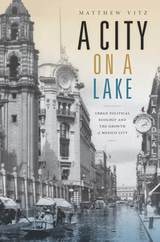
A City on a Lake
Urban Political Ecology and the Growth of Mexico CityMatthew Vitz
Duke University Press, 2018
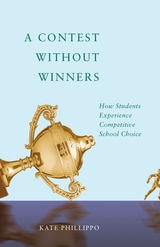
A Contest without Winners
How Students Experience Competitive School ChoiceKate Phillippo
University of Minnesota Press, 2019
Seeing the consequences of competitive school choice policy through students’ eyes
While policymakers often justify school choice as a means to alleviate opportunity and achievement gaps, an unanticipated effect is increased competition over access to coveted, high-performing schools. In A Contest without Winners, Kate Phillippo follows a diverse group of Chicago students through the processes of researching, applying to, and enrolling in public high school. Throughout this journey, students prove themselves powerful policy actors who carry out and redefine competitive choice.
Phillippo’s work amplifies the voices of students—rather than the parents, educators, public intellectuals, and policymakers who so often inform school choice research—and investigates how students interact with and emerge from competitive choice academically, developmentally, and civically. Through students’ experiences, she shows how competitive choice legitimates and exacerbates existing social inequalities; collides with students’ developmental vulnerability to messages about their ability, merit, and potential; and encourages young people’s individualistic actions as they come to feel that they must earn their educational rights. From urban infrastructure to income inequality to racial segregation, Phillippo examines the factors that shape students’ policy enactment and interpretation, as policymakers and educators ask students to compete for access to public resources.
With competitive choice, even the winners—the lucky few admitted to their dream schools—don’t outright win. A Contest without Winners challenges meritocratic and market-driven notions of opportunity creation for young people and raises critical questions about the goals we have for public schooling.
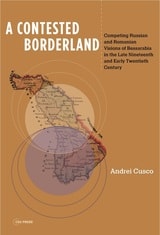
A Contested Borderland
Competing Russian and Romanian Visions of Bessarabia in the Second Half of the 19th and Early 20th CenturyAndrei Cusco
Central European University Press, 2017
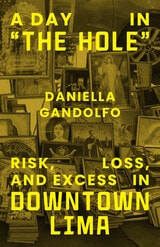
A Day in "The Hole"
Risk, Loss, and Excess in Downtown LimaDaniella Gandolfo
University of Chicago Press, 2025
A single day in a semilegal market in Lima, Peru, reveals a social world that defies conventional economic logic.
In the heart of Lima’s historic center, the markets of El Hueco (“The Hole”) and sprawling Mesa Redonda pulse with life, with thousands of vendors selling everything from knockoff electronics to religious icons. In A Day in “The Hole,” anthropologist Daniella Gandolfo immerses readers in a single, tumultuous day—the thirty-fourth anniversary of a vendors’ cooperative—while examining the dynamics that sustain these marketplaces.
Through a blend of cinematic storytelling and incisive anthropological insight, Gandolfo reveals a world with its own unique codes. She inspects how vendors embrace expenditure over profit and instability over order, and moving through the sights and sounds of El Hueco and Mesa Redonda, she finds a dissident economy that is as much about survival as it is about spectacle. Gandolfo redefines how we think about urban economies and the unexpected ways these defiant communities thrive in this textured portrait of Lima’s markets and the people who animate them.
A Fatal Drifting Apart
Democratic Social Knowledge and Chicago ReformLaura M. Westhoff
The Ohio State University Press, 2007
A Fatal Drifting Apart: Democratic Social Knowledge and Chicago Reform explores the efforts of diverse groups within Chicago during the Progressive Era. This backdrop of industrialization, emerging classes, and ethnic and racial pluralism frequently riven with class conflict set the stage on which Chicago reformers took up the seemingly impossible challenge of enacting democracy. Laura M. Westhoff examines historic events and well-known individuals of the period and brings them together in an unusual framework that offers a new perspective on the reorientation of knowledge, civic identity, and democratic culture at the dawn of the twentieth century, which she terms democratic social knowledge. The book raises important questions that continue to resonate: In a democracy, who has the power to define social problems and offer solutions, and whose experience and knowledge are seen as legitimate?
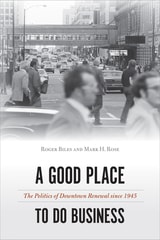
A Good Place to Do Business
The Politics of Downtown Renewal since 1945Roger Biles and Mark H. Rose
Temple University Press, 2022
The “Pittsburgh Renaissance,” an urban renewal effort launched in the late 1940s, transformed the smoky rust belt city’s downtown. Working-class residents and people of color saw their neighborhoods cleared and replaced with upscale, white residents and with large corporations housed in massive skyscrapers. Pittsburgh’s Renaissance’s apparent success quickly became a model for several struggling industrial cities, including St. Louis, Cleveland, Detroit, Chicago, and Philadelphia.
In A Good Place to Do Business, Roger Biles and Mark Rose chronicle these urban “makeovers” which promised increased tourism and fashionable shopping as well as the development of sports stadiums, convention centers, downtown parks, and more. They examine the politics of these government-funded redevelopment programs and show how city politics (and policymakers) often dictated the level of success.
As city officials and business elites determined to reorganize their downtowns, a deeply racialized politics sacrificed neighborhoods and the livelihoods of those pushed out. Yet, as A Good Place to Do Business demonstrates, more often than not, costly efforts to bring about the hoped-for improvements failed to revitalize those cities, or even their downtowns.
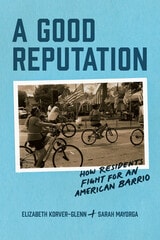
A Good Reputation
How Residents Fight for an American BarrioElizabeth Korver-Glenn and Sarah Mayorga
University of Chicago Press, 2024
Neighborhoods have the power to form significant parts of our worlds and identities. A neighborhood’s reputation, however, doesn’t always match up to how residents see themselves or wish to be seen. The distance between residents’ desires and their environment can profoundly shape neighborhood life.
In A Good Reputation, sociologists Elizabeth Korver-Glenn and Sarah Mayorga delve into the development and transformation of the reputation of Northside, a predominantly Latinx barrio in Houston. Drawing on two years of ethnographic research and in-depth interviews with residents, developers, and other neighborhood stakeholders, the authors show that people’s perceptions of their neighborhoods are essential to understanding urban inequality and poverty. Korver-Glenn and Mayorga’s empirically detailed account of disputes over neighborhood reputation helps readers understand the complexity of high-poverty urban neighborhoods, demonstrating that gentrification is a more complicated and irregular process than existing accounts of urban inequality would suggest. Offering insightful theoretical analysis and compelling narrative threads from understudied communities, A Good Reputation will yield insights for scholars of race and ethnicity, urban planning, and beyond.
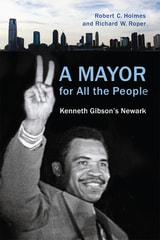
A Mayor for All the People
Kenneth Gibson's NewarkRobert C. Holmes
Rutgers University Press, 2020
In 1970, Kenneth Gibson was elected as Newark, New Jersey’s first African-American mayor, a position he held for an impressive sixteen years. Yet even as Gibson served as a trailblazer for black politicians, he presided over a troubled time in the city’s history, as Newark’s industries declined and its crime and unemployment rates soared.
This book offers a balanced assessment of Gibson’s leadership and his legacy, from the perspectives of the people most deeply immersed in 1970s and 1980s Newark politics: city employees, politicians, activists, journalists, educators, and even fellow big-city mayors like David Dinkins. The contributors include many of Gibson’s harshest critics, as well as some of his closest supporters, friends, and family members—culminating in an exclusive interview with Gibson himself, reflecting on his time in office.
Together, these accounts provide readers with a compelling inside look at a city in crisis, a city that had been rocked by riots three years before Gibson took office and one that Harper’s magazine named “America’s worst city” at the start of his second term. At its heart, it raises a question that is still relevant today: how should we evaluate a leader who faced major structural and economic challenges, but never delivered all the hope and change he promised voters?
A Nation of Neighborhoods
Imagining Cities, Communities, and Democracy in Postwar AmericaBenjamin Looker
University of Chicago Press, 2015
Looker investigates the cultural, social, and political complexities of the idea of “neighborhood” in postwar America and how Americans grappled with vast changes in their urban spaces from World War II to the Reagan era. In the face of urban decline, competing visions of the city neighborhood’s significance and purpose became proxies for broader debates over the meaning and limits of American democracy. By studying the way these contests unfolded across a startling variety of genres—Broadway shows, radio plays, urban ethnographies, real estate documents, and even children’s programming—Looker shows that the neighborhood ideal has functioned as a central symbolic site for advancing and debating theories about American national identity and democratic practice.
A Nation on the Line
Call Centers as Postcolonial Predicaments in the PhilippinesJan M. Padios
Duke University Press, 2018
A Neighborhood That Never Changes
Gentrification, Social Preservation, and the Search for AuthenticityJaponica Brown-Saracino
University of Chicago Press, 2009
Newcomers to older neighborhoods are usually perceived as destructive, tearing down everything that made the place special and attractive. But as A Neighborhood That Never Changes demonstrates, many gentrifiers seek to preserve the authentic local flavor of their new homes, rather than ruthlessly remake them. Drawing on ethnographic research in four distinct communities—the Chicago neighborhoods of Andersonville and Argyle and the New England towns of Provincetown and Dresden—Japonica Brown-Saracino paints a colorful portrait of how residents new and old, from wealthy gay homeowners to Portuguese fishermen, think about gentrification.
The new breed of gentrifiers, Brown-Saracino finds, exhibits an acute self-consciousness about their role in the process and works to minimize gentrification’s risks for certain longtime residents. In an era of rapid change, they cherish the unique and fragile, whether a dilapidated house, a two-hundred-year-old landscape, or the presence of people deeply rooted in the place they live. Contesting many long-standing assumptions about gentrification, Brown-Saracino’s absorbing study reveals the unexpected ways beliefs about authenticity, place, and change play out in the social, political, and economic lives of very different neighborhoods.
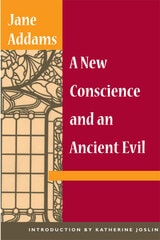
A New Conscience and an Ancient Evil
Jane Addams
University of Illinois Press, 2002
Addams offers lurid accounts–-drawn from the records of Chicago's Juvenile Protection Association–-of young women coerced into lives of prostitution by men who lurked outside hotels and sweatshops. Because they lacked funds for proper recreation, Addams argues, poor and socially marginalized women were susceptible to sexual slavery, and without radical social change they would perhaps be "almost as free" as young men. In addition to promoting higher wages and better living conditions, Addams suggests that a longer period of public education for young women would deter them from the dangers of city life.
Despite its appeal to middle–class readers eager for tales of sexual excess and the rape of innocence, the press and prominent intellectuals criticized A New Conscience and an Ancient Evil for being disproportionately hysterical to its philosophical weight. Katherine Joslin's introduction considers the controversial reactions to the book and the circumstances of its publication. Behind the sensationalism of the narratives, Joslin locates themes including the commodification of sex and the importance of marriage for young women.
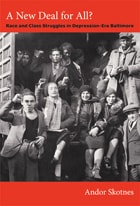
A New Deal for All?
Race and Class Struggles in Depression-Era BaltimoreAndor Skotnes
Duke University Press, 2012
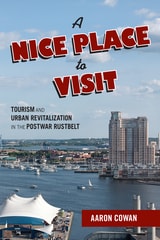
A Nice Place to Visit
Tourism and Urban Revitalization in the Postwar RustbeltAaron Cowan
Temple University Press, 2016
How did tourism gain a central role in the postwar American Rustbelt city? And how did tourism development reshape the meaning and function of these cities? These are the questions at the heart of Aaron Cowan’s groundbreaking book, A Nice Place to Visit.
Cowan provides an insightful, comparative look at the historical development of Cincinnati, St. Louis, Pittsburgh, and Baltimore in the post–World War II period to show how urban tourism provided a potential solution to the economic woes of deindustrialization. A Nice Place to Visit chronicles the visions of urban leaders who planned hotels, convention centers, stadiums, and festival marketplaces to remake these cities as tourist destinations. Cowan also addresses the ever-present tensions between tourist development and the needs and demands of residents in urban communities.
A Nice Place to Visit charts how these Rustbelt cities adapted to urban decline and struggled to meet the challenge of becoming an appealing place to visit, as well as good and just communities in which to live.
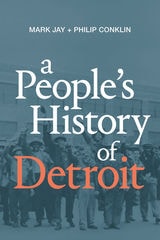
A People's History of Detroit
Mark Jay and Philip Conklin
Duke University Press, 2020

A Psalm for Cottondale
PoemsSharony A. Green
University of Alabama Press, 2026
A lyrical journey through memory, place, and resilience in the heart of Alabama
A Psalm for Cottondale is a lyrical meditation on memory, place, and survival in the American South. Through a sequence of interconnected free-verse poems, Sharony Green reflects on life in Cottondale, Alabama, where change unfolds in ways that can be both poignant and unexpected. Rooted in the histories, landscapes, and cultural currents of an Alabama college town, the collection explores how one place can evoke the memory of many others, inviting readers to consider broader questions of identity, belonging, and endurance.
Written in a clear, steady voice, these poems balance intimacy with historical awareness, allowing inherited stories, silences, and everyday moments to emerge with quiet power. Green’s careful craftsmanship and emotional restraint lend authority to the collection, while a subtle psalmic undercurrent adds spiritual depth without sacrificing nuance. As the poems move through themes of joy, grief, witness, and renewal, Cottondale becomes both a physical community and a symbolic terrain shaped by race, land, memory, and hope.
Inspired by writings that engage history, geography, and culture, A Psalm for Cottondale offers an elegant and deeply attentive reflection on Southern and American life, illuminating the ways people endure, adapt, and find meaning in a changing world. Ideal for readers of contemporary poetry, Southern literature, African American studies, place-based writing, and works that explore history, memory, faith, and community through a lyrical lens.
A Right to Housing
Foundation for a New Social AgendaRachel Bratt
Temple University Press, 2006
The contributors to A Right to Housing consider the key issues related to America's housing crisis, including income inequality and insecurity, segregation and discrimination, the rights of the elderly, as well as legislative and judicial responses to homelessness. The book offers a detailed examination of how access to adequate housing is directly related to economic security.
With essays by leading activists and scholars, this book presents a powerful and compelling analysis of the persistent inability of the U.S. to meet many of its citizens' housing needs, and a comprehensive proposal for progressive change.
A Short History Of Reno
Barbara Land
University of Nevada Press, 1995
A Short History of Carson City
Richard Moreno
University of Nevada Press, 2011
A Short History of Denver
Stephen J. Leonard
University of Nevada Press, 2016
A Short History of Denver portrays the city’s twentieth-century ups and downs, including the City Beautiful movement, political corruption, the rise of the Ku Klux Klan in the 1920s, and the Great Depression of the 1930s. Here readers will find the meat and potatoes of economic and political history and much more, including sports history, social history, and the history of metropolitan-wide efforts to preserve the past.
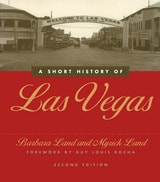
A Short History of Las Vegas
Barbara Land
University of Nevada Press, 2004
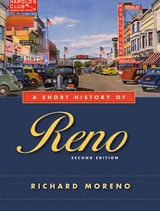
A Short History of Reno, Second Edition
Richard Moreno
University of Nevada Press, 2015
Moreno brings the city’s history up-to-date with coverage of the businesspeople and civic leaders who helped make Reno an attraction that still lures millions of visitors each year. Today’s travelers and residents explore Reno’s flamboyant heart and scenic wonders, topics the author examines in an accessible and lively fashion.
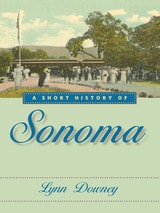
A Short History of Sonoma
Lynn Downey
University of Nevada Press, 2013
The book also addresses such topics as the development of local ranching and businesses and of transportation links to San Francisco that helped to make Sonoma and the surrounding Valley of the Moon a popular location for summer homes and resorts. It discusses the role of the nearby hot springs in attracting visitors and permanent residents, including people seeking cures for various ailments. There are also accounts of some of the famous people who lived in or near Sonoma and helped establish its mystique, including Mexican general Mariano Vallejo, the town’s first leader; Hungarian winemaker Agoston Haraszthy, who first saw the region’s potential for producing superior wines; and writers Jack London and M. F. K. Fisher, who made their homes in the Valley of the Moon, drawn by its beauty and bucolic lifestyle.
A Short History of Sonoma is generously illustrated with vintage photographs. It is a delightful account of one of America’s most charming towns and its evolution from rowdy frontier settlement to the paragon of sophisticated living that it is today.
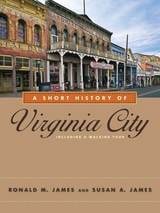
A Short History of Virginia City
Ronald M. James
University of Nevada Press, 2014
The city’s story did not end when the Comstock Lode played out. Beginning in the 1930s, bohemian artists, literati, and tourists were intrigued by this remnant of the Old West. The leader of Manhattan’s café society, Lucius Beebe, moved here and relaunched the Territorial Enterprise in 1950. Television’s most popular western from 1959 to 1973, Bonanza, located its fictional Ponderosa Ranch nearby. In the summer of 1965, a handful of Bay Area musicians, including Big Brother and the Holding Company, performed at the Red Dog Saloon and launched psychedelic rock, part of the inspiration for a defining decade of youth culture. Today it is both a National Historic Landmark District and a living community. Visitors come to enjoy its saloons and restaurants, admire its architecture, and learn from its museums and exhibits. A Short History of Virginia City will enhance their experience and will also be enjoyed by anyone interested in the history of Nevada, mining, and the Old West.
• Includes an illustrated walking tour describing more than thirty buildings and sites
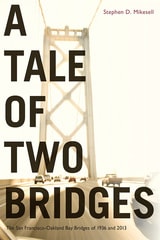
A Tale of Two Bridges
The San Francisco–Oakland Bay Bridges of 1936 and 2013Stephen Mikesell
University of Nevada Press, 2017
A Tale of Two Bridges is a history of two versions of the San Francisco—Oakland Bay Bridge: the original bridge built in 1936 and a replacement for the eastern half of the bridge finished in 2013. The 1936 bridge revolutionized transportation in the Bay Area and profoundly influenced settlement patterns in the region. It was also a remarkable feat of engineering. In the 1950s the American Society of Civil Engineers adopted a list of the “Seven Engineering Wonders” of the United States. The 1936 structure was the only bridge on the list, besting even the more famous Golden Gate Bridge. One of its greatest achievements was that it was built on time (in less than three years) and came in under budget. Mikesell explores in fascinating detail how the bridge was designed by a collection of the best-known engineers in the country as well as the heroic story of its construction by largely unskilled laborers from California, joined by highly skilled steel workers.
By contrast, the East Span replacement, which was planned between 1989 and 1998, and built between 1998 and 2013, fell victim to cost overruns in the billions of dollars, was a decade behind schedule, and suffered from structural problems that has made it a perpetual maintenance nightmare.
This is narrative history in its purest form. Mikesell excels at explaining highly technical engineering issues in language that can be understood and appreciated by general readers. Here is the story of two very important bridges, which provides a fair but uncompromising analysis of why one bridge succeeded and the other did not.
A Voice but No Power
Organizing for Social Justice in MinneapolisDavid Forrest
University of Minnesota Press, 2022
Examining the work of social justice groups in Minneapolis following the 2008 recession
Since the Great Recession, even as protest and rebellion have occurred with growing frequency, many social justice organizers continue to displace as much as empower popular struggles for egalitarian and emancipatory change. In A Voice but No Power, David Forrest explains why this is the case and explores how these organizers might better reach their potential as advocates for the abolition of exploitation, discrimination, and other unjust conditions.
Through an in-depth study of post-2008 Minneapolis—a center of progressive activism—Forrest argues that social justice organizers so often fall short of their potential largely because of challenges they face in building what he calls “contentious identities,” the public identities they use to represent their constituents and counteract stigmatizing images such as the “welfare queen” or “the underclass.” In the process of assembling, publicizing, and legitimating contentious identities, he shows, these organizers encounter a series of political hazards, each of which pushes them to make choices that weaken movements for equality and freedom. Forrest demonstrates that organizers can achieve better outcomes, however, by steadily working to remake their hazardous political terrain.
The book’s conclusion reflects on the 2020 uprising that followed the police killing of George Floyd, assessing what it means for the future of social justice activism. Ultimately, Forrest’s detailed analysis contributes to leading theories about organizing and social movements and charts possibilities for further emboldening grassroots struggles for a fairer society.
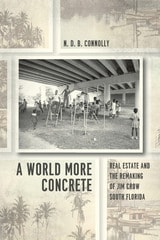
A World More Concrete
Real Estate and the Remaking of Jim Crow South FloridaN. D. B. Connolly
University of Chicago Press, 2014
A World More Concrete argues that black and white landlords, entrepreneurs, and even liberal community leaders used tenements and repeated land dispossession to take advantage of the poor and generate remarkable wealth. Through a political culture built on real estate, South Florida’s landlords and homeowners advanced property rights and white property rights, especially, at the expense of more inclusive visions of equality. For black people and many of their white allies, uses of eminent domain helped to harden class and color lines. Yet, for many reformers, confiscating certain kinds of real estate through eminent domain also promised to help improve housing conditions, to undermine the neighborhood influence of powerful slumlords, and to open new opportunities for suburban life for black Floridians.
Concerned more with winners and losers than with heroes and villains, A World More Concrete offers a sober assessment of money and power in Jim Crow America. It shows how negotiations between powerful real estate interests on both sides of the color line gave racial segregation a remarkable capacity to evolve, revealing property owners’ power to reshape American cities in ways that can still be seen and felt today.

A World of Gangs
Armed Young Men and Gangsta CultureJohn M. M. Hagedorn
University of Minnesota Press, 2008
“Street gangs mirror the inhuman ambitions and greed of society’s trendsetters and deities even as they fight to the death over scraps from the table of the international drug trade. But John Hagedorn, characteristically, also finds hope in the contradictory values of outlaw youth—selflessness, solidarity, and love amid cupidity and directionless rage—and he maintains the hope that a culture of resistance will ultimately prevail over the forces of self-destruction. Whether one shares his optimism or not, he makes a compelling case that the future of the world will be determined on the streets of our cities.” —Mike Davis, from the Foreword
“A World of Gangs is an illuminating journey around the cultures, lives, tragedies, and dreams of millions of rebellious youth around the planet. It is an indispensable work to understand the world we live in and essential reading for students of cities and communities.” —Manuel Castells
For the more than a billion people who now live in urban slums, gangs are ubiquitous features of daily life. Though still most closely associated with American cities, gangs are an entrenched, worldwide phenomenon that play a significant role in a wide range of activities, from drug dealing to extortion to religious and political violence. In A World of Gangs, John Hagedorn explores this international proliferation of the urban gang as a consequence of the ravages of globalization.
Looking closely at gang formation in three world cities-Chicago, Rio de Janeiro, and Capetown-he discovers that some gangs have institutionalized as a strategy to confront a hopeless cycle of poverty, racism, and oppression. In particular, Hagedorn reveals, the nihilistic appeal of gangsta rap and its street ethic of survival “by any means necessary” provides vital insights into the ideology and persistence of gangs around the world. This groundbreaking work concludes on a hopeful note. Proposing ways in which gangs might be encouraged to overcome their violent tendencies, Hagedorn appeals to community leaders to use the urgency, outrage, and resistance common to both gang life and hip-hop in order to bring gangs into broader movements for social justice.
John M. Hagedorn is associate professor of criminal justice at the University of Illinois, Chicago. He is editor of Gangs in the Global City and author of the highly influential People and Folks: Gangs, Crime, and the Underclass in a Rustbelt City.
MacArthur fellow Mike Davis is the author of many books, including Planet of Slums and, most recently, Buda’s Wagon: A Brief History of the Car Bomb.
Abandoned Families
Social Isolation in the Twenty-First CenturyKristin S. Seefeldt
Russell Sage Foundation, 2016
Vasquez-Tokos finds that their experiences in childhood, adolescence, and young adulthood shape their perceptions of race, which in turn influence their romantic expectations. Most Latinos marry other Latinos, but those who intermarry tend to marry whites. She finds that some Latina women who had domineering fathers assumed that most Latino men shared this trait and gravitated toward white men who differed from their fathers. Other Latina respondents who married white men fused ideas of race and class and perceived whites as higher status and considered themselves to be “marrying up.” Latinos who married non-Latino minorities—African Americans, Asian Americans, and Native Americans—often sought out non-white partners because they shared similar experiences of racial marginalization. Latinos who married Latinos of a different national origin expressed a desire for shared cultural commonalities with their partners, but—like those who married whites—often associated their own national-origin groups with oppressive gender roles.
Vasquez-Tokos also investigates how racial and cultural identities are maintained or altered for the respondents’ children. Within Latino-white marriages, biculturalism—in contrast with Latinos adopting a white “American” identity—is likely to emerge. For instance, white women who married Latino men often embraced aspects of Latino culture and passed it along to their children. Yet, for these children, upholding Latino cultural ties depended on their proximity to other Latinos, particularly extended family members. Both location and family relationships shape how parents and children from interracial families understand themselves culturally.
As interracial marriages become more common, Marriage Vows and Racial Choices shows how race, gender, and class influence our marital choices and personal lives.
Abstract Barrios
The Crises of Latinx Visibility in CitiesJohana Londoño
Duke University Press, 2020
African American Urban History since World War II
Edited by Kenneth L. Kusmer and Joe W. Trotter
University of Chicago Press, 2009
Historians have devoted surprisingly little attention to African American urban history ofthe postwar period, especially compared with earlier decades. Correcting this imbalance, African American Urban History since World War II features an exciting mix of seasoned scholars and fresh new voices whose combined efforts provide the first comprehensive assessment of this important subject.
The first of this volume’s five groundbreaking sections focuses on black migration and Latino immigration, examining tensions and alliances that emerged between African Americans and other groups. Exploring the challenges of residential segregation and deindustrialization, later sections tackle such topics as the real estate industry’s discriminatory practices, the movement of middle-class blacks to the suburbs, and the influence of black urban activists on national employment and social welfare policies. Another group of contributors examines these themes through the lens of gender, chronicling deindustrialization’s disproportionate impact on women and women’s leading roles in movements for social change. Concluding with a set of essays on black culture and consumption, this volume fully realizes its goal of linking local transformations with the national and global processes that affect urban class and race relations.
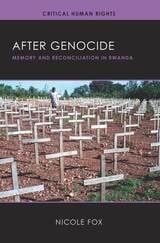
After Genocide
Memory and Reconciliation in RwandaNicole Fox
University of Wisconsin Press, 2023
In the wake of unthinkable atrocities, it is reasonable to ask how any population can move on from the experience of genocide. Simply remembering the past can, in the shadow of mass death, be retraumatizing. So how can such momentous events be memorialized in a way that is productive and even healing for survivors? Genocide memorials tell a story about the past, preserve evidence of the violence that occurred, and provide emotional support to survivors. But the goal of amplifying survivors’ voices can fade amid larger narratives entrenched in political motivations.
In After Genocide,Nicole Fox investigates the ways memorials can shape the experiences of survivors decades after mass violence has ended. She examines how memorializations can both heal and hurt, especially when they fail to represent all genders, ethnicities, and classes of those afflicted. Drawing on extensive interviews with Rwandans, Fox reveals their relationships to these spaces and uncovers those voices silenced by the dominant narrative—arguing that the erasure of such stories is an act of violence itself. The book probes the ongoing question of how to fit survivors in to the dominant narrative of healing and importantly demonstrates how memorials can shape possibilities for growth, national cohesion, reconciliation, and hope for the future.
After Prison
Navigating Adulthood in the Shadow of the Justice SystemDavid J. Harding
Russell Sage Foundation, 2020
The transition to young adulthood typically includes school completion, full-time employment, leaving the childhood home, marriage, and childbearing, events that are disrupted by incarceration. While one quarter of the young men who participated in the study successfully transitioned into adulthood—achieving employment and residential independence and avoiding arrest and incarceration—the same number of young men remained deeply involved with the criminal justice system, spending on average four out of the seven years after their initial release re-incarcerated. Not surprisingly, whites are more likely to experience success after prison. The authors attribute this racial disparity to the increased stigma of criminal records for blacks, racial discrimination, and differing levels of social network support that connect whites to higher quality jobs. Black men earn less than white men, are more concentrated in industries characterized by low wages and job insecurity, and are less likely to remain employed once they have a job.
The authors demonstrate that families, social networks, neighborhoods, and labor market, educational, and criminal justice institutions can have a profound impact on young people’s lives. Their research indicates that residential stability is key to the transition to adulthood. Harding and Harris make the case for helping families, municipalities, and non-profit organizations provide formerly incarcerated young people access to long-term supportive housing and public housing. A remarkably large number of men in this study eventually enrolled in college, reflecting the growing recognition of college as a gateway to living wage work. But the young men in the study spent only brief spells in college, and the majority failed to earn degrees. They were most likely to enroll in community colleges, trade schools, and for-profit institutions, suggesting that interventions focused on these kinds of schools are more likely to be effective. The authors suggest that, in addition to helping students find employment, educational institutions can aid reentry efforts for the formerly incarcerated by providing supports like childcare and paid apprenticeships.
After Prison offers a set of targeted policy interventions to improve these young people’s chances: lifting restrictions on federal financial aid for education, encouraging criminal record sealing and expungement, and reducing the use of incarceration in response to technical parole violations. This book will be an important contribution to the fields of scholarly work on the criminal justice system and disconnected youth.
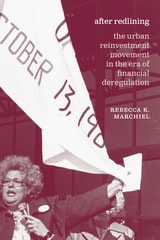
After Redlining
The Urban Reinvestment Movement in the Era of Financial DeregulationRebecca K. Marchiel
University of Chicago Press, 2020
American banks, to their eternal discredit, long played a key role in disenfranchising nonwhite urbanites and, through redlining, blighting the very city neighborhoods that needed the most investment. Banks long showed little compunction in aiding and abetting blockbusting, discrimination, and outright theft from nonwhites. They denied funds to entire neighborhoods or actively exploited them, to the benefit of suburban whites—an economic white flight to sharpen the pain caused by the demographic one.
And yet, the dynamic between banks and urban communities was not static, and positive urban development, supported by banks, became possible. In After Redlining, Rebecca K. Marchiel illuminates how, exactly, urban activists were able to change some banks’ behavior to support investment in communities that they had once abandoned. The leading activists arose in an area hit hard by banks’ discriminatory actions and politics: Chicago’s West Side. A multiracial coalition of low- and moderate-income city residents, this Saul Alinsky–inspired group championed urban reinvestment. And amazingly, it worked: their efforts inspired national action, culminating in the federal Home Mortgage Disclosure Act and the Community Reinvestment Act.
While the battle for urban equity goes on, After Redlining provides a blueprint of hope.
After Redlining
The Urban Reinvestment Movement in the Era of Financial DeregulationRebecca K. Marchiel
University of Chicago Press, 2020
Focusing on Chicago's West Side, After Redlining illuminates how urban activists were able to change banks’ behavior to support investment in communities that they had once abandoned.
American banks, to their eternal discredit, long played a key role in disenfranchising nonwhite urbanites and, through redlining, blighting the very city neighborhoods that needed the most investment. Banks long showed little compunction in aiding and abetting blockbusting, discrimination, and outright theft from nonwhites. They denied funds to entire neighborhoods or actively exploited them, to the benefit of suburban whites—an economic white flight to sharpen the pain caused by the demographic one.
And yet, the dynamic between banks and urban communities was not static, and positive urban development, supported by banks, became possible. In After Redlining, Rebecca K. Marchiel illuminates how, exactly, urban activists were able to change some banks’ behavior to support investment in communities that they had once abandoned. The leading activists arose in an area hit hard by banks’ discriminatory actions and politics: Chicago’s West Side. A multiracial coalition of low- and moderate-income city residents, this Saul Alinsky–inspired group championed urban reinvestment. And amazingly, it worked: their efforts inspired national action, culminating in the federal Home Mortgage Disclosure Act and the Community Reinvestment Act.
While the battle for urban equity goes on, After Redlining provides a blueprint of hope.
Against the Commons
A Radical History of Urban PlanningÁlvaro Sevilla-Buitrago
University of Minnesota Press, 2022
An alternative history of capitalist urbanization through the lens of the commons
Characterized by shared, self-managed access to food, housing, and the basic conditions for a creative life, the commons are essential for communities to flourish and protect spaces of collective autonomy from capitalist encroachment. In a narrative spanning more than three centuries, Against the Commons provides a radical counterhistory of urban planning that explores how capitalism and spatial politics have evolved to address this challenge.
Highlighting episodes from preindustrial England, New York City and Chicago between the 1850s and the early 1900s, Weimar-era Berlin, and neoliberal Milan, Álvaro Sevilla-Buitrago shows how capitalist urbanization has eroded the egalitarian, convivial life-worlds around the commons. The book combines detailed archival research with provocative critical theory to illuminate past and ongoing struggles over land, shared resources, public space, neighborhoods, creativity, and spatial imaginaries.
Against the Commons underscores the ways urbanization shapes the social fabric of places and territories, lending particular awareness to the impact of planning and design initiatives on working-class communities and popular strata. Projecting history into the future, it outlines an alternative vision for a postcapitalist urban planning, one in which the structure of collective spaces is ultimately defined by the people who inhabit them.
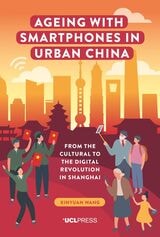
Ageing with Smartphones in Urban China
From the Cultural to the Digital Revolution in ShanghaiXinyuan Wang
University College London, 2023
The current oldest generation in Shanghai was born at a time when the average household could not afford electric lights, but today they can turn their lights off using smartphone apps. Grounded in extensive ethnographic fieldwork in Shanghai, Ageing with Smartphones in Urban China tackles the intersection between the “two revolutions” experienced by the older generation in Shanghai: the contemporary smartphone-based digital revolution and the earlier communist revolutions and argues that we can only understand the smartphone revolution if we first appreciate the long-term consequences of these people’s experiences during the communist revolutions. Supported by detailed ethnographic material, the observations and analysis here provide a panorama view of the social landscape of contemporary China, addressing such topics the digital and everyday life, aging and healthcare, intergenerational relations and family development, community building and grassroots organizations, collective memories, and political attitudes among ordinary Chinese people.
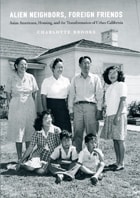
Alien Neighbors, Foreign Friends
Asian Americans, Housing, and the Transformation of Urban CaliforniaCharlotte Brooks
University of Chicago Press, 2009
Between the early 1900s and the late 1950s, the attitudes of white Californians toward their Asian American neighbors evolved from outright hostility to relative acceptance. Charlotte Brooks examines this transformation through the lens of California’s urban housing markets, arguing that the perceived foreignness of Asian Americans, which initially stranded them in segregated areas, eventually facilitated their integration into neighborhoods that rejected other minorities.
Against the backdrop of cold war efforts to win Asian hearts and minds, whites who saw little difference between Asians and Asian Americans increasingly advocated the latter group’s access to middle-class life and the residential areas that went with it. But as they transformed Asian Americans into a “model minority,” whites purposefully ignored the long backstory of Chinese and Japanese Americans’ early and largely failed attempts to participate in public and private housing programs. As Brooks tells this multifaceted story, she draws on a broad range of sources in multiple languages, giving voice to an array of community leaders, journalists, activists, and homeowners—and insightfully conveying the complexity of racialized housing in a multiracial society.

All That Was Not Her
Todd Meyers
Duke University Press, 2022
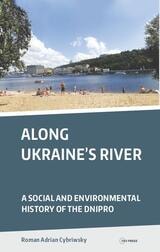
Along Ukraine's River
A Social and Environmental History of the DniproRoman Adrian Cybriwsky
Central European University Press, 2018
The River Dnipro (formerly better known by the Russian name of Dnieper) is intimately linked to the history and identity of Ukraine. Cybriwsky discusses the history of the river, from when it was formed and its many uses and modifications by human agencies from ancient times to the present.
From key vantage points along the river’s course—its source in western Russia, through Belarus and Ukraine, to the Black Sea—interesting stories shed light on past and present life in Ukraine. Scenes set along the river from Russian and Ukrainian literature are evoked, as well as musical compositions and works of art. Topics include the legacy of the region’s cultural ancestors as the Kyivan Rus, the period of Cossack dominion, the epic battles for the river’s bridges in World War II, the building of dams and huge reservoirs by the Soviet Union, and the crisis of Chornobyl (Chernobyl). The author argues that the Dnipro and the farmlands along it are Ukraine’s chief natural resources, and that the country's future depends on putting both to good use.
Written without academic pretence in an informal style with dashes of humor, Along Ukraine's River is illustrated with original line drawings, maps, and photographs.

American Allegory
Lindy Hop and the Racial ImaginationBlack Hawk Hancock
University of Chicago Press, 2013
In American Allegory, Black Hawk Hancock offers an embedded and embodied ethnography that situates dance within a larger Chicago landscape of segregated social practices. Delving into two Chicago dance worlds, the Lindy and Steppin’, Hancock uses a combination of participant-observation and interviews to bring to the surface the racial tension that surrounds white use of black cultural forms. Focusing on new forms of appropriation in an era of multiculturalism, Hancock underscores the institutionalization of racial disparities and offers wonderful insights into the intersection of race and culture in America.
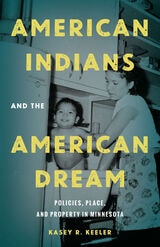
American Indians and the American Dream
Policies, Place, and Property in MinnesotaKasey R. Keeler
University of Minnesota Press, 2023
Understanding the processes and policies of urbanization and suburbanization in American Indian communities
Nearly seven out of ten American Indians live in urban areas, yet studies of urban Indian experiences remain scant. Studies of suburban Natives are even more rare. Today’s suburban Natives, the fastest-growing American Indian demographic, highlight the tensions within federal policies working in tandem to move and house differing groups of people in very different residential locations. In American Indians and the American Dream, Kasey R. Keeler examines the long history of urbanization and suburbanization of Indian communities in Minnesota.
At the intersection of federal Indian policy and federal housing policy, American Indians and the American Dream analyzes the dispossession of Indian land, property rights, and patterns of home ownership through programs and policies that sought to move communities away from their traditional homelands to reservations and, later, to urban and suburban areas. Keeler begins this analysis with the Homestead Act of 1862, then shifts to the Indian Reorganization Act in the early twentieth century, the creation of Little Earth in Minneapolis, and Indian homeownership during the housing bubble of the early 2000s.
American Indians and the American Dream investigates the ways American Indians accessed homeownership, working with and against federal policy, underscoring American Indian peoples’ unequal and exclusionary access to the way of life known as the American dream.
Cover alt text: Vintage photo of Native person bathing smiling child in the sink of a midcentury kitchen. Title in yellow.
American School Reform
What Works, What Fails, and WhyJoseph P. McDonald and the Cities and Schools Research Group
University of Chicago Press, 2014
McDonald and his colleagues lay out several interrelated ideas in what they call a theory of action space. Frequently education policy gets so ambitious that implementing it becomes a near impossibility. Action space, however, is what takes shape when talented educators, leaders, and reformers guide the social capital of civic leaders and the financial capital of governments, foundations, corporations, and other backers toward true results. Exploring these extraordinary collaborations through their lifespans and their influences on future efforts, the authors provide political hope—that reform efforts can work, and that our schools can be made better.
American Value
Migrants, Money, and Meaning in El Salvador and the United StatesDavid Pedersen
University of Chicago Press, 2012

An American Obsession
Science, Medicine, and Homosexuality in Modern SocietyJennifer Terry
University of Chicago Press, 1999
Terry's overarching argument is compelling: that homosexuality served as a marker of the "abnormal" against which malleable, tenuous, and often contradictory concepts of the "normal" were defined. One of the few histories to take into consideration homosexuality in both women and men, Terry's work also stands out in its refusal to erase the agency of people classified as abnormal. She documents the myriad ways that gays, lesbians, and other sexual minorities have coauthored, resisted, and transformed the most powerful and authoritative modern truths about sex. Proposing this history as a "useable past," An American Obsession is an indispensable contribution to the study of American cultural history.
An Artificial History of Natural Intelligence
Thinking with Machines from Descartes to the Digital AgeDavid W. Bates
University of Chicago Press, 2024
We imagine that we are both in control of and controlled by our bodies—autonomous and yet automatic. This entanglement, according to David W. Bates, emerged in the seventeenth century when humans first built and compared themselves with machines. Reading varied thinkers from Descartes to Kant to Turing, Bates reveals how time and time again technological developments offered new ways to imagine how the body’s automaticity worked alongside the mind’s autonomy. Tracing these evolving lines of thought, An Artificial History of Natural Intelligence offers a new theorization of the human as a being that is dependent on technology and produces itself as an artificial automaton without a natural, outside origin.
An Atlantic City Reader
The Rise and Decline of an American ResortLouis J. Parascandola
Rutgers University Press, 2026
As Atlantic City grew to become one of the largest tourist destinations on the East Coast, it loomed ever larger in the imaginations of American writers. Generation upon generation of novelists, journalists, musicians, and poets visited Atlantic City and left with vivid impressions of its kaleidoscopic delights and its seedy underbelly.
This new reader collects all of these diverse perspectives on the city in one place, including accounts of Atlantic City by such famous visitors as Walt Whitman, William Carlos Williams, Fanny Hurst, Arthur Conan Doyle, Damon Runyon, Langston Hughes, Elmore Leonard, and Bruce Springsteen. Arranged chronologically, the anthology traces the city’s history from its humble beginnings as a quiet health resort to its rapid ascent to the world’s playground, its gradual decline, and its hopeful if tenuous future. Together, the pieces in this collection take us inside the city’s glitz, glamor, and gambling palaces, but they also don’t shy away from its troubling histories of racial discrimination, political corruption, and urban decay. Compiling fiction, poetry, drama, memoirs, newspaper stories, and magazine reports, The Atlantic City Reader presents an engaging and multifaceted portrait of this iconic resort town.
Animated Urbanism
Bringing Cities to Smart Digital LifeGillian Rose
University of Minnesota Press, 2027
A critical examination of the digital imagery and visualization tools that mediate urban life
Animated Urbanism explores the ways urban life is increasingly mediated by digital visualization tools, from elaborate marketing productions to specialized techniques of urban planning that rely on the collection of large datasets. By developing a critical vocabulary for these forms of digital imagery, Gillian Rose investigates the implications of using digital technology to manage the spatial and temporal organization of life in cities.
Pushing back against the so-called smartness mandate, which sees urban existence and its infrastructure as necessarily governed by big data, automation, and artificial intelligence, Animated Urbanism is a nuanced examination of the various types of media structuring urban life and their propensity to replicate highly gendered and racialized forms of human embodiment. From smartphone apps to special effects in movies to sophisticated “fly-through” videos of cities created by urban developers, Rose analyzes the corporate imaginaries that are being created, building on the influential theories of Donna Haraway, among others, concerning the interrelation of technology, power, and human life.
While recent digital analysis often focuses on the political economy of tech platforms or the efficacy of data in smart cities, Rose emphasizes the role of human subjectivity in the shifting configurations of these new urban landscapes. With an incisive, feminist approach to the imagery enabled by software and handheld devices, Animated Urbanism invites us to question how human life emerges from these complex entanglements of technology and visual culture.
Retail e-book files for this title are screen-reader friendly with images accompanied by short alt text and/or extended descriptions.
Arabian Oasis City
The Transformation of 'UnayzahBy Soraya Altorki and Donald P. Cole
University of Texas Press, 1989
Vast social change has occurred in the Middle East since the oil boom of the mid-1970s. As the first anthropological study of an urban community in Saudi Arabia since that oil boom, Arabian Oasis City is also the first to document those changes.
Based on extensive interviews and participant observation with both men and women, the authors record and analyze the transformation that has occurred in this ancient oasis city throughout the twentieth century: the creation of the present Saudi Arabian state and of a new national economy based on the export of oil and the economic boom brought about by the dramatic increases in the price of oil following the October 1973 Arab-Israeli War. In addition, the authors reveal the changes brought about by the fall in the price of oil beginning in 1982 and analyze the problems confronting ‘Unayzah in its aftermath.
By demonstrating that the area was not exclusively dominated by tribalism and Bedouin nomads, this empirical case study destroys stereotypical views about Saudi Arabia. Indeed, it proves the existence—prior to the coming of the modern Saudi Arabian state— of surplus agricultural and craft production and the full development of local, regional, and long-distance trade networks. It shows that women, although veiled, played active roles in work outside the household. The social impact of change over the years is, however, profound—especially the gradual replacement of the extended family by the nuclear family, changing patterns of husband-wife relationships, the impact of self-earned income on the status of women, and the emergence of a new middle class of employees and entrepreneurs. Because of the high degree of gender segregation in this area of research, Altorki and Cole give us a fortunate collaboration between a Saudi Arabian female scholar and an American male scholar experienced in research in the Middle East.