Results by title
5 books match the query 'Urban Mayas'
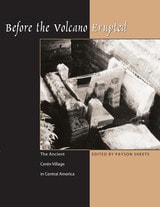
Before the Volcano Erupted
The Ancient Cerén Village in Central AmericaEdited by Payson Sheets
University of Texas Press, 2002
On an August evening around AD 600, residents of the Cerén village in the Zapotitán Valley of what is now El Salvador were sitting down to their nightly meal when ground tremors and loud steam emissions warned of an impending volcanic eruption. The villagers fled, leaving their town to be buried under five meters of volcanic ash and forgotten until a bulldozer uncovered evidence of the extraordinarily preserved town in 1976. The most intact Precolumbian village in Latin America, Cerén has been called the "Pompeii of the New World."
This book presents complete and detailed reports of the excavations carried out at Cerén since 1978 by a multidisciplinary team of archaeologists, ethnographers, volcanologists, geophysicists, botanists, conservators, and others. The book is divided into sections that discuss the physical environment and resources, household structures and economy, special buildings and their uses, artifact analysis, and topical and theoretical issues.
As the authors present and analyze Cerén's houses and their goods, workshops, civic and religious buildings, kitchen gardens, planted fields, and garbage dumps, a new and much clearer picture of how commoners lived during the Maya Classic Period emerges. These findings constitute landmark contributions to the anthropology and archaeology of Central America.
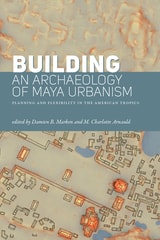
Building an Archaeology of Maya Urbanism
Planning and Flexibility in the American TropicsDamien B. Marken and M. Charlotte Arnauld
University Press of Colorado, 2023
Integrating recent lidar survey data with more traditional excavation and artifact-based archaeological practices, chapters in this volume offer broadened perspectives on the patterns of Maya urban design and planning by viewing bottom-up and self-organizing processes as integral to the form, development, and dissolution of Classic lowland cities alongside potentially centralized civic designs. Full of innovative examples of how to build an archaeology of urbanism that can be applied not just to the lowland Maya and across the region, Building an Archaeology of Maya Urbanism simultaneously improves interpretations of lowland Maya culture history and contributes to empirical and comparative discussions of tropical, non-Western cities worldwide.
Contributors: Divina Perla Barrera, Arianna Campiani, Cyril Castanet, Adrian S. Z. Chase, Lydie Dussol, Sara Dzul Góngora, Keith Eppich, Thomas Garrison, María Rocio González de la Mata, Timothy Hare, Julien Hiquet, Takeshi Inomata, Eva Lemonnier, José Francisco Osorio León, Marilyn Masson, Elsa Damaris Menéndez, Timothy Murtha, Philippe Nondédéo, Keith M. Prufer, Louise Purdue, Francisco Pérez Ruíz, Julien Sion, Travis Stanton, Rodrigo Liendo Stuardo, Karl A. Taube, Marc Testé, Amy E. Thompson, Daniela Triadan

Deciding To Be Legal
A Maya Community in HoustonJacqueline Hagan
Temple University Press, 1994
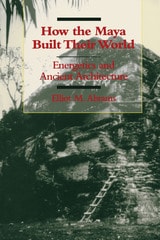
How the Maya Built Their World
Energetics and Ancient ArchitectureBy Elliot M. Abrams
University of Texas Press, 1994
Maya architecture is often described as "massive" and "monumental," but experiments at Copan, Honduras, convinced Elliot Abrams that 300 people could have built one of the large palaces there in only 100 days.
In this groundbreaking work, Abrams explicates his theory of architectural energetics, which involves translating structures into volumes of raw and manufactured materials that are then multiplied by the time required for their production and assembly to determine the labor costs of past construction efforts. Applying this method to residential structures of the Late Classic period (A.D. 700-900) at Copan leads Abrams to posit a six-tiered hierarchic social structure of political decision making, ranging from a stratified elite to low-ranking commoners. By comparing the labor costs of construction and other economic activities, he also prompts a reconsideration of the effects of royal construction demands on commoners.
How the Maya Built Their World will interest a wide audience in New and Old World anthropology, archaeology, architecture, and engineering.
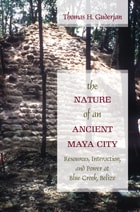
The Nature of an Ancient Maya City
Resources, Interaction, and Power at Blue Creek, BelizeThomas H. Guderjan
University of Alabama Press, 2007
For two millennia, the site now known as Blue Creek in northwestern Belize was a Maya community that became an economic and political center that included some 15,000-20,000 people at its height. Fairly well protected from human destruction, the site offers the full range of city components including monumental ceremonial structures, elite and non-elite residences, ditched agricultural fields, and residential clusters just outside the core. Since 1992, a multi-disciplinary, multi-national research team has intensively investigated Blue Creek in an integrated study of the dynamic structure and functional inter-relationships among the parts of a single Maya city. Documented in coverage by National Geographic, Archaeology magazine, and a documentary film aired on the Discovery Channel, Blue Creek is recognized as a unique site offering the full range of undisturbed architectural construction to reveal the mosaic that was the ancient city. Moving beyond the debate of what constitutes a city, Guderjan’s long-term research reveals what daily Maya life was like.