Results by title
5 books match the query 'Urban ecology (Biology)'
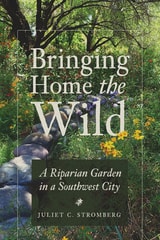
Bringing Home the Wild
A Riparian Garden in a Southwest CityJuliet C. Stromberg
University of Arizona Press, 2023
When living in a large sprawling city, one may feel disconnected and adrift. Finding ways to belong and have positive effects is challenging. In Bringing Home the Wild, botanist Juliet C. Stromberg demonstrates how ecologically guided gardening develops a sense of place, restores connections to nature, and brings joy and meaning to our lives.
This book follows a two-decade journey in ecologically guided gardening on a four-acre irrigated parcel in Phoenix, Arizona, from the perspective of a retired botanist and her science historian partner. Through humor and playful use of language, Bringing Home the Wild not only introduces the plants who are feeding them, buffering the climate, and elevating their moods but also acknowledges the animals and fungi who are pollinating the plants and recycling the waste. Some of the plants featured are indigenous to the American Southwest, while others are part of the biocultural heritage of the cityscape. This book makes the case for valuing inclusive biodiversity and for respectful interactions with all wild creatures, regardless of their historical origin.
As author and partner learn to cohabit with the plants who feed them, calm them, entertain them, and protect them from the increasing heat, their desire to live sustainably, ethically, and close to the land becomes even stronger, revealing the importance of observing, appreciating, and learning from the ecosystems of which we are a part.
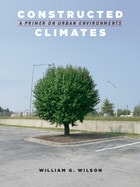
Constructed Climates
A Primer on Urban EnvironmentsWilliam G. Wilson
University of Chicago Press, 2011
As our world becomes increasingly urbanized, an understanding of the context, mechanisms, and consequences of city and suburban environments becomes more critical. Without a sense of what open spaces such as parks and gardens contribute, it’s difficult to argue for their creation and maintenance: in the face of schools needing resources, roads and sewers needing maintenance, and people suffering at the hands of others, why should cities and counties spend scarce dollars planting trees and preserving parks?
In Constructed Climates, ecologist William G. Wilson demonstrates the value of urban green. Focusing specifically on the role of vegetation and trees, Wilson shows the costs and benefits reaped from urban open spaces, from cooler temperatures to better quality ground water—and why it all matters. While Constructed Climates is a work of science, it does not ignore the social component. Wilson looks at low-income areas that have poor vegetation, and shows how enhancing these areas through the planting of community gardens and trees can alleviate social ills. This book will be essential reading for environmentalists and anyone making decisions for the nature and well-being of our cities and citizens.
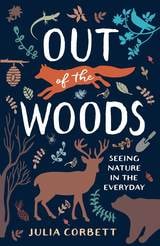
Out of the Woods
Seeing Nature in the EverydayJulia Corbett
University of Nevada Press, 2018
Have you ever wondered about society’s desire to cultivate the perfect lawn, why we view some animals as “good” and some as “bad,” or even thought about the bits of nature inside everyday items–toothbrushes, cell phones, and coffee mugs? In this fresh and introspective collection of essays, Julia Corbett examines nature in our lives with all of its ironies and contradictions by seamlessly integrating personal narratives with morsels of highly digestible science and research. Each story delves into an overlooked aspect of our relationship with nature—insects, garbage, backyards, noise, open doors, animals, and language—and how we cover our tracks.
With a keen sense of irony and humor and an awareness of the miraculous in the mundane, Julia recognizes the contradictions of contemporary life. She confronts the owner of a high-end market who insists on keeping his doors open in all temperatures. Takes us on a trip to a new mall with a replica of a trout stream that once flowed nearby. The phrase “out of the woods” guides us through layers of meaning to a contemplation of grief, remembrance, and resilience.
Out of the Woods leads to surprising insights into the products, practices, and phrases we take for granted in our everyday encounters with nature and encourages us all to consider how we might re-value or reimagine our relationships with nature in our everyday lives.
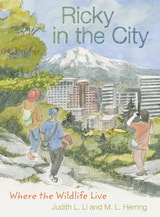
Ricky in the City
Where the Wildlife LiveJudith L. Li
Oregon State University Press, 2019
The kids find insects and reptiles moving about garden patches and bioswales, song birds and squirrels in neighborhood tree canopies, falcons and eagles crossing spacious river floodplains. As they record and map how wildlife and people are connected in these city spaces, they become community scientists, contributing to actual regional databases. After they see the young trees Marcus planted in his neighborhood, the feeders Jenny tends for hummingbirds, and the fascinating wildlife underpasses built in the wetlands, Ricky and Ellie realize there are many ways people actively care for the city’s wildlife.
In this fourth and final story of their award-winning children’s series, M. L. Herring’s vivid pen and watercolor illustrations complement the engaging storytelling of Judith Li. Readers will delight in the journal pages and maps “hand drawn” by Ricky and Ellie at the end of each chapter, while the “Dear Reader” section offers further tips for budding citizen scientists.

Urban Wildlife Habitats
A Landscape PerspectiveLowell W. Adams
University of Minnesota Press, 1994
Urban Wildlife Habitats was first published in 1994. Minnesota Archive Editions uses digital technology to make long-unavailable books once again accessible, and are published unaltered from the original University of Minnesota Press editions.
In cities, towns, and villages, between buildings and parking lots, streets and sidewalks, and polluted streams and rivers, there is ever less space for the "natural," the plants and animals that once were at home across North America. In this first book-length study of the subject, Lowell W. Adams reviews the impact of urban and suburban growth on natural plant and animal communities and reveals how, with appropriate landscape planning and urban development, cities and towns can be made more accommodating for a wide diversity of species, including our own.
Soils and ground surface, air, water, and noise pollution, space and demographics are among the urban characteristics Adams considers in relation to wildlife. He describes changes in the composition and structure of vegetation, as native species are replaced by exotic ones, and shows how, with spreading urbanization of natural habitats, the diversity of species of plants and animals almost always declines, although the density of a few species increases. Adams contends, however, that it is possible for a wide variety of species to coexist in the metropolitan environment, and he cites a growing interest in the practice of "natural landscaping," which emphasizes the use of native species and considers the structure, pattern, and species composition of vegetation as it relates to wildlife needs. Urban habitats vary from small city parks in densely built downtowns to suburbs with large yards and considerable open space. Adams discusses the opportunities these areas—along with school yards, hospital grounds, cemeteries, individual residences, and vacant lots—provide for judicious wildlife management and for the salutary interaction of people with nature.Lowell W. Adams is vice president of the National Institute for Urban Wildlife in Columbia, Maryland.