Results by title
9 books match the query 'Urban transportation'
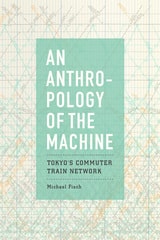
An Anthropology of the Machine
Tokyo's Commuter Train NetworkMichael Fisch
University of Chicago Press, 2018
An Anthropology of the Machine is a creative ethnographic study of the culture, history, and experience of commuting in Tokyo. At the same time, it is a theoretically ambitious attempt to think through our very relationship with technology and our possible ecological futures. Fisch provides an unblinking glimpse into what it might be like to inhabit a future in which more and more of our infrastructure—and the planet itself—will have to operate beyond capacity to accommodate our ever-growing population.

Industrial Relations in Urban Transportation
Emerson P. Schmidt
University of Minnesota Press, 1937
Industrial Relations in Urban Transportation was first published in 1937. Minnesota Archive Editions uses digital technology to make long-unavailable books once again accessible, and are published unaltered from the original University of Minnesota Press editions.
In the present era of industrial warfare and violence, this book points a "middle way" in employer-employee relations. It describes the remarkable achievement of the Amalgamated Association of Street, Electric Railway, and Motor Coach Employees of America, which for nearly fifty years has used the machinery of arbitration to settle all labor disputes without resort to strikes. Herein also is probably the first attempt to measure on a nation-wide scale the influence of a union in raising wages and reducing hours.
But this is much more than the story of a successful union. It is a complete history of urban transportation in the United States — the first such history to be written. It deals with technological, financial, and regulatory, as well as labor, aspects. The characteristics of transportation work and the type of men attracted to it are carefully analyzed, and there is a chapter devoted to the late nineteenth century conditions which gave birth to unionism.
This readable study will be of particular interest to owners, managers, and employees of local transportation systems, to investment bankers and investors, regulatory commissions and city aldermen, public mediators and arbitrators of labor disputes, and students of economic history.
Low Carbon Mobility for Future Cities
Principles and applicationsHussein Dia
The Institution of Engineering and Technology, 2017
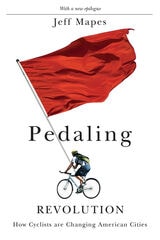
Pedaling Revolution
How Cyclists Are Changing American CitiesJeff Mapes
Oregon State University Press, 2009
In a world of increasing traffic congestion, a grassroots movement is carving out a niche for bicycles on city streets. Pedaling Revolution explores the growing bike culture that is changing the look and feel of cities, suburbs, and small towns across North America.
From traffic-dodging bike messengers to tattooed teenagers on battered bikes, from riders in spandex to well-dressed executives, ordinary citizens are becoming transportation revolutionaries. Jeff Mapes traces the growth of bicycle advocacy and explores the environmental, safety, and health aspects of bicycling. He rides with bicycle advocates who are taming the streets of New York City, joins the street circus that is Critical Mass in San Francisco, and gets inspired by the every-day folk pedaling in Amsterdam, the nirvana of American bike activists. Chapters focused on big cities, college towns, and America’s most successful bike city, Portland, show how cyclists, with the encouragement of local officials, are claiming a share of the valuable streetscape.
“A growing number of Americans, mounted on their bicycles like some new kind of urban cowboy, are mixing it up with swift, two-ton motor vehicles as they create a new society on the streets. They’re finding physical fitness, low-cost transportation, environmental purity—and, still all too often, Wild West risks of sudden death or injury.” —from the introduction
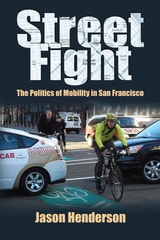
Street Fight
The Politics of Mobility in San FranciscoJason Henderson
University of Massachusetts Press, 2013
Faced with intolerable congestion and noxious pollution, cities around the world are rethinking their reliance on automobiles. In the United States a loosely organized livability movement seeks to reduce car use by reconfiguring urban space into denser, transit-oriented, walkable forms, a development pattern also associated with smart growth and new urbanism. Through a detailed case study of San Francisco, Jason Henderson examines how this is not just a struggle over what type of transportation is best for the city, but a series of ideologically charged political fights over issues of street space, public policy, and social justice.
Historically San Francisco has hosted many activist demonstrations over its streets, from the freeway revolts of the 1960s to the first Critical Mass bicycle rides decades later. Today the city's planning and advocacy establishment is changing zoning laws to limit the number of parking spaces, encouraging new car-free housing near transit stations, and applying “transit first” policies, such as restricted bus lanes. Yet Henderson warns that the city's accomplishments should not be romanticized. Despite significant gains by livability advocates, automobiles continue to dominate the streets, and the city's financially strained bus system is slow and often unreliable.
Both optimistic and cautionary, Henderson argues that ideology must be understood as part of the struggle for sustainable cities and that three competing points of view—progressive, neoliberal, and conservative—have come to dominate the contemporary discourse about urban mobility. Consistent with its iconic role as an incubator of environmental, labor, civil rights, and peace movements, San Francisco offers a compelling example of how the debate over sustainable urban transportation may unfold both in the United States and globally.
The Cycling City
Bicycles and Urban America in the 1890sEvan Friss
University of Chicago Press, 2015
The Cycling City is a sharp history of the bicycle’s rise and fall in the late nineteenth century. In the 1890s, American cities were home to more cyclists, more cycling infrastructure, more bicycle friendly legislation, and a richer cycling culture than anywhere else in the world. Evan Friss unearths the hidden history of the cycling city, demonstrating that diverse groups of cyclists managed to remap cities with new roads, paths, and laws, challenge social conventions, and even dream up a new urban ideal inspired by the bicycle. When cities were chaotic and filthy, bicycle advocates imagined an improved landscape in which pollution was negligible, transportation was silent and rapid, leisure spaces were democratic, and the divisions between city and country were blurred. Friss argues that when the utopian vision of a cycling city faded by the turn of the century, its death paved the way for today’s car-centric cities—and ended the prospect of a true American cycling city ever being built.
The Great American Transit Disaster
A Century of Austerity, Auto-Centric Planning, and White FlightNicholas Dagen Bloom
University of Chicago Press, 2023
Many a scholar and policy analyst has lamented American dependence on cars and the corresponding lack of federal investment in public transportation throughout the latter decades of the twentieth century. But as Nicholas Dagen Bloom shows in The Great American Transit Disaster, our transit networks are so bad for a very simple reason: we wanted it this way.
Focusing on Baltimore, Atlanta, Chicago, Detroit, Boston, and San Francisco, Bloom provides overwhelming evidence that transit disinvestment was a choice rather than destiny. He pinpoints three major factors that led to the decline of public transit in the United States: municipal austerity policies that denied most transit agencies the funding to sustain high-quality service; the encouragement of auto-centric planning; and white flight from dense city centers to far-flung suburbs. As Bloom makes clear, these local public policy decisions were not the product of a nefarious auto industry or any other grand conspiracy—all were widely supported by voters, who effectively shut out options for transit-friendly futures. With this book, Bloom seeks not only to dispel our accepted transit myths but hopefully to lay new tracks for today’s conversations about public transportation funding.
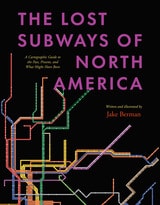
The Lost Subways of North America
A Cartographic Guide to the Past, Present, and What Might Have BeenJake Berman
University of Chicago Press, 2023
A visual exploration of the transit histories of twenty-three US and Canadian cities.
Every driver in North America shares one miserable, soul-sucking universal experience—being stuck in traffic. But things weren’t always like this. Why is it that the mass transit systems of most cities in the United States and Canada are now utterly inadequate?
The Lost Subways of North America offers a new way to consider this eternal question, with a strikingly visual—and fun—journey through past, present, and unbuilt urban transit. Using meticulous archival research, cartographer and artist Jake Berman has successfully plotted maps of old train networks covering twenty-three North American metropolises, ranging from New York City’s Civil War–era plan for a steam-powered subway under Fifth Avenue to the ultramodern automated Vancouver SkyTrain and the thousand-mile electric railway system of pre–World War II Los Angeles. He takes us through colorful maps of old, often forgotten streetcar lines, lost ideas for never-built transit, and modern rail systems—drawing us into the captivating transit histories of US and Canadian cities.
Berman combines vintage styling with modern printing technology to create a sweeping visual history of North American public transit and urban development. With more than one hundred original maps, accompanied by essays on each city’s urban development, this book presents a fascinating look at North American rapid transit systems.
The Thirty-Year War
A History of Detroit's Streetcars, 1892–1922Neil J. Lehto
Michigan State University Press, 2017