Results by title
19 books match the query 'VERSE'
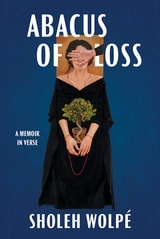
Abacus of Loss
A Memoir in VerseSholeh Wolpé
University of Arkansas Press, 2022
lbert Einstein said, “Not everything that can be counted counts, and not everything that counts can be counted.” It is in this vein that Sholeh Wolpé’s mesmerizing memoir in verse unfolds. In this lyrical and candid work, her fifth collection of poems, Wolpé invokes the abacus as an instrument of remembering. Through different countries and cultures, she carries us bead by bead on a journey of loss and triumph, love and exile. In the end, the tally is insight, not numbers, and we arrive at a place where nothing is too small for gratitude.

Book and Verse
A Guide to Middle English Biblical LiteratureJames H. Morey
University of Illinois Press, 2000
Book and Verse is an indispensable guide to the variety and extent of biblical literature in England, exclusive of drama and the Wycliffite Bible that appeared between the twelfth and the fifteenth centuries. Entries provide detailed information on how much of what parts of the Bible appear in Middle English and where this biblical material can be found. Comprehensive indexing by name, keyword, and biblical verse allows a researcher to find, for example, all the occurrences of the Flood Story or of the encounter between Elijah and the Widow of Sarephta. An invaluable resource, Book and Verse provides the first easy access to the "popular Bible" assembled before and after John Wyclif's translation of the Vulgate into English.
Crime in Verse
The Poetics of Murder in the Victorian EraEllen L. O’Brien
The Ohio State University Press, 2008
Gentle Flame
The Life and Verse of Dudley, Fourth Lord NorthDale B. J. Randall
Duke University Press, 1983
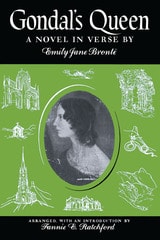
Gondal's Queen
A Novel in VerseBy Emily Jane Brontë
University of Texas Press, 1955
In Gondal’s Queen, Fannie Elizabeth Ratchford presents a cycle of eighty-four poems by Emily Jane Brontë, for the first time arranged in logical sequence, to re-create the “novel in verse” which Emily wrote about their beloved mystical kingdom of Gondal and its ruler, Augusta Geraldine Almeda, who brought tragedy to those who loved her.
Thanks to previous publications by Ratchford, the imaginative world of Gondal is well known not only to Brontë scholars but also to general readers. Only in the present book, however, with Emily’s lovely poems restored to the setting which gave them being, can the full impact of this extraordinary literary creation be realized.
The life story of Gondal’s Queen, from portentous birth to tragic death, is set in a world compounded of dark Gothic romance and Byronic extravagance; yet out of it emerges not only a real country of wild moor sheep and piercingly beautiful nights but also the portrait of a real woman, whose doom was wrought not by the stars but by the clashing complications of her own nature.
In A.G.A. (the appellation most usually applied to the Queen), Emily Brontë created a personality, not a puppet reciting lovely lines. And Ratchford, in reconstructing her story, has re-affirmed the dignity, beauty, and richness of Emily’s poetry.
Gondal’s Queen is the end of a long trail of research and literary detection which has led Ratchford to all known Brontë documentary sources. This quest was originally stimulated by curiosity over a tiny booklet signed, “C. Brontë, June 29th, 1837,” in the Wrenn Library at the University of Texas at Austin. Ratchford’s intense and astonishingly fruitful interest in the Brontës had its origin in her attempt to unravel the fascinating puzzle presented by this little book, which seemed to be merely a series of childish vignettes held together by “a shadow of a common character” and a “tendency toward a unified plot.”
Bit by bit, Ratchford assembled clues from manuscripts and obscure publications until the significance of the play world of the Brontë children began to emerge. In spite of the fact that the Brontës had been the subject of the liveliest literary speculation since their deaths, it remained for Ratchford to establish the importance of their juvenile writings to the later writings of Charlotte. In successive publications she presented the accumulating evidence. For a time her curiosity was centered on Charlotte and the group, but it finally became focused on Emily through a manuscript journal fragment which fortunately came to hand.
Unlike Charlotte, Emily left no prose works from her childhood. But it is apparent from journal entries and birthday notes written by Emily and Anne (whose shared creation Gondal was) not only that the two younger Brontës lived in and sustained daily an imaginary world which had evolved from the earlier play of the four children together, but also that they had written separately voluminous histories and “novels” about it. Of Emily’s vast Gondal literature, only a small body of verse has survived, poems originally intended for no eye but her own and possibly Anne’s. But it is clear that Gondal was not only Emily Brontë’s childhood dream world but also the major preoccupation of her adult creative life.
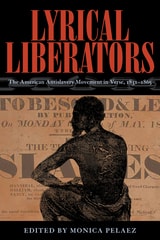
Lyrical Liberators
The American Antislavery Movement in Verse, 1831–1865Monica Pelaez
Ohio University Press, 2018
Before Black Lives Matter and Hamilton, there were abolitionist poets, who put pen to paper during an era when speaking out against slavery could mean risking your life. Indeed, William Lloyd Garrison was dragged through the streets by a Boston mob before a planned lecture, and publisher Elijah P. Lovejoy was fatally shot while defending his press from rioters. Since poetry formed a part of the cultural, political, and emotional lives of readers, it held remarkable persuasive power. Yet antislavery poems have been less studied than the activist editorials and novels of the time.
In Lyrical Liberators, Monica Pelaez draws on unprecedented archival research to recover these poems from the periodicals—Garrison’s Liberator, Frederick Douglass’s North Star, and six others—in which they originally appeared. The poems are arranged by theme over thirteen chapters, a number that represents the amendment that finally abolished slavery in 1865. The book collects and annotates works by critically acclaimed writers, commercially successful scribes, and minority voices including those of African Americans and women.
There is no other book like this. Sweeping in scope and passionate in its execution, Lyrical Liberators is indispensable for scholars and teachers of American literature and history, and stands as a testimony to the power of a free press in the face of injustice.
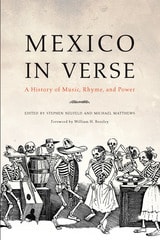
Mexico in Verse
A History of Music, Rhyme, and PowerEdited by Stephen Neufeld and Michael Matthews; Foreword by William H. Beezley
University of Arizona Press, 2015
Focusing on modern Mexico, from 1840 to the 1980s, this volume examines the cultural venues in which people articulated their understanding of the social, political, and economic change they witnessed taking place during times of tremendous upheaval, such as the Mexican-American War, the Porfiriato, and the Mexican Revolution. The words of diverse peoples—people of the street, of the field, of the cantinas—reveal the development of the modern nation. Neufeld and Matthews have chosen sources so far unexplored by Mexicanist scholars in order to investigate the ways that individuals interpreted—whether resisting or reinforcing—official narratives about formative historical moments.
The contributors offer new research that reveals how different social groups interpreted and understood the Mexican experience. The collected essays cover a wide range of topics: military life, railroad accidents, religious upheaval, children’s literature, alcohol consumption, and the 1985 earthquake. Each chapter provides a translated song or poem that encourages readers to participate in the interpretive practice of historical research and cultural scholarship. In this regard, Mexico in Verse serves both as a volume of collected essays and as a classroom-ready primary document reader.

Not God
A Play in VerseMarc J. Straus
Northwestern University Press, 2006
Poetry's Afterlife
Verse in the Digital AgeKevin Stein
University of Michigan Press, 2010
"The great pleasure of this book is the writing itself. Not only is it free of academic and ‘lit-crit' jargon, it is lively prose, often deliciously witty or humorous, and utterly contemporary. Poetry's Afterlife has terrific classroom potential, from elementary school teachers seeking to inspire creativity in their students, to graduate students in MFA programs, to working poets who struggle with the aesthetic dilemmas Stein elucidates, and to teachers of poetry on any level."
--- Beckian Fritz Goldberg, Arizona State University
"Kevin Stein is the most astute poet-critic of his generation, and this is a crucial book, confronting the most vexing issues which poetry faces in a new century."
---David Wojahn, Virginia Commonwealth University
At a time when most commentators fixate on American poetry's supposed "death," Kevin Stein's Poetry's Afterlife instead proposes the vitality of its aesthetic hereafter. The essays of Poetry's Afterlife blend memoir, scholarship, and personal essay to survey the current poetry scene, trace how we arrived here, and suggest where poetry is headed in our increasingly digital culture. The result is a book both fetchingly insightful and accessible. Poetry's spirited afterlife has come despite, or perhaps because of, two decades of commentary diagnosing American poetry as moribund if not already deceased. With his 2003 appointment as Illinois Poet Laureate and his forays into public libraries and schools, Stein has discovered that poetry has not given up its literary ghost. For a fated art supposedly pushing up aesthetic daisies, poetry these days is up and about in the streets, schools, and universities, and online in new and compelling digital forms. It flourishes among the people in a lively if curious underground existence largely overlooked by national media. It's this second life, or better, Poetry's Afterlife, that his book examines and celebrates.
Kevin Stein is Caterpillar Professor of English and Director of the Creative Writing Program at Bradley University and has served as Illinois Poet Laureate since 2003, having assumed the position formerly held by Gwendolyn Brooks and Carl Sandburg. He is the author of numerous books of poetry and criticism.
digitalculturebooksis an imprint of the University of Michigan Press and the Scholarly Publishing Office of the University of Michigan Library dedicated to publishing innovative and accessible work exploring new media and their impact on society, culture, and scholarly communication. Visit the website at www.digitalculture.org.
Revolutions in Verse
The Medium of Russian ModernismIsobel Palmer
Northwestern University Press, 2025
How modernist interartistic experimentation and the proliferation of new media technologies inspired fresh insights into poetry
Isobel Palmer spotlights Russian modernist poets’ and formalist theorists’ conscious engagement with formal convention, showing how their efforts were tied up with broader attempts in the early Soviet era to understand and articulate the nature of poetry and its most characteristic devices. Returning to critical debates around poetic encounters with three key aesthetic categories—rhythm, image, and voice—Palmer unpacks the period’s deeper interest in the material bases of poetic speech itself. Through fresh, incisive readings of canonical poets and theorists, from Andrei Bely and Vladimir Mayakovsky to Yury Tynianov and Viktor Shklovsky, Revolutions in Verse: The Medium of Russian Modernism explores the proliferation of interartistic experiments and the emergence of new media technologies that made poetry visible as a medium in its own right.
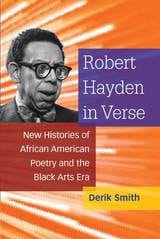
Robert Hayden in Verse
New Histories of African American Poetry and the Black Arts EraDerik Smith
University of Michigan Press, 2018
This book sheds new light on the work of Robert Hayden (1913–80) in response to changing literary scholarship. While Hayden’s poetry often reflected aspects of the African American experience, he resisted attempts to categorize his poetry in racial terms. This fresh appreciation of Hayden’s work recontextualizes his achievements against the backdrop of the Black Arts Movement and traces his influence on contemporary African American poets. Placing Hayden at the heart of a history of African American poetry and culture spanning the Harlem Renaissance to the Hip-Hop era, the book explains why Hayden is now a canonical figure in 20th-century American literature.
In deep readings that focus on Hayden’s religiousness, class consciousness, and historical vision, author Derik Smith inverts earlier scholarly accounts that figure Hayden as an outsider at odds with the militancy of the Black Arts movement. Robert Hayden in Verse offers detailed descriptions of the poet’s vigorous contributions to 1960s discourse about art, modernity, and blackness to show that the poet was, in fact, an earnest participant in Black Arts-era political and aesthetic debates.
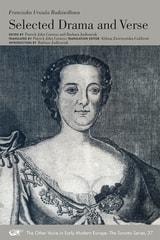
Selected Drama and Verse
Franciszka Urszula Radziwillowa
Iter Press, 2015
Self-Evidence
A Selection of Verse, 1977-1997Pamela White Hadas
Northwestern University Press, 1997
Pamela White Hadas won enthusiastic recognition for her early books of poetry, Designing Women and Beside Herself. In Self-Evidence, she selects the best of her published work and combines it with poems never before collected. This collection contains legendary, mythic, historical, and imaginary characters--Lilith, Pocahontas, Simone Weil, the wives of Watergate, a circus performer, and others. With playful originality and virtuoso voicing, Hadas weaves breathtaking tapestries of women's loves and labors.

St. Austin Review, Verse in Adversity
Poetry & Modernity, May/June 2016, Vol. 16, No. 3Joseph Pearce
St. Augustine's Press, 2016
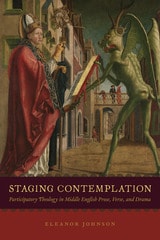
Staging Contemplation
Participatory Theology in Middle English Prose, Verse, and DramaEleanor Johnson
University of Chicago Press, 2018
Yet, in this groundbreaking new book, Eleanor Johnson argues instead for the pervasiveness and accessibility of contemplative works to medieval audiences. By drawing together ostensibly diverse literary genres—devotional prose, allegorical poetry, cycle dramas, and morality plays—Staging Contemplation paints late Middle English contemplative writing as a broad genre that operated collectively and experientially as much as through radical individual disengagement from the world. Johnson further argues that the contemplative genre played a crucial role in the exploration of the English vernacular as a literary and theological language in the fifteenth century, tracing how these works engaged modes of disfluency—from strained syntax and aberrant grammar, to puns, slang, code-switching, and laughter—to explore the limits, norms, and potential of English as a devotional language. Full of virtuoso close readings, this book demonstrates a sustained interest in how poetic language can foster a participatory experience of likeness to God among lay and devotional audiences alike.
The Centenary Edition of the Works of Nathaniel Hawthorne
MISCELLANEOUS PROSE AND VERSENathaniel Hawthorne
The Ohio State University Press, 1995
The Monster I Am Today
Leontyne Price and a Life in VerseKevin Simmonds
Northwestern University Press, 2021
Structured operatically into overture, acts, and postlude, The Monster I Am Today guides the reader through associative shifts from arias like “weather events” and Price’s forty-two-minute final ovation to memories of Simmonds’s coming of age in New Orleans. As he melds lyric forms with the biography of one of classical music’s greatest virtuosos, Simmonds composes a duet that spotlights Price’s profound influence on him as a person and an artist: “That’s how I hear: Her.”

Under 25
Duke Narrative and Verse, 1945–1962: A Collection of Short Stories and Verse by Sixteen Duke AuthorsWilliam M. Blackburn, ed.
Duke University Press, 0
Watercolor Women Opaque Men
A Novel in VerseAna Castillo, introduction by Carmen Tafolla
Northwestern University Press, 2017
In this updated edition of Ana Castillo’s celebrated novel in verse, featuring a new introduction by Poet Laureate of Texas Carmen Tafolla, we revisit the story’s spirited heroine, known only as “Ella” or “She,” as she takes us through her own epic journey of self-actualization as an artist and a woman. With a remarkable combination of tenderness, lyricism, wicked humor, and biting satire, Castillo dramatizes Ella’s struggle through poverty as a Chicano single mother at the threshold of the twenty-first century, fighting for upward mobility while trying to raise her son to be independent and self-sufficient. Urged on by the gods of the ancients, Ella’s life interweaves with those of others whose existences are often neglected, even denied, by society’s status quo. Castillo’s strong rhythmic voice and exploration of such issues as love, sexual orientation, and cultural identity will resonate with readers today as much as they did upon the book’s original publication more than ten years ago. This expanded edition also includes a short preface by the author, as well as a glossary, a reader’s guide, and a list of additional suggested readings.