Results by title
4 books match the query 'Vichy'
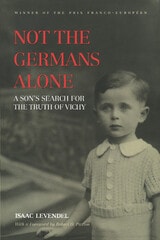
Not the Germans Alone
A Son's Search for the Truth of VichyIsaac Levendel
Northwestern University Press, 2000
Winner of the Prix Franco-Européen
On the eve of D-Day, Isaac Levendel's mother left her hiding place on a farm in southern France and never returned. After 40 years of silence and torment, he returned to France in 1990 determined to find out what had happened. This is the story of how, with perseverance, luck, and official help, he gained access to secret wartime documents laying bare the details of French collaboration-and the truth about his mother's fate.
On the eve of D-Day, Isaac Levendel's mother left her hiding place on a farm in southern France and never returned. After 40 years of silence and torment, he returned to France in 1990 determined to find out what had happened. This is the story of how, with perseverance, luck, and official help, he gained access to secret wartime documents laying bare the details of French collaboration-and the truth about his mother's fate.
[more]
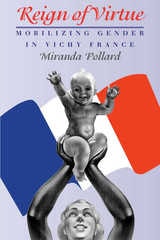
Reign of Virtue
Mobilizing Gender in Vichy FranceMiranda Pollard
University of Chicago Press, 1998
In Reign of Virtue, Miranda Pollard explores the effects of military defeat and Nazi occupation on French articulations of gender in wartime France.
Drawing on governmental archives, historical texts, and propaganda, Pollard explores what most historians have ignored: the many ways in which Vichy's politicians used gendered images of work, family, and sexuality to restore and maintain political and social order. She argues that Vichy wanted to return France to an illustrious and largely mythical past of harmony, where citizens all knew their places and fulfilled their responsibilities, where order prevailed. The National Revolution, according to Pollard, replaced the ideals of liberty, equality, and fraternity with work, family, and fatherland, making the acceptance of traditional masculine and feminine roles a key priority. Pollard shows how Vichy's policies promoted the family as the most important social unit of a new France and elevated married mothers to a new social status even as their educational, employment, and reproductive rights were strictly curtailed.
Drawing on governmental archives, historical texts, and propaganda, Pollard explores what most historians have ignored: the many ways in which Vichy's politicians used gendered images of work, family, and sexuality to restore and maintain political and social order. She argues that Vichy wanted to return France to an illustrious and largely mythical past of harmony, where citizens all knew their places and fulfilled their responsibilities, where order prevailed. The National Revolution, according to Pollard, replaced the ideals of liberty, equality, and fraternity with work, family, and fatherland, making the acceptance of traditional masculine and feminine roles a key priority. Pollard shows how Vichy's policies promoted the family as the most important social unit of a new France and elevated married mothers to a new social status even as their educational, employment, and reproductive rights were strictly curtailed.
[more]
Theater, War, and Memory in Crisis
Vichy, Algeria, the AftermathJohn Ireland
University of Michigan Press, 2025
Theater, War, and Memory in Crisis explores how French and Algerian dramatists have engaged with two traumatic events that continue to haunt France: the German occupation and Vichy government from 1940 to 1944 and the Algerian War from 1954 to 1962. John Ireland’s investigation is guided by one central question: can theater take on issues of violence, war trauma, and conflicted memory in a fundamentally different way from archival forms of culture such as memoirs, narrative fiction, and film? Throughout the twentieth century, French cultural anthropologists, classicists, and social scientists repeatedly revisited links between archaic religious ritual, the practice of sacrifice, and Greek tragedy as attempts to understand, regulate, and mitigate the violence of human conflict and war. Ireland argues that contemporary French playwrights dealing with war trauma and contested memory were influenced by aspects of this research that foregrounded the core virtues of oral culture: presence and the present, the “here and now” that also regulate theatrical performance. That connection to the present encouraged dramatists and performance artists to make “live” historiographical contributions to reverberating, unresolved history but also revived perennial therapeutic values of oral culture that evolved in ancient Greece. Theater, War, and Memory in Crisis brings original readings of canonical authors like Jean-Paul Sartre, Jean Genet, Bernard-Marie Koltès, and Kateb Yacine into dialogue with non-canonical dramatists such as Armand Gatti, Liliane Atlan, and Noureddine Aba.
[more]
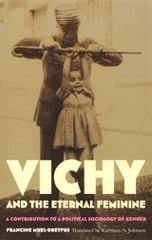
Vichy and the Eternal Feminine
A Contribution to a Political Sociology of GenderFrancine Muel-Dreyfus
Duke University Press, 2001
In this nuanced history of occupied France, Francine Muel-Dreyfus presents a powerful examination of the political and social construction of gender under the Vichy regime. Arguing that the regime used symbolic violence to reshape a liberal culture once based on individual rights into one of deference to hierarchical authority, Muel-Dreyfus shows how Vichy invoked theories of “natural” gender inequality and “eternal” opposition between the masculine and the feminine to justify women’s legal and social subordination, and how these ideologies were incorporated into the French woman’s sense of self.
Drawing on an extensive body of legislative, religious, educational, medical, and literary texts, Muel-Dreyfus examines how the Vichy regime brutally resurrected the gender politics that had been rejected during France’s social struggles in the 1930s. Strikingly, she reveals how this resurrection in turn fed into racial politics: childless women, for instance, and those who had abortions were construed—like Jews—as threats to France’s racial “purity.” With its atendant patterns of social inclusion and exclusion that were deeply rooted in the political and cultural history of the Third Republic, Muel-Dreyfus claims, a pervasive range of gendered metaphors helped to structure the very laws and policies of the Vichy regime.
The French language edition of this book was published in 1996 to wide acclaim. Contributing to theories about the role of gender in political philosophy, to the cultural anthropology of symbolic representation, and to our understanding of the history of fascism, Vichy and the Eternal Feminine will appeal to French, European, and twentieth-century historians; students and scholars of gender and racial studies; political scientists; and anthropologists.
[more]