Results by title
24 books match the query 'Victoria, 1837-1901'
Autobiography
Narrative of TransformationCarolyn A. Barros
University of Michigan Press, 1997
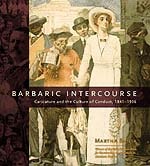
Barbaric Intercourse
Caricature and the Culture of Conduct, 1841-1936Martha Banta
University of Chicago Press, 2003
Banta also deals extensively with London's Punch, a sharp critic of American nationalism, and draws from images and writings in magazines as diverse as Puck,The Crisis,Harper's Weekly, and The International Socialist Review. Orchestrating a wealth of material, including reproductions of rarely seen political cartoons, she offers a richly layered account of the cultural struggles of the age, from contests over immigration and the role of the New Negro in American society, to debates over Wall Street greed, women's suffrage, and the moral consequences of Western expansionism.
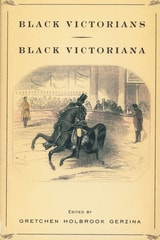
Black Victorians / Black Victoriana
Edited by Gretchen Holbrook Gerzina
Rutgers University Press, 2003
The essays taken as a whole also highlight prevailing Victorian attitudes toward race by focusing on the ways in which empire building spawned a "subculture of blackness" consisting of caricature, exhibition, representation, and scientific racism absorbed by society at large. This misrepresentation made it difficult to be both black and British while at the same time it helped to construct British identity as a whole. Covering many topics that detail the life of blacks during this period, Black Victorians/Black Victoriana will be a landmark contribution to the emergent field of black history in England.
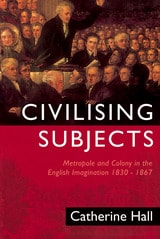
Civilising Subjects
Metropole and Colony in the English Imagination 1830-1867Catherine Hall
University of Chicago Press, 2002
Hall uses the stories of two groups of Englishmen and -women to explore British self-constructions both in the colonies and at home. In Jamaica, a group of Baptist missionaries hoped to make African-Jamaicans into people like themselves, only to be disappointed when the project proved neither simple nor congenial to the black men and women for whom they hoped to fashion new selves. And in Birmingham, abolitionist enthusiasm dominated the city in the 1830s, but by the 1860s, a harsher racial vocabulary reflected a new perception of the nonwhite subjects of empire as different kinds of men from the "manly citizens" of Birmingham.
This absorbing study of the "racing" of Englishness will be invaluable for imperial and cultural historians.
Functions of Victorian Culture at the Present Time
Christine L. Krueger
Ohio University Press, 2002
Genre of Autobiography in Victorian Literature
Clinton Machann
University of Michigan Press, 1995

In the Nineties
John Stokes
University of Chicago Press, 1990
Spurning fixed boundaries, Stokes relates the controversial topics of the day—the status of the "New Journalism," the "degenerative" influence of Impressionist painting, the dubious morality of the music hall, the urgent need for prison reform, and the prevalence of suicide—to primary literary texts, such as The Ballad of Reading Gaol, The Importance of Being Earnest, Jude the Obscure, and Portrait of a Lady. And in the process, he explores crucial areas of sociological and psychological interest: criminality, sexuality, madness, and "morbidity."
Each of the book's six chapters opens with a look at the correspondence columns of daily newspapers and goes on, with a keen eye for the hidden link, to pursue a particular theme. Locations shift from Leicester Square and the Thames embankment to the Normandy coast and the Paris morgue and feature, along with famous names, a lesser known company of acrobats, convicts, aesthetes, "philistines," and mysterious suicides.
Nearly a century later, John Stokes's unrivalled knowledge of how the arts actually functioned in the nineties makes this book a major contribution to modern cultural studies.
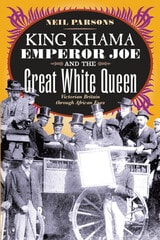
King Khama, Emperor Joe, and the Great White Queen
Victorian Britain through African EyesNeil Parsons
University of Chicago Press, 1997
The chiefs initially went to England to persuade Queen Victoria not to give their lands to ruthless Rhodes and his British South Africa Company. Abandoned by the Secretary of State for the Colonies, Joseph Chamberlain, and denied an audience with the queen, the three rulers decided to tour the British Isles to plead their case to the populace. Appealing to the middle-class morality of Victorian society, the chiefs were remarkably successful in gaining support, eventually swaying Chamberlain into drafting the agreement that secured their territories against the encroachment of Rhodesia.
Historian Neil Parsons has reconstructed this journey with the help of African archival materials and news clippings from British papers, garnered from the clippings service the chiefs had the foresight to employ. In equal parts narrative of pilgrimage, voyage of discovery, and colonial resistance, King Khama, Emperor Joe, and the Great White Queen provides a view from the other side of colonialism and imperialism. It demonstrates the nuances of cultural and religious interaction between Africans and Europeans, and it does so with the richness and depth of a fully realized novel.
Love among the Poets
The Victorian Poetics of IntimacyPearl Chaozon Bauer; Erik Gray
Ohio University Press, 2024
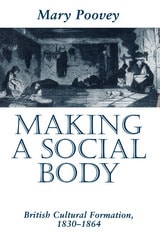
Making a Social Body
British Cultural Formation, 1830-1864Mary Poovey
University of Chicago Press, 1995
Poovey illuminates the ways literary genres, such as the novel, and innovations in social thought, such as statistical thinking and anatomical realism, helped separate social concerns from the political and economic domains. She then discusses the influence of the social body concept on Victorian ideas about the role of the state, examining writings by James Phillips Kay, Thomas Chalmers, and Edwin Chadwick on regulating the poor. Analyzing the conflict between Kay's idea of the social body and Babbage's image of the social machine, she considers the implications of both models for the place of Victorian women. Poovey's provocative readings of Disraeli's Coningsby, Gaskell's Mary Barton, and Dickens's Our Mutual Friend show that the novel as a genre exposed the role gender played in contemporary discussions of poverty and wealth.
Making a Social Body argues that gender, race, and class should be considered in the context of broader concerns such as how social authority is distributed, how institutions formalize knowledge, and how truth is defined.
PLOTS OF OPPORTUNITY
REPRESENTING CONSPIRACY IN VICTORIAN ENGLANDAlbert D. Pionke
The Ohio State University Press, 2004
The working classes, colonial subjects, European nationalists, and Roman Catholics—these groups generated intense anxiety for Victorian England’s elite public, which often responded by accusing them of being dangerous conspirators. Bringing together a wide range of literary and historical evidence, Albert D. Pionke argues that the pejorative meanings attached to such opportunistic accusations of conspiracy were undermined by the many valorized versions of secrecy in Victorian society.
After surveying England’s evolving theories of representative politics and individual and collective secretive practices, Pionke traces the intersection of democracy and secrecy through a series of case histories. Using works by Thomas Carlyle, Wilkie Collins, Charles Dickens, Benjamin Disraeli, John Henry Newman, and others, along with periodicals, histories, and parliamentary documents of the period, he shows the rhetorical prominence of groups such as the Freemasons, the Thugs, the Carbonari, the Fenians, and the Jesuits in Victorian democratic discourse.
By highlighting the centrality of representations of conspiracy in every case, Plots of Opportunity shows for the first time the markedly similar strategies of repression, resistance, and concealment used by competing agents in the democracy debate.
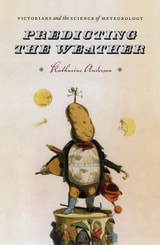
Predicting the Weather
Victorians and the Science of MeteorologyKatharine Anderson
University of Chicago Press, 2005
Studying meteorology as a means to examine the historical identity of prediction, Katharine Anderson offers here an engrossing account of forecasting that analyzes scientific practice and ideas about evidence, the organization of science in public life, and the articulation of scientific values in Victorian culture. In Predicting the Weather, Anderson grapples with fundamental questions about the function, intelligibility, and boundaries of scientific work while exposing the public expectations that shaped the practice of science during this period.
A cogent analysis of the remarkable history of weather forecasting in Victorian Britain, Predicting the Weather will be essential reading for scholars interested in the public dimensions of science.
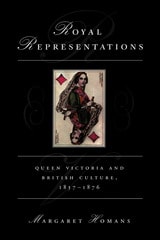
Royal Representations
Queen Victoria and British Culture, 1837-1876Margaret Homans
University of Chicago Press, 1998
Arguing that being, seeming, and appearing were crucial to Victoria's "rule," Homans explores the variability of Victoria's agency and of its representations using a wide array of literary, historical, and visual sources. Along the way she shows how Victoria provided a deeply equivocal model for women's powers in and out of marriage, how Victoria's dramatic public withdrawal after Albert's death helped to ease the monarchy's transition to an entirely symbolic role, and how Victoria's literary self-representations influenced debates over political self-representation.
Homans considers versions of Victoria in the work of Elizabeth Barrett Browning, George Eliot, John Ruskin, Margaret Oliphant, Lewis Carroll, Alfred Lord Tennyson, and Julia Margaret Cameron.

SILENT REVOLUTION MAKING OF VICTORIAN
HERBERT SCHLOSSBERG
The Ohio State University Press, 2000
Sex Scandal
The Private Parts of Victorian FictionWilliam A. Cohen
Duke University Press, 1996
Scandal, then as now, makes public the secret indiscretions of prominent people, engrossing its audience in salacious details that violate the very code of propriety it aims to enforce. In narratives ranging from Great Expectations to the Boulton and Park sodomy scandal of 1870–71, from Eliot’s and Trollope’s novels about scandalous women to Oscar Wilde’s writing and his trials for homosexuality, Cohen shows how, in each instance, sexuality appears couched in coded terms. He identifies an assortment of cunning narrative techniques used to insinuate sex into Victorian writing, demonstrating that even as such narratives air the scandalous subject, they emphasize its unspeakable nature.
Written with an eye toward the sex scandals that still whet the appetites of consumers of news and novels, this work is suggestive about our own modes of imagining sexuality today and how we arrived at them. Sex Scandal will appeal to scholars and general readers interested in Victorian literature, the history of sexuality, gender studies, nineteenth-century Britain, and gay, lesbian, and queer studies.
Strange Science
Investigating the Limits of Knowledge in the Victorian AgeEdited by Lara Karpenko and Shalyn Claggett
University of Michigan Press, 2017
The Camera as Historian
Amateur Photographers and Historical Imagination, 1885-1918Elizabeth Edwards
Duke University Press, 2012

The Complete Works of Robert Browning, Volume IX
With Variant Readings and AnnotationsRobert Browning
Ohio University Press, 1990
The Victorian World Picture
Newsome, David
Rutgers University Press, 1997
When did the Victorians come to regard themselves as "Victorians" and to use that term to describe the period in which they were living? David Newsome's monumental history takes a good, long look at the Victorian age and what distinguishes it so prominently in the history of both England and the world. The Victorian World Picture presents a vivid canvas of the Victorians as they saw themselves and as the rest of the world saw them.
The Victorian era was a time of unprecedented population growth and massive industrialization. Darwinian theory shook people's religious beliefs and foreign competition threatened industry and agriculture. The transformation of this nineteenth-century world was overhwelming, pervading the social, cultural, intellectual, economic, and political spheres. By the time of the Great Exhibition in 1851, the British were calling themselves Victorians and Prince Albert was able to proclaim, "We are living at a period of most wonderful transition." David Newsome weaves all these strands of Victorian life into a compelling evocation of the spirit of a fascinating time that laid the foundation for the modern age.
The Victorians in the Rearview Mirror
Simon Joyce
Ohio University Press, 2007
When Margaret Thatcher called in 1979 for a return to Victorian values such as hard work, self-reliance, thrift, and national pride, Labour Party leader Neil Kinnock responded that “Victorian values” also included “cruelty, misery, drudgery, squalor, and ignorance.”
The Victorians in the Rearview Mirror is an in-depth look at the ways that the twentieth century reacted to and reimagined its predecessor. It considers how the Victorian inheritance has been represented in literature, politics, film, and visual culture; the ways in which modernists and progressives have sought to differentiate themselves from an image of the Victorian; and how conservatives (and some liberals) have sought to revive elements of nineteenth-century life. Nostalgic and critical impulses combine to fix an understanding of the Victorians in the popular imagination.
Simon Joyce examines heritage culture, contemporary politics, and the “neo-Dickensian” novel to offer a more affirmative assessment of the Victorian legacy, one that lets us imagine a model of social interconnection and interdependence that has come under threat in today’s politics and culture.
Although more than one hundred years have passed since the death of Queen Victoria, the impact of her time is still fresh. The Victorians in the Rearview Mirror speaks to diverse audiences in literary and cultural studies, in addition to those interested in visual culture and contemporary politics, and situates detailed close readings of literary and cinematic texts in the context of a larger argument about the legacies of an era not as distant as we might like to think.
Useful Knowledge
The Victorians, Morality, and the March of IntellectAlan Rauch
Duke University Press, 2001
Rauch discusses both the influence and the ideology of knowledge in terms of how it affected nineteenth-century anxieties about moral responsibility and religious beliefs. Drawing on a wide array of literary, scientific, and popular works of the period, the book focusses on the growing importance of scientific knowledge and its impact on Victorian culture. From discussions of Jane Webb Loudon’s The Mummy! and Mary Shelley’s Frankenstein, to Charlotte Brontë’s The Professor, Charles Kingsley’s Alton Locke, and George Eliot’s Mill on the Floss, Rauch paints a fascinating picture of nineteenth-century culture and addresses issues related to the proliferation of knowledge and the moral issues of this time period. Useful Knowledge touches on social and cultural anxieties that offer both historical and contemporary insights on our ongoing preoccupation with knowledge.
Useful Knowledge will appeal to readers interested in nineteenth century history, literature, culture, the mediation of knowledge, and the history of science.
Ventures into Childland
Victorians, Fairy Tales, and FemininityU. C. Knoepflmacher
University of Chicago Press, 1998
"Ventures into Childland is acute, well written and stimulating. It also has a political purpose, to insist on the importance of protecting and nurturing children, imaginatively and physically."—Jan Marsh, Times Literary Supplement
"A provocative and interesting book about Victorian culture."—Library Journal
Victorian Afterlife
Postmodern Culture Rewrites the Nineteenth CenturyJohn Kucich
University of Minnesota Press, 2000
A foundational look at contemporary uses of the Victorian and the presence of the past in postmodern culture.
Celebrated films by Francis Ford Coppola, Jane Campion, and Ang Lee; best-selling novels by A. S. Byatt and William Gibson; revivals of Oscar Wilde, Lewis Carroll’s Alice, and nostalgic photography; computer graphics and cyberpunk performances: contemporary culture, high and low, has fallen in love with the nineteenth century. Major critical thinkers have found in the period the origins of contemporary consumerism, sexual science, gay culture, and feminism. And postmodern theory, which once drove a wedge between contemporary interpretation and its historical objects, has lately displayed a new self-consciousness about its own appropriations of the past. This diverse collection of essays begins a long-overdue discussion of how postmodernism understands the Victorian as its historical predecessor.
Contributors: Nancy Armstrong, Brown U; Ian Baucom, Duke U; Jay Clayton, Vanderbilt U; Mary A. Favret, Indiana U; Simon Gikandi, U of Michigan; Jennifer Green-Lewis, George Washington U; Kali Israel, U of Michigan; Laurie Langbauer, U of North Carolina; Susan Lurie, Rice U; John McGowan, U of North Carolina; Judith Roof, Indiana U; Hilary M. Schor, USC; Ronald R. Thomas, Trinity College; and Shelton Waldrep, U of Southern Maine.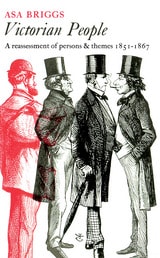
Victorian People
A Reassessment of Persons and Themes, 1851-67Asa Briggs
University of Chicago Press, 1975
"For expounding this theme, this interaction of event and personality, Mr. Briggs is abundantly and happily endowed. He is always readable, often amusing, never facetious. He is widely read and widely interested. He has a sound historic judgment, and an unfailing sense for what is significant in the historic sequence and what is merely topical. . . . Above all, he is in sympathy with the age of which he is writing."—Times Literary Supplement