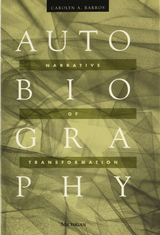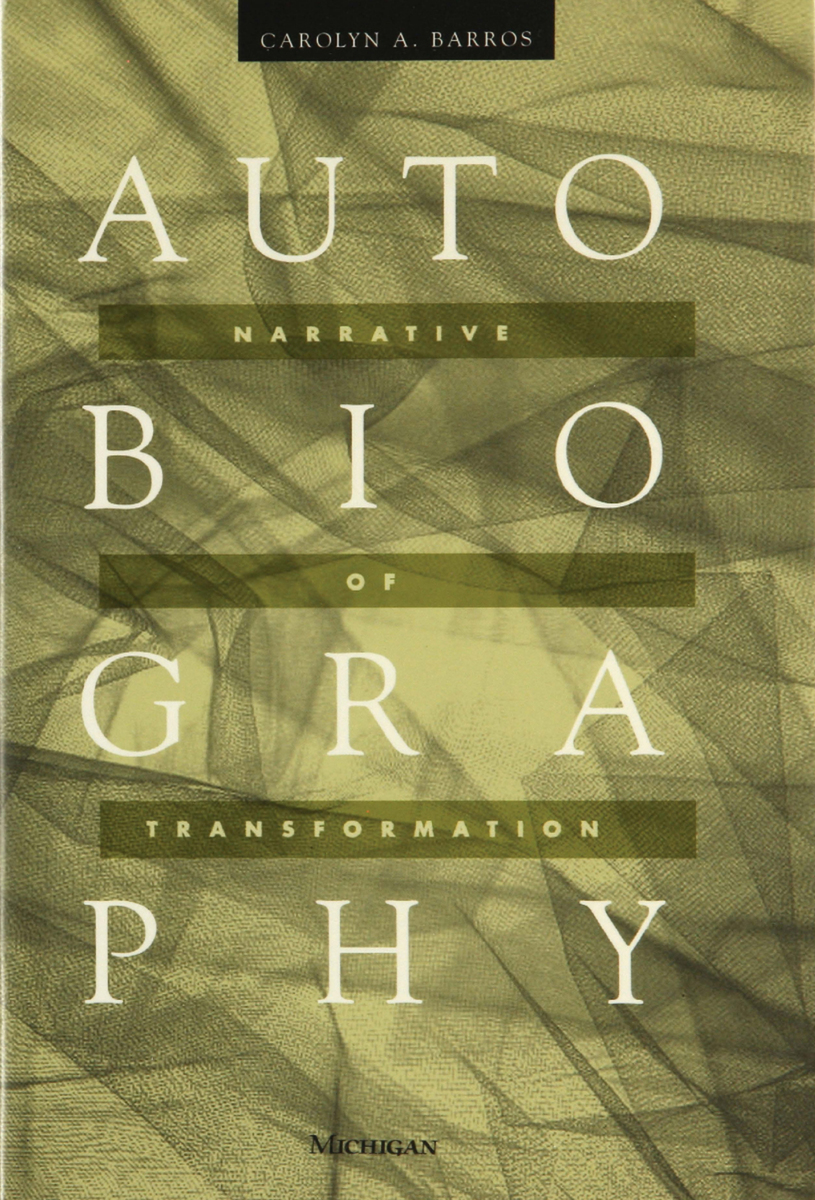
Autobiography: Narrative of Transformation
University of Michigan Press, 1997
Cloth: 978-0-472-10786-5 | eISBN: 978-0-472-22497-5 (standard)
Library of Congress Classification PR788.A9B37 1998
Dewey Decimal Classification 828.80809492
Cloth: 978-0-472-10786-5 | eISBN: 978-0-472-22497-5 (standard)
Library of Congress Classification PR788.A9B37 1998
Dewey Decimal Classification 828.80809492
ABOUT THIS BOOK | AUTHOR BIOGRAPHY | REQUEST ACCESSIBLE FILE
ABOUT THIS BOOK
In Autobiography: Narrative of Transformation, Carolyn Barros creates a primer for the study of autobiography, a genre many consider highly problematic. She sees autobiography as a "narrative of transformation"--a text that presents the "before" and "after" of an individual's life. Focusing on autobiography as narrative, of something that "happened to me," Barros highlights the various metamorphoses that are emplotted, bounded, and framed by the author's language and demonstrates that change is the operative metaphor in autobiographical discourse. The study focuses primarily on autobiographies from the rich Victorian period. Thomas Carlyle's Sartor Resartus, as it self-consciously fictionalized the composition of Diogenes Teufelsdröckh's life narrative, provides a striking analog and paradigm for introducing the study and its methodological approach. Barros's major chapters on John Henry Cardinal Newman, John Stuart Mill, Charles Darwin, and Margaret Oliphant detail four very different types of autobiographical transformation -- religious, philosophical, scientific, and literary -- and in Barros's judgment establish benchmarks for considering autobiographies from antiquity to the present. A final chapter discusses autobiography's significance to an individual writer's corpus, to a particular culture, and finally to a history of "narratives of transformation."
See other books on: Autobiography | Darwin, Charles | Narration (Rhetoric) | Narrative | Transformation
See other titles from University of Michigan Press