Results by title
8 books match the query 'Video & Animation'
Digital Cinema
Stephen Prince
Rutgers University Press, 2019
Digital Cinema considers how new technologies have revolutionized the medium, while investigating the continuities that might remain from filmmaking’s analog era. In the process, it raises provocative questions about the status of realism in a pixel-generated digital medium whose scenes often defy the laws of physics. It also considers what these changes might bode for the future of cinema. How will digital works be preserved and shared? And will the emergence of virtual reality finally consign cinema to obsolescence?
Stephen Prince offers a clear, concise account of how digital cinema both extends longstanding traditions of filmmaking and challenges some fundamental assumptions about film. It is essential reading for anyone interested in understanding how movies are shot, produced, distributed, and consumed in the twenty-first century.
Stephen Prince offers a clear, concise account of how digital cinema both extends longstanding traditions of filmmaking and challenges some fundamental assumptions about film. It is essential reading for anyone interested in understanding how movies are shot, produced, distributed, and consumed in the twenty-first century.
[more]
Experimental Games
Critique, Play, and Design in the Age of GamificationPatrick Jagoda
University of Chicago Press, 2020
In our unprecedentedly networked world, games have come to occupy an important space in many of our everyday lives. Digital games alone engage an estimated 2.5 billion people worldwide as of 2020, and other forms of gaming, such as board games, role playing, escape rooms, and puzzles, command an ever-expanding audience. At the same time, “gamification”—the application of game mechanics to traditionally nongame spheres, such as personal health and fitness, shopping, habit tracking, and more—has imposed unprecedented levels of competition, repetition, and quantification on daily life.
Drawing from his own experience as a game designer, Patrick Jagoda argues that games need not be synonymous with gamification. He studies experimental games that intervene in the neoliberal project from the inside out, examining a broad variety of mainstream and independent games, including StarCraft, Candy Crush Saga, Stardew Valley, Dys4ia, Braid, and Undertale. Beyond a diagnosis of gamification, Jagoda imagines ways that games can be experimental—not only in the sense of problem solving, but also the more nuanced notion of problem making that embraces the complexities of our digital present. The result is a game-changing book on the sociopolitical potential of this form of mass entertainment.
Drawing from his own experience as a game designer, Patrick Jagoda argues that games need not be synonymous with gamification. He studies experimental games that intervene in the neoliberal project from the inside out, examining a broad variety of mainstream and independent games, including StarCraft, Candy Crush Saga, Stardew Valley, Dys4ia, Braid, and Undertale. Beyond a diagnosis of gamification, Jagoda imagines ways that games can be experimental—not only in the sense of problem solving, but also the more nuanced notion of problem making that embraces the complexities of our digital present. The result is a game-changing book on the sociopolitical potential of this form of mass entertainment.
[more]
Indie Cinema Online
Sarah E.S. Sinwell
Rutgers University Press, 2020
Indie Cinema Online investigates the changing nature of contemporary American independent cinema in an era of media convergence. Focusing on the ways in which modes of production, distribution, and exhibition are shifting with the advent of online streaming, simultaneous release strategies, and web series, this book analyzes sites such as SundanceTV, YouTube, Netflix, Hulu, and other online spaces as a means of redefining independent cinema in a digital era. Analyzing the intersections among cinema studies, cultural studies, and new media studies within contemporary convergence culture, author Sarah E.S. Sinwell looks at sites of media convergence that are often ignored within most studies of digital media. Emphasizing the ways in which the forms and technologies of media culture have changed during the age of convergence, this book analyzes contemporary production, distribution, and exhibition practices as a means of examining the changing meanings of independent cinema within digital culture.
[more]
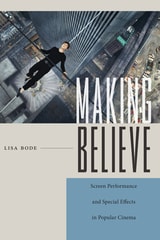
Making Believe
Screen Performance and Special Effects in Popular CinemaBode, Lisa
Rutgers University Press, 2017
In the past twenty years, we have seen the rise of digital effects cinema in which the human performer is entangled with animation, collaged with other performers, or inserted into perilous or fantastic situations and scenery. Making Believe sheds new light on these developments by historicizing screen performance within the context of visual and special effects cinema and technological change in Hollywood filmmaking, through the silent, early sound, and current digital eras.
Making Believe incorporates North American film reviews and editorials, actor and crew interviews, trade and fan magazine commentary, actor training manuals, and film production publicity materials to discuss the shifts in screen acting practice and philosophy around transfiguring makeup, doubles, motion capture, and acting to absent places or characters. Along the way it considers how performers and visual and special effects crew work together, and struggle with the industry, critics, and each other to define the aesthetic value of their work, in an industrial system of technological reproduction. Bode opens our eyes to the performing illusions we love and the tensions we experience in wanting to believe in spite of our knowledge that it is all make believe in the end.
Making Believe incorporates North American film reviews and editorials, actor and crew interviews, trade and fan magazine commentary, actor training manuals, and film production publicity materials to discuss the shifts in screen acting practice and philosophy around transfiguring makeup, doubles, motion capture, and acting to absent places or characters. Along the way it considers how performers and visual and special effects crew work together, and struggle with the industry, critics, and each other to define the aesthetic value of their work, in an industrial system of technological reproduction. Bode opens our eyes to the performing illusions we love and the tensions we experience in wanting to believe in spite of our knowledge that it is all make believe in the end.
[more]
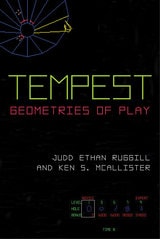
Tempest
Geometries of PlayJudd Ethan Ruggill and Ken S. McAllister
University of Michigan Press, 2015
Atari’s 1981 arcade hit Tempest was a “tube shooter” built around glowing, vector-based geometric shapes. Among its many important contributions to both game and cultural history, Tempest was one of the first commercial titles to allow players to choose the game’s initial play difficulty (a system Atari dubbed “SkillStep”), a feature that has since became standard for games of all types. Tempest was also one of the most aesthetically impactful games of the twentieth century, lending its crisp, vector aesthetic to many subsequent movies, television shows, and video games. In this book, Ruggill and McAllister enumerate and analyze Tempest’s landmark qualities, exploring the game’s aesthetics, development context, and connections to and impact on video game history and culture. By describing the game in technical, historical, and ludic detail, they unpack the game’s latent and manifest audio-visual iconography and the ideological meanings this iconography evokes.
[more]

The Music of Nobuo Uematsu in the Final Fantasy Series
Edited by Richard Anatone
Intellect Books, 2023
On the oeuvre of Nobuo Uematsu, the Beethoven of video game music.
Japanese musician and composer Nobuo Uematsu has built his career and reputation on his soundtracks to the enduring Final Fantasy video game series, which are notable for their remarkable cinematic feel. Today Uematsu is one of Japan’s most beloved living composers, credited with inspiring a new generation of classical music fans. This volume, the first book-length study of the music of Uematsu, takes a variety of different analytical approaches to his body of work. It offers readers interested in ludomusicology—the study of and research into video game music—a variety of ways with which to understand Uematsu’s compositional process and the role that video game music has in the overall gaming experience.
Japanese musician and composer Nobuo Uematsu has built his career and reputation on his soundtracks to the enduring Final Fantasy video game series, which are notable for their remarkable cinematic feel. Today Uematsu is one of Japan’s most beloved living composers, credited with inspiring a new generation of classical music fans. This volume, the first book-length study of the music of Uematsu, takes a variety of different analytical approaches to his body of work. It offers readers interested in ludomusicology—the study of and research into video game music—a variety of ways with which to understand Uematsu’s compositional process and the role that video game music has in the overall gaming experience.
[more]
Virtual Reality and Light Field Immersive Video Technologies for Real-World Applications
Gauthier Lafruit
The Institution of Engineering and Technology, 2022
Virtual reality (VR) refers to technologies that use headsets to generate realistic images, sounds and other sensations that replicate a real-world environment or create an imaginary setting. VR also simulates a user's physical presence in this environment. In virtual reality, six degrees of freedom allows users to not only look around, but also to move around the virtual world and look from above, below or behind objects. To have a true VR experience, the hardware must provide six degrees of freedom, using both orientation tracking (rotational) and positional tracking (translation).
[more]
War Games
Jonna Eagle
Rutgers University Press, 2020
The word “wargames” might seem like a contradiction in terms. After all, the declaration “This is war” is meant to signal that things have turned deadly serious, that there is no more playing around. Yet the practices of war are intimately entangled with practices of gaming, from military videogames to live battle reenactments. How do these forms of play impact how both soldiers and civilians perceive acts of war?
This Quick Take considers how various war games and simulations shape the ways we imagine war. Paradoxically, these games grant us a sense of mastery and control as we strategize and scrutinize the enemy, yet also allow us the thrilling sense of being immersed in the carnage and chaos of battle. But as simulations of war become more integrated into both popular culture and military practice, how do they shape our apprehension of the traumatic realities of warfare?
Covering everything from chess to football, from Saving Private Ryan to American Sniper, and from Call of Duty to drone interfaces, War Games is an essential guide for anyone seeking to understand the militarization of American culture, offering a compact yet comprehensive look at how we play with images of war.
[more]